

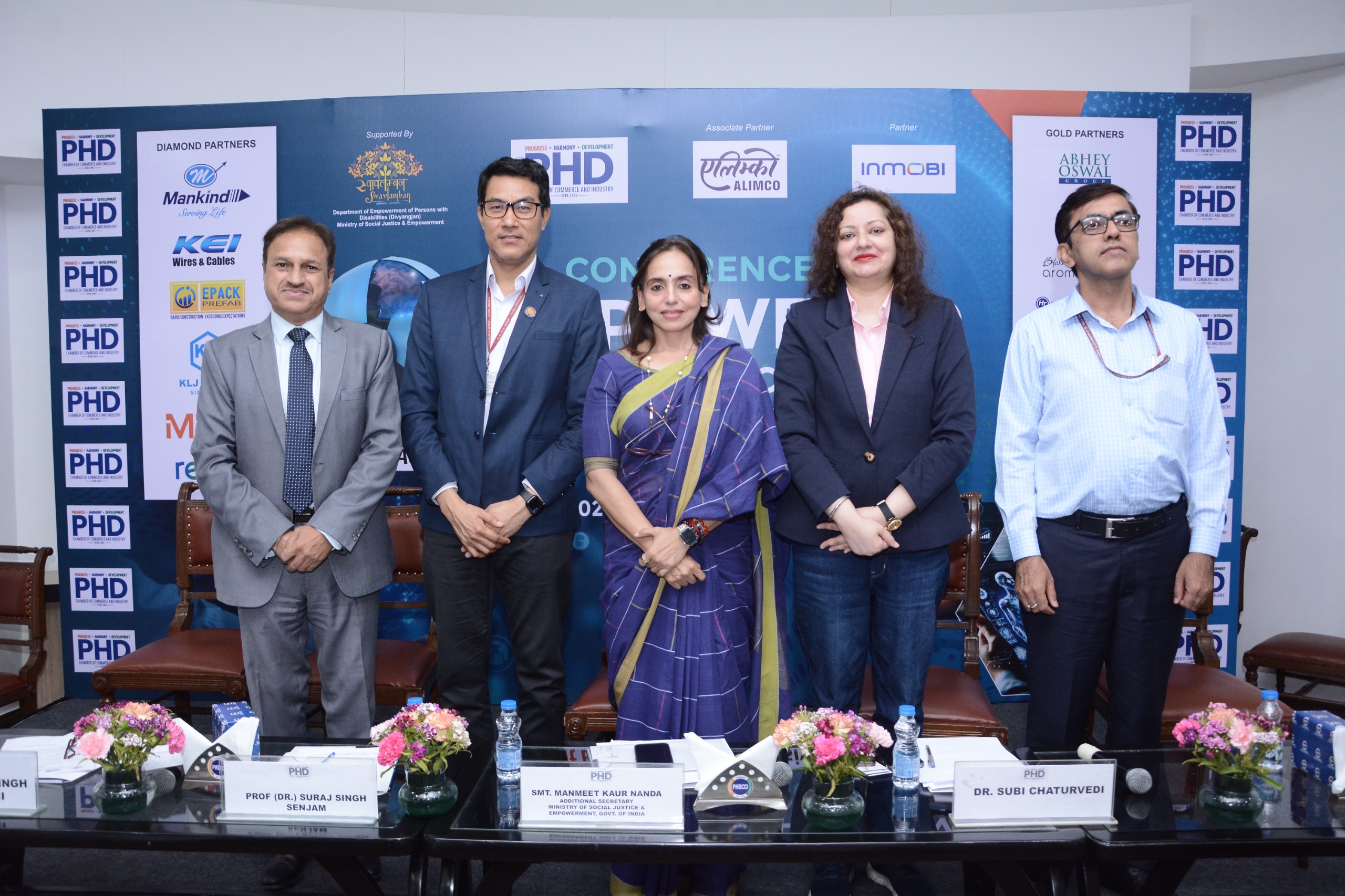
PHD Chamber of Commerce & Industry (PHDCCI) organised a national conference on “AI-Powered Assistive Technology for Divyangjan Empowerment: Accelerating Viksit Bharat through Inclusive Innovation” on 29 May 2026 at PHD House, New Delhi, bringing together senior government officials, industry leaders, academics, startups, CSR heads, and R&D institutions to deliberate on leveraging artificial intelligence to empower India’s Divyangjan community. The conference sparked robust discussion on building affordable and scalable AT solutions, channelling innovation towards inclusion, and positioning India as a global leader in assistive technology.
In her address as the Guest of Honour, Smt. Manmeet Kaur Nanda, IAS, Additional Secretary, Department of Empowerment of Persons with Disabilities, Ministry of Social Justice & Empowerment, Government of India, emphasized that there can be no true “Viksit Bharat” without an Inclusive Bharat, highlighting AI-powered assistive technology as a critical pillar for building an accessible and equitable future. She underscored the need for accessibility to be embedded into AI systems from the design stage itself, rather than treated as an afterthought, stressing the importance of inclusive interfaces, algorithmic fairness, and testing AI solutions with persons with disabilities. Referring to India’s growing “inclusivity stack,” supportive policy framework, and the Supreme Court’s recognition of accessibility as a fundamental right, she stated that India is uniquely positioned to emerge as a global leader in affordable, scalable, and deployable assistive technologies. She also highlighted the massive market potential of assistive technology in India, noting that nearly 200 million Indians live with significant disabilities, and called upon MSMEs, startups, and industry stakeholders to collaborate in manufacturing, distribution, and innovation. Showcasing initiatives such as AI-enabled assessment tools, smart assistive devices, Sign Language AI solutions, and government-backed schemes including ADIP and PMDK centres, she invited industry and innovators to partner with the government and organizations like ALIMCO to scale indigenous assistive technology solutions across the country.
Speaking at the conference, Dr. Subi Chaturvedi, Chair – AI & Innovation Committee, PHDCCI and Global SVP and Chief Public Policy Officer of InMobi, highlighted the transformative potential of AI and assistive technologies in advancing inclusive growth and (Antyodaya) last-mile empowerment in India. Speaking on the occasion, she said: “AI-powered assistive technologies represent one of the most important public policy and innovation opportunities of our time. When accessibility becomes a design principle, not an afterthought. We unlock new pathways to education, employment, healthcare, and economic growth for millions. India is uniquely positioned to demonstrate how inclusive innovation can be scaled responsibly and affordably. The choices we make today will not only advance Viksit Bharat but help define what an inclusive AI future looks like for the world at InMobi under our founder Naveen Tewari’s vision that we are inclusive by design.” She further emphasized that AI is a “great democratizer” capable of creating scalable solutions across education, accessibility, adaptive learning, healthcare, MSMEs, and digital inclusion. Referring to India’s growing innovation ecosystem and strong AI talent base, she noted that the country is uniquely positioned to lead globally in inclusive and accessible technologies. She stressed that inclusion should not be treated as a “good to have” but as a fundamental design principle while developing digital platforms and emerging technologies. Referring to the globally recognized W3C’s POUR framework for digital accessibility, she explained that technologies must be Perceivable, Operable, Understandable, and Robust to ensure equitable access for all users, including persons with disabilities. Dr. Chaturvedi also highlighted the importance of collaboration between government, industry, startups, academia, and civil society in accelerating impactful innovation. Through initiatives such as innovation hackathons, AI-led interventions, and industry partnerships under PHDCCI’s AI and Innovation Committee, she noted that efforts are being made to build scalable, indigenous solutions capable of addressing persistent societal challenges and making technology truly inclusive and accessible across India.
Shri S.K. Tripathi, DGM, Artificial Limbs Manufacturing Corporation of India (ALIMCO) highlighted ALIMCO’s transformative role in advancing assistive technology and inclusion across India. He shared that over 3.5 million persons with disabilities and senior citizens have benefited from assistive devices distributed through various Government of India schemes and CSR-supported initiatives over the last decade. Emphasizing ALIMCO’s modernization and expansion, he noted that the organization has strengthened its manufacturing capabilities and nationwide outreach through initiatives such as the Pradhan Mantri Divyasha Kendras, which are being expanded across States and Union Territories to ensure easier access to assistive devices at the grassroots level. He further stated that ALIMCO is working to position India as a global hub for indigenously developed assistive technologies and invited startups, research institutions, corporates, and MSMEs to collaborate to build innovative, affordable, and scalable solutions for a more inclusive India.
In his address, Prof. (Dr.) Suraj Singh Senjam, Department of Community Ophthalmology, Dr. R.P. Centre for Ophthalmic Sciences, AIIMS, New Delhi emphasized the growing importance of assistive technology in improving the lives of millions of persons with disabilities and individuals facing functional challenges across India. Highlighting the rapid evolution of the sector since 2017, he noted that India has emerged as a key player in the assistive technology ecosystem, driven by innovation, accessibility needs, and advancements in AI. He stressed that creating affordable and accessible assistive solutions requires strong collaboration among government bodies, startups, manufacturers, healthcare institutions, NGOs, and industry stakeholders. Underscoring the need for indigenous manufacturing and cost-effective innovation, he pointed out that even basic assistive products are still heavily imported, reflecting the urgent need to strengthen India’s domestic capabilities.
Delivering the welcome address, Dr. Jatinder Singh, Deputy Secretary General, PHDCCI, underlined that a truly developed India will not be measured by GDP figures alone, but by whether every citizen, irrespective of ability or disability, has access to tools, dignity, and the opportunity to participate fully in the nation’s growth. Highlighting that over 2.68 crore Indians live with disabilities, with nearly 70% residing in rural areas, he stressed the urgent need for inclusive healthcare, education, and economic access. He also noted that the global assistive technology market is projected to grow from USD 33 billion in 2024 to USD 70 billion by 2030, presenting significant opportunities for Indian startups and MSMEs. Calling for stronger industry participation, he urged greater focus on innovation, manufacturing, inclusive procurement, and CSR-led investments in assistive technologies.
The conference also featured two focused technical sessions: AI, Future Trends and Innovations in Assistive Technology and Manufacturing & Market Access Issues, Challenges and Opportunities; and WHO’s 5P Framework to Strengthen Access to Assistive Technology.
The conference concluded with a strong collective resolve among government, industry, academia, startups, and civil society to accelerate the development of affordable, inclusive, and AI-driven assistive technologies to empower Divyangjan. The deliberations reinforced the vision of building a truly inclusive Viksit Bharat where innovation, accessibility, and technology-led empowerment become central to India’s growth story.