
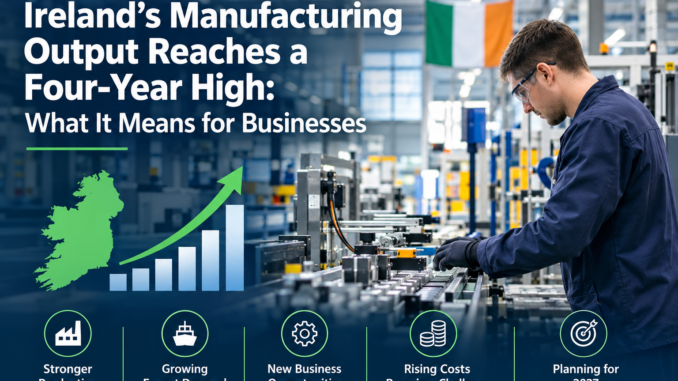
Oct 29: Ireland’s manufacturing sector is showing signs of renewed growth, offering fresh opportunities for businesses involved in production, logistics, industrial technology and exports. Factory activity strengthened in September 2026, with output expanding at its fastest pace in more than four years. The improvement comes as new orders increase and export demand gains momentum, although rising costs continue to put pressure on manufacturers.
According to the AIB Ireland Manufacturing Purchasing Managers’ Index (PMI), compiled by S&P Global, manufacturing output grew at its fastest rate since March 2022 in September 2026. The headline PMI increased to 55.5 from 55.4 in August. A reading above 50 indicates an expansion in manufacturing activity.
The survey also recorded a 21st consecutive month of growth in new orders, while export orders strengthened. For businesses, these figures point to improving demand and potential opportunities across the manufacturing supply chain. However, the pace of recovery varies across industries, making it important to look beyond the headline numbers.
What Is Driving Ireland’s Manufacturing Growth?
Stronger demand is helping Irish manufacturers increase production and attract new business. The September PMI indicated that new orders continued to rise, while export demand improved compared with the previous month.
The findings suggest that some manufacturers are responding to growing order books by purchasing more materials, increasing production activity and addressing outstanding work.
Ireland’s position in international supply chains also creates opportunities for companies supplying components, machinery, packaging and specialist services. As manufacturers respond to new orders, demand can extend to transport providers, engineering firms, equipment maintenance companies and technology suppliers.
However, the PMI is a survey-based indicator of business conditions rather than a direct measure of the value of goods produced. Its results should therefore be considered alongside official production statistics to understand the wider performance of the sector.
What Do the Official Manufacturing Figures Show?
The latest survey results offer an encouraging signal, but official figures reveal a more mixed picture.
The Central Statistics Office (CSO), in its Industrial Production and Turnover release published on 9 October 2026, reported that manufacturing production increased by 1.0% in the three months to August compared with the preceding three-month period. However, production was 5.8% lower than in the same period of 2025.
Manufacturing turnover rose by 0.3% compared with the preceding three-month period and was 6.8% higher year on year.
The figures highlight an important distinction: manufacturing activity can improve over a short period even when production remains below its level a year earlier.
Performance also differed between manufacturing segments. Production in the traditional manufacturing sector increased by 0.8% year on year in the three months to August 2026. In contrast, production in the highly globalised modern sector, which includes pharmaceuticals, chemicals, computers and electronic products, declined by 6.8%.
For businesses, these differences underline the importance of understanding individual industry trends rather than assuming that stronger overall activity will benefit every manufacturer equally.
Business Opportunities Beyond the Factory Floor
An increase in manufacturing activity can benefit a wide range of businesses beyond those directly involved in production. When factories receive more orders, they may need additional materials, reliable transport, equipment servicing and better systems to manage their operations.
For small and medium-sized enterprises (SMEs), this creates opportunities to become part of the manufacturing supply chain.
Logistics and supply-chain management
Higher production volumes can increase demand for freight services, warehousing, inventory management and delivery coordination. Businesses that offer reliable delivery schedules and competitive pricing may find opportunities to establish long-term relationships with manufacturers.
Suppliers of packaging materials, industrial components and other essential goods can also benefit as factories replenish stocks and respond to new orders.
Automation and manufacturing technology
As production schedules become busier, manufacturers may look for ways to increase efficiency without significantly raising operating costs. Automation and digital tools can help businesses monitor production, manage inventory, identify equipment problems and reduce waste.
Opportunities exist for providers of manufacturing software, automated inspection systems, predictive maintenance solutions and production planning tools.
For technology companies, demonstrating measurable benefits is essential. Solutions that reduce downtime, improve product quality or shorten production cycles can offer a clear commercial advantage.
Engineering and equipment maintenance
Manufacturers need reliable machinery to meet delivery commitments. Equipment failures can interrupt production, delay orders and increase costs.
This creates opportunities for engineering firms that provide preventive maintenance, electrical services, equipment inspections and industrial safety solutions. Smaller service providers may be able to secure repeat business by helping manufacturers maintain equipment and avoid unexpected breakdowns.
Export and business support services
Stronger export orders can also create opportunities for companies that help manufacturers reach international customers. Freight forwarders, export consultants, digital marketing agencies and business-to-business lead generation providers can support companies seeking to expand into new markets.
However, entering a new market requires careful planning. Businesses must consider shipping costs, regulatory requirements, customer demand and payment risks before committing significant resources.
Rising Costs Could Limit Profit Growth
Despite the improvement in manufacturing activity, rising input costs remain a concern.
The September PMI indicated that input-price inflation accelerated to its highest level since June. Manufacturers reported pressure from expenses such as energy, fuel and transport.
Higher demand does not necessarily translate into stronger profits. If raw materials, electricity and delivery costs rise faster than selling prices, businesses may find their margins shrinking even as production increases.
Manufacturers can respond by reviewing supplier contracts, improving energy efficiency and identifying areas where material waste can be reduced. Regular cost reviews can also help businesses determine which products and customer contracts remain profitable.
Passing higher costs on to customers may be an option, but this depends on competition and customers’ willingness to accept price increases.
For smaller manufacturers in particular, controlling costs while maintaining product quality will be essential to making the most of any improvement in demand.
Why Working Capital Matters as Orders Increase
Growing order books can put additional pressure on cash flow. Manufacturers often need to purchase materials, pay employees and cover transport expenses before receiving payment from customers.
This means that a rise in sales can create financial pressure if working capital is not managed carefully.
Businesses should prepare cash-flow forecasts, follow up on overdue invoices and review payment terms with suppliers and customers. Inventory also requires close attention. Holding too little stock can delay production, while purchasing excessive quantities can tie up money that could be used elsewhere.
Manufacturers should base purchasing and production decisions on realistic sales forecasts rather than assuming that recent growth will continue at the same pace.
For SMEs, maintaining sufficient cash reserves and access to working capital can be just as important as expanding production capacity.
How Irish Manufacturers Can Prepare for 2027
The latest figures offer reasons for cautious optimism, but manufacturers should not base long-term investment decisions on a single month’s survey results.
Instead, businesses can prepare for 2027 by focusing on practical measures that improve resilience and efficiency.
- Improve demand forecasting: Use customer orders, sales pipelines and market trends to plan production more accurately.
- Review operating costs: Track changes in energy, transport, labour and raw-material expenses.
- Strengthen supplier relationships: Reduce excessive dependence on individual suppliers and review alternative sourcing options.
- Invest in technology selectively: Prioritise automation and digital systems that offer measurable improvements in productivity.
- Develop workforce skills: Ensure employees have the technical and digital capabilities needed to support changing production requirements.
- Explore export opportunities: Assess potential markets, customer demand and the full cost of international expansion before investing.
Manufacturers should also monitor new orders, input prices, employment trends and upcoming CSO production releases. Looking at these indicators together can help businesses determine whether the improvement is becoming more sustained.
What the Manufacturing Recovery Means for Ireland’s Economy
A stronger manufacturing sector can have wider benefits for Ireland’s business economy. Increased production can support employment, create opportunities for suppliers and strengthen demand for logistics, engineering and professional services.
It can also encourage businesses to invest in equipment, technology and workforce development when they have greater confidence in future demand.
However, the benefits will depend on how the recovery develops across different industries. The latest CSO figures show that manufacturing performance remains uneven, while the PMI highlights the pressure created by rising input costs.
Businesses should therefore focus on their own order books, operating margins and customer requirements rather than relying solely on broader economic indicators.
For smaller companies, the opportunity may lie in supplying larger manufacturers, providing specialist services or helping factories improve efficiency. Building reliable customer relationships and delivering consistent quality can be more valuable than pursuing rapid expansion without a clear commercial plan.
Conclusion
Ireland’s manufacturing sector is showing renewed momentum, with the September 2026 PMI recording the fastest growth in output since March 2022. Stronger new orders and improving export demand offer opportunities for manufacturers and the businesses that support them.
At the same time, official CSO figures show that production remained below its year-earlier level in the three months to August. Differences between traditional and modern manufacturing also highlight the uneven nature of the recovery.
For Irish businesses, the priority is to turn stronger demand into sustainable growth. Careful cash-flow management, tighter cost control, reliable supply chains and targeted investment in technology can help manufacturers prepare for the opportunities and challenges ahead.
Whether the recent improvement develops into a lasting recovery will become clearer in the months ahead. Until then, businesses that combine realistic planning with operational efficiency will be better positioned to respond to changing market conditions.
