
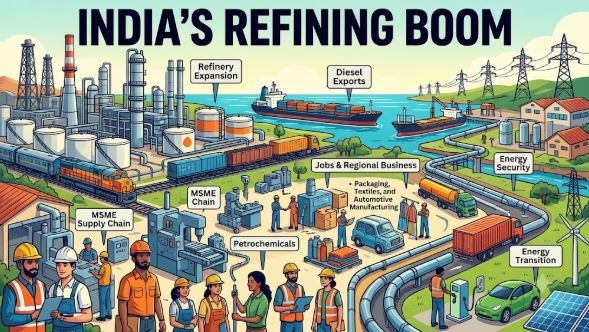
India’s refining boom is about more than producing additional fuel. It is about building an industrial ecosystem that connects energy, manufacturing, transportation and international trade. As refiners expand capacity and invest in new facilities, the country has an opportunity to strengthen diesel exports, attract industrial investment and create fresh demand for businesses across the supply chain.
India’s refining capacity stood at approximately 267 million tonnes per annum in 2026, with a longer-term ambition to reach around 300 million tonnes by 2030. Planned additions to diesel-making capacity could further strengthen the country’s role in global fuel markets.
For businesses, the expansion brings both opportunities and challenges. More production can support exports and industrial activity, but profitability will depend on global oil prices, refining margins and changing energy demand.
1. Refinery Expansion Creates a New Industrial Cycle
India’s oil refiners are investing in new facilities and upgrading existing plants to meet domestic requirements and serve international markets.
- Higher production capacity: India aims to increase refining capacity to around 300 million tonnes annually by 2030.
- More diesel output: Planned additions of approximately 15–16.5 million tonnes of annual diesel-making capacity by 2027 could increase export availability.
- Industrial investment: New projects require machinery, engineering services, construction materials and specialised technology.
- Stronger supply chains: Greater domestic processing capacity can help improve the availability of refined fuels.
The business impact extends beyond oil companies. Equipment suppliers, engineering firms, transport operators and industrial service providers can all find opportunities as projects progress.
2. Diesel Exports Could Become a Major Growth Driver
Diesel is essential to freight movement, agriculture, construction and manufacturing. When global markets experience supply disruptions, additional production capacity can give exporters more flexibility to serve international customers.
India’s planned increase in diesel production could help refiners pursue new export opportunities from 2027.
For the business sector, the potential benefits include:
- Higher export revenue for refiners when international market conditions are favourable.
- Greater demand for port services, storage facilities and fuel transportation.
- Opportunities for shipping and logistics companies to handle additional cargo.
- Potential expansion into overseas markets for Indian energy businesses.
However, higher production does not automatically mean higher profits. Export earnings will depend on international demand, crude oil costs, freight charges and competition from other fuel-producing countries.
3. MSMEs Could Benefit from the Refining Supply Chain
One of the less visible effects of refinery expansion is the demand it creates for smaller industrial businesses.
Refineries rely on a broad network of suppliers and service providers. MSMEs may find opportunities in:
- Industrial equipment and component manufacturing.
- Fabrication, welding and specialised engineering.
- Plant maintenance and technical services.
- Electrical systems, safety equipment and industrial coatings.
- Transportation, warehousing and other support services.
For smaller enterprises, contracts linked to large industrial projects can provide access to new customers and encourage investment in technology and workforce skills.
The opportunity will depend on competitive pricing, reliable delivery and compliance with industrial safety and quality standards. Smaller businesses may also need sufficient working capital to manage large orders and payment cycles.
4. Petrochemicals Add Value Beyond Fuel
Refineries can also support growth in the petrochemical industry by supplying feedstocks used in plastics, packaging, synthetic fibres, chemicals and industrial materials.
This creates a broader business opportunity because the value of crude oil can extend beyond petrol and diesel into products used by numerous manufacturing industries.
Potential areas of impact include:
- Packaging: Raw materials for containers, films and industrial packaging.
- Textiles: Feedstocks used in synthetic fibres.
- Automotive: Materials used in components and industrial applications.
- Manufacturing: Chemical inputs for a range of consumer and industrial products.
Greater integration between refining and petrochemical production could help domestic manufacturers access a wider industrial base. Its benefits will depend on investment, product demand, feedstock costs and the competitiveness of locally produced materials.
5. Investment Can Support Jobs and Regional Business
Refinery projects involve significant expenditure on plant construction, machinery, technology and operations. This can generate business for engineering contractors, equipment manufacturers and specialised service companies.
Employment opportunities may arise in plant operations, engineering, maintenance, logistics and safety management. Additional demand can also benefit suppliers and service providers operating around industrial hubs.
The wider economic effect comes from the connections between large projects and smaller businesses. When local suppliers secure contracts, the benefits can spread through industrial communities.
However, employment outcomes will vary according to project design, automation, construction timelines and the extent of domestic sourcing.
6. Energy Security Remains a Key Business Consideration
India’s expanding refining capacity can strengthen its ability to process crude oil and supply essential fuels. Yet domestic refining does not eliminate the country’s dependence on imported crude oil.
This distinction matters because international crude prices, currency movements and geopolitical disruptions can affect production costs and business margins.
For companies across the energy chain, the priorities remain clear:
- Improve operational efficiency and reduce avoidable costs.
- Maintain reliable supplies of crude oil and other inputs.
- Strengthen storage and transportation infrastructure.
- Develop flexible production strategies to respond to changing demand.
A stronger refining industry can improve supply-chain resilience, but managing imported input costs remains essential.
7. The Energy Transition Will Shape Future Investment
India’s refining expansion is taking place alongside the growth of electric vehicles, ethanol blending and other efforts to diversify energy use.
Over time, these changes could influence demand for individual fuels. Gasoline demand, in particular, is projected in some industry outlooks to peak around 2035, although the timing remains uncertain.
For refiners, this creates a need to balance current opportunities with long-term market changes.
Investment in efficiency, flexible production, petrochemicals and cleaner technologies could help companies respond to evolving customer needs. Businesses that adapt their operations to changing energy markets may be better positioned to manage future risks.
The challenge is to expand capacity without assuming that demand for every petroleum product will continue to grow at the same pace.
Conclusion
India’s refining boom offers a significant opportunity to expand energy exports, attract industrial investment and create business for manufacturers, logistics providers and MSMEs. Its wider economic value lies in how effectively refinery expansion connects with domestic supply chains and higher-value industries.
Yet capacity alone is not a measure of success. Competitive production costs, reliable infrastructure, responsible investment and the ability to respond to changing fuel demand will determine whether the expansion delivers lasting benefits.
For India, the next stage of refining growth is not simply about processing more crude oil. It is about turning that capacity into stronger businesses, more resilient supply chains and sustainable industrial value.
