
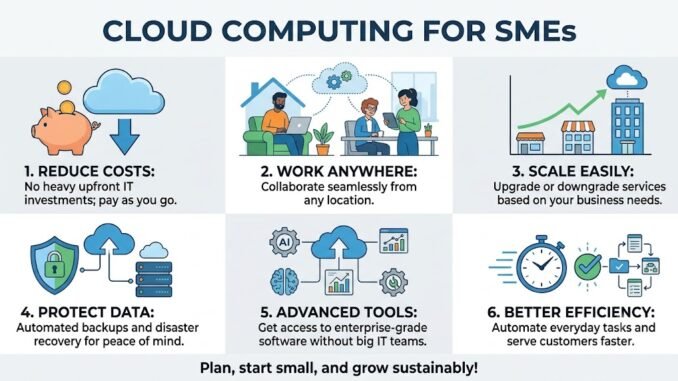
For small and medium-sized enterprises (SMEs), growth often comes with a difficult choice: invest in technology to remain competitive or preserve limited funds for everyday operations. Maintaining physical servers, purchasing software, protecting business data and hiring technical specialists can place considerable pressure on budgets. Yet as customers increasingly expect faster services, digital payments and convenient online experiences, avoiding technology investment can also limit a business’s growth.
Cloud computing for SMEs is changing how smaller businesses access and manage technology. Instead of investing heavily in physical infrastructure, businesses can use software, storage and computing services over the internet, often paying through subscriptions or according to their usage. This allows a retailer to manage inventory digitally, a manufacturer to coordinate suppliers and a startup to expand its operations without immediately building an expensive IT setup.
The benefits extend beyond cost savings. Cloud technology can improve collaboration, support data-driven decisions, strengthen business continuity and provide access to advanced tools that were once difficult for smaller companies to afford. However, subscription expenses, cybersecurity risks, internet dependency and technical limitations must be considered before making the transition.
For SMEs, the real opportunity lies in adopting cloud technology strategically—not simply to modernise operations, but to improve efficiency, serve customers better and build a sustainable business.
1. Understanding Cloud Computing and How It Works
Cloud computing refers to the delivery of computing services over the internet. These services include business software, data storage, virtual servers, databases, backup systems and tools for analytics and artificial intelligence.
Traditionally, a business would purchase computers and servers, install software and maintain its own infrastructure. With cloud computing, much of that infrastructure is managed by a service provider, allowing the business to access the resources it needs without owning every component.
Cloud services generally fall into three categories:
- Software as a Service (SaaS): Ready-to-use applications for accounting, email, customer management, collaboration and other business activities.
- Infrastructure as a Service (IaaS): Virtual computing resources, storage and servers that businesses can use to run applications without purchasing physical hardware.
- Platform as a Service (PaaS): Tools and environments that help developers build, test and deploy applications without managing the entire underlying infrastructure.
For many SMEs, cloud adoption begins with straightforward applications such as online accounting software, file storage or team communication platforms. As their needs become more complex, businesses can explore cloud-based inventory systems, analytics, automation and customised applications.
The key is to choose services that address actual business needs rather than investing in technology simply because it is available.
2. Reducing Upfront Investment and Managing Costs
One of the main attractions of cloud computing is the opportunity to reduce the initial expense of setting up and maintaining IT infrastructure.
Purchasing servers, installing business software and maintaining equipment can require significant capital. These costs may be particularly difficult for smaller companies that also need to invest in staff, inventory, marketing and customer service.
Cloud services can reduce the need for large upfront purchases by shifting some technology spending towards monthly subscriptions or usage-based charges. Businesses can access the resources they need while avoiding certain hardware maintenance and upgrade responsibilities.
For example, a growing online retailer may require additional storage and computing capacity during a festive sales period. Cloud services can often be adjusted to accommodate the increase without purchasing permanent infrastructure for temporary demand.
However, cloud computing does not automatically guarantee lower costs. Subscription fees, migration expenses, data transfer charges and unused services can increase spending over time. SMEs should compare the total cost of ownership, including support, security and future expansion, before deciding whether a cloud-based solution offers better value.
3. Scaling Operations as the Business Grows
Business demand can change quickly. A small company may begin with a handful of employees and a limited customer base before expanding into new markets or launching additional services.
Cloud computing makes it easier to adjust technology resources as requirements change. Businesses can often increase storage, computing capacity or software access without purchasing and installing additional physical equipment.
This flexibility can reduce the risk of investing too heavily before demand is established. Startups, for example, can test a new digital product with a limited number of users and expand capacity as customer adoption increases.
For seasonal businesses, adjustable resources can also help manage fluctuations in demand. Rather than maintaining infrastructure that remains underused for much of the year, a company may be able to match its technology usage more closely to its operational needs.
For SMEs, this means growth can become more manageable, provided that expansion is supported by adequate cash flow, staff capacity and a clear business strategy.
4. Improving Collaboration and Everyday Productivity
Cloud-based applications allow employees to access authorised files, business information and shared workspaces from different locations. This can make coordination easier for businesses with multiple offices, remote teams, field employees or external partners.
A sales representative can update customer records after a meeting, an accountant can access financial information remotely, and a business owner can review reports without being physically present at the workplace.
Shared digital systems can also reduce the confusion caused by duplicate documents, outdated spreadsheets and disconnected communication channels. When employees work with consistent information, teams may be able to respond to customers faster and coordinate tasks more effectively.
For smaller businesses, these capabilities can improve productivity without requiring a large office or a dedicated technology department.
Nevertheless, effective collaboration depends on reliable internet access, appropriate user permissions and employee training. Businesses must also establish clear procedures for sharing confidential information and managing access when employees leave the organisation.
5. Protecting Business Data and Supporting Continuity
For an SME, losing important records can disrupt operations, delay customer orders and create unexpected financial costs. Hardware failure, accidental deletion, cyberattacks and physical damage can all threaten business information.
Cloud services can provide automated backups, recovery options and storage across separate systems or locations, depending on the provider and configuration. These features can help businesses restore information following an incident and reduce dependence on a single office computer or server.
Consider a small distribution business that stores its customer orders, inventory records and invoices on a cloud-based system. If an office computer fails, authorised employees may still be able to access the information through another device, subject to internet availability and the service’s recovery arrangements.
However, storing information in the cloud is not a complete disaster recovery strategy by itself. Businesses should confirm how frequently backups occur, how long deleted information remains recoverable and how quickly critical systems can be restored.
Regular recovery testing, multi-factor authentication and clear data protection policies are essential to making cloud-based systems more resilient.
6. Accessing Advanced Technology Without a Large IT Team
Cloud computing can give smaller businesses access to tools that might otherwise require significant investment in infrastructure and specialised expertise.
Cloud-based analytics can help companies identify sales trends, monitor inventory and understand customer preferences. Automation software can reduce repetitive administrative work, while AI-powered applications can assist with customer enquiries, document processing and information analysis.
For example, a small manufacturer can use cloud-based inventory software to monitor raw materials and identify when supplies need replenishing. Better visibility may help the business reduce avoidable stock shortages and plan purchases more accurately.
A service provider can use customer relationship management software to track enquiries, schedule follow-ups and identify opportunities for repeat business.
These applications can help SMEs make decisions using better information and spend less time on manual processes. However, the quality of the results depends on accurate data, appropriate software and employees who understand how to use the tools effectively.
Technology can support business judgment, but it cannot replace a clear understanding of customers, costs and market conditions.
7. Understanding the Costs and Financial Risks
Although cloud computing can reduce infrastructure expenses, businesses must plan for ongoing costs rather than focusing only on the initial subscription price.
The main financial considerations include:
- Subscription fees: Monthly or annual payments may increase as the business adds users, storage or services.
- Migration expenses: Moving existing data and applications can require technical support, employee training and workflow changes.
- Unexpected usage charges: Poorly monitored resources, excessive data transfers and unused services can lead to higher-than-expected bills.
- Integration costs: Older accounting, inventory or production systems may require additional work to connect with cloud applications.
- Long-term expenses: Over several years, an unmanaged cloud arrangement may cost more than maintaining a suitable local system.
SMEs can manage these risks by setting budgets, monitoring usage, removing unnecessary services and reviewing bills regularly. Comparing providers and understanding contract terms can also prevent unexpected expenses.
A gradual migration or pilot project can help businesses assess real costs and operational benefits before committing to a wider transformation.
8. Addressing Security, Privacy and Technical Challenges
Cloud adoption introduces important responsibilities. Although service providers may offer advanced security features, businesses must still protect their accounts, devices, data and internal processes.
Cybersecurity and data privacy: Weak passwords, excessive access permissions and compromised accounts can expose confidential information. Multi-factor authentication, encryption where appropriate and regular access reviews can reduce risks.
Dependence on internet connectivity: Cloud applications generally require a reliable internet connection. Slow or interrupted service can delay work, making backup connectivity important for businesses that rely heavily on online systems.
Limited technical expertise: Smaller companies may lack the staff needed to configure systems, monitor security and manage complex cloud environments. Suitable providers and external technical support can help address these gaps.
Vendor lock-in: Switching providers can be difficult if business applications rely heavily on proprietary tools or data formats. SMEs should review data-export options, contract conditions and exit costs before making long-term commitments.
Integration with existing systems: Older software may not work smoothly with new cloud platforms. Compatibility checks and careful implementation can help avoid duplicated work and operational disruption.
These challenges do not mean SMEs should avoid cloud technology. They underline the importance of selecting suitable services, understanding the risks and putting clear management procedures in place.
9. How Cloud Computing Can Strengthen India’s SME Sector
India’s SME sector includes businesses with very different levels of digital maturity, from neighbourhood retailers and local service providers to manufacturers supplying larger domestic and international companies. Cloud computing can help these businesses improve operations without requiring every company to build its own technology infrastructure.
Retailers can manage inventory and online orders, manufacturers can coordinate suppliers and monitor production information, and professional service firms can organise client records, billing and communication through connected applications.
Businesses in smaller cities may also benefit from accessing digital services without establishing large IT teams. With the right tools, they can serve customers across geographical boundaries, participate in digital marketplaces and work more efficiently with suppliers and business partners.
Cloud adoption may also create demand for skills in software support, data management, cybersecurity and digital operations. As SMEs modernise their systems, employee training will become increasingly important to ensure that technology improves productivity rather than adding complexity.
The broader economic opportunity lies in helping smaller businesses become more competitive, resilient and capable of reaching new markets. Cloud computing can support that progress, although its impact will depend on affordability, connectivity, digital skills and effective implementation.
10. A Practical Roadmap for Cloud Adoption
SMEs do not need to transfer every business function to the cloud at once. A measured approach can reduce disruption and help business owners understand whether the investment is delivering results.
- Identify the business need: Start with a specific problem, such as inefficient accounting, scattered customer records or unreliable data backups.
- Choose the right service: Compare features, security, pricing, support and compatibility with existing systems.
- Calculate the full cost: Include subscriptions, migration, training, maintenance and potential usage charges.
- Begin with a pilot: Test the service with one team or function before expanding it across the business.
- Train employees: Ensure staff understand the new system, its benefits and the precautions needed to use it safely.
- Set security and recovery procedures: Establish access controls, backup schedules and a plan for restoring essential operations.
- Measure business results: Review whether the technology saves time, reduces errors, improves service or supports revenue growth.
This process helps SMEs make technology decisions based on practical outcomes rather than assumptions. It also allows businesses to adjust their approach before making larger commitments.
Conclusion
Cloud computing is changing how small and medium-sized enterprises access technology, manage resources and compete in an increasingly digital economy. By reducing the need for extensive physical infrastructure, it can help businesses improve collaboration, access advanced tools, protect important information and respond more flexibly to changing demand.
Yet the benefits depend on more than adopting a cloud service. Uncontrolled spending, weak security, unreliable connectivity and poor integration can undermine the value of an investment if businesses fail to plan carefully.
For SMEs, the most effective approach is to choose cloud solutions that address genuine operational challenges, fit the available budget and support long-term business objectives. When technology adoption is combined with employee training, careful cost management and responsible data protection, cloud computing can become a practical foundation for stronger productivity, greater competitiveness and sustainable business growth.
