
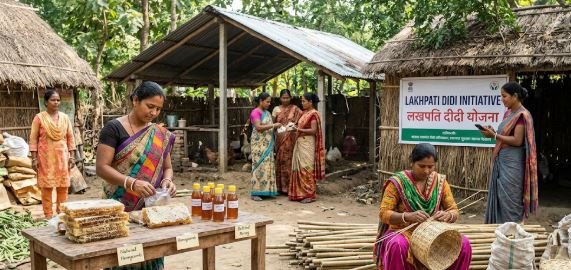
India’s rural women-led enterprises are gaining momentum as the government’s Lakhpati Didi Initiative expands its ambition to create six crore financially empowered women by March 2029.
India’s rural economy is witnessing a significant transformation, with women from Self-Help Groups (SHGs) increasingly moving beyond traditional livelihood activities to become entrepreneurs and independent economic contributors. At the centre of this transformation is the government’s Lakhpati Didi Initiative, a flagship programme designed to strengthen women’s financial independence through sustainable livelihoods, enterprise development and improved access to markets.
Announced on August 15, 2023, the initiative initially aimed to enable two crore women from SHG households to achieve an annual household income of at least ₹1 lakh. The target was subsequently increased to three crore in February 2024. In February 2026, the government envisioned a more ambitious goal of creating six crore Lakhpati Didis by March 2029.
Rural Women Become Emerging Entrepreneurs
The initiative represents a shift in India’s rural development strategy, placing women-led enterprises at the centre of economic growth. Rather than focusing solely on financial assistance, the programme combines livelihood diversification, skill development, financial inclusion and enterprise planning.
A Lakhpati Didi is defined as a woman belonging to a Self-Help Group whose household earns at least ₹1 lakh annually. The income benchmark includes earnings from eligible agricultural and non-agricultural activities, calculated after expenses and sustained across agricultural seasons or business cycles.
This approach encourages women to develop multiple income streams instead of depending on a single source of livelihood.
Activities such as livestock rearing, poultry, honey production, bamboo-based businesses, silk production and other local enterprises offer opportunities for rural women to participate in the wider business economy.
3.76 Crore Women Enabled as Lakhpati Didis
The initiative has recorded substantial progress in expanding women’s economic participation.
By June 2026, approximately 3.76 crore rural SHG women had been enabled as Lakhpati Didis, while another 5.70 crore women had been identified as Potential Lakhpati Didis.
An independent evaluation conducted by IIM Ahmedabad, covering 6,531 respondents across 17 states and Union Territories, reported improvements in household economic conditions.
According to the evaluation, average monthly household income increased by 61 per cent, while average monthly savings rose by 61.7 per cent.
These findings highlight the potential of organised rural entrepreneurship to improve household financial stability and strengthen local economic activity.
Self-Help Groups: The Foundation of Women’s Business Growth
The success of the initiative is closely linked to the institutional network established under the Deendayal Antyodaya Yojana-National Rural Livelihoods Mission (DAY-NRLM), launched in June 2011.
The mission organises women from rural households into Self-Help Groups, encouraging regular savings, collective financial activities and access to institutional credit.
These groups are supported by Village Organisations and Cluster Level Federations, which strengthen community-level coordination.
By November 12, 2026, DAY-NRLM had mobilised approximately 10.13 crore SHG members into 94.40 lakh Self-Help Groups.
This extensive network provides an existing platform through which women can access banking services, business training, credit facilities, livelihood assets and market opportunities.
For rural entrepreneurs, these institutional connections can help address some of the major challenges associated with starting and expanding small businesses.
Digital Platforms Strengthen Business Planning
Technology has become an important component of the Lakhpati Didi Initiative.
The Digital Aajeevika Register, introduced in May 2024, records household livelihoods and income details. The LokOS platform helps identify Potential Lakhpati Didis and supports monitoring of progress.
Trained Community Resource Persons (CRPs) assist women in preparing individual business plans based on household requirements and available economic opportunities.
The introduction of the Didi Business Plan tool and financial-literacy application in July 2025 further strengthened the programme’s digital infrastructure.
These interventions aim to connect rural women with coordinated support in areas such as financial services, skills, productive assets and market access.
The government has also introduced data-validation measures to improve the reliability of reported income figures and strengthen accountability.
From Livelihood Activities to Sustainable Enterprises
One of the most important aspects of the initiative is its focus on long-term business sustainability.
Women receive coordinated implementation support over three years, including training, finance, livelihood assets and market access.
The programme also encourages convergence between government departments and existing development schemes to improve access to resources.
Priority livelihood sectors include bamboo, honey, goat rearing, poultry and tasar silk. These sectors offer opportunities to build enterprises around locally available resources, traditional skills and rural production systems.
The broader objective is to help women transition from subsistence-based activities towards commercially sustainable enterprises.
The Road Ahead: Six Crore Lakhpati Didis by 2029
The government’s revised target of six crore Lakhpati Didis by March 2029 reflects the growing importance of women-led economic development in rural India.
Achieving this ambition will require continued investment in institutional capacity, financial literacy, enterprise development, digital monitoring and market connectivity.
Access to credit alone cannot guarantee business success. Rural women-led enterprises also need reliable buyers, appropriate technology, business knowledge and sustainable income opportunities.
Strengthening these areas will be essential to ensuring that increased household income translates into long-term economic security.
Conclusion
The Lakhpati Didi Initiative is emerging as an important model of women-centred rural economic development. By combining Self-Help Groups, enterprise planning, financial inclusion and digital infrastructure, the programme seeks to transform rural women from participants in livelihood activities into active contributors to India’s business economy.
Its long-term success will depend not only on the number of women achieving the ₹1 lakh income benchmark but also on the sustainability, profitability and market competitiveness of the enterprises they develop.
As India works towards its 2029 target, the initiative offers a significant opportunity to strengthen grassroots entrepreneurship and create a more inclusive rural economy.
