
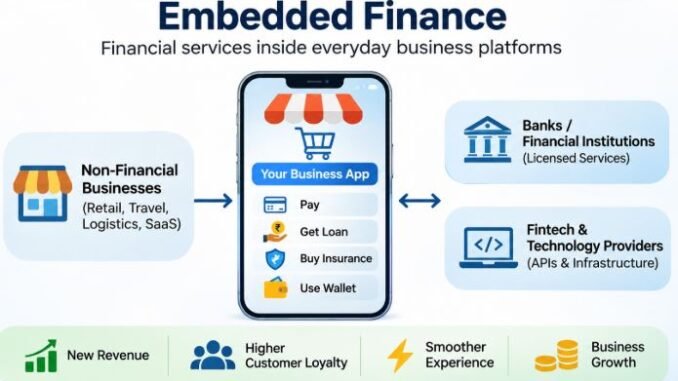
Financial services are no longer limited to traditional banks and financial institutions. Today, customers can make payments, access credit, purchase insurance and manage transactions directly through the digital platforms they already use for shopping, travel, transportation and business operations.
This development is known as embedded finance, and it is creating new opportunities for companies across multiple industries.
Through technology integrations and partnerships with regulated financial institutions, non-financial businesses can offer financial products without building an entire banking infrastructure themselves. A customer buying a product online, for example, may be able to choose an instalment payment option at checkout. A small business using a digital platform may receive access to working capital or faster payments without visiting a bank branch.
The shift is changing how companies think about their products and customer relationships. Financial services are becoming an integrated part of the business experience rather than a separate activity.
What Is Embedded Finance and Why Is It Important?
Embedded finance refers to the integration of financial services into non-financial products, applications and digital platforms.
Instead of asking customers to visit a separate banking website or financial application, businesses make relevant financial services available within their own platforms.
For example, an online retailer can offer digital payments and buy-now-pay-later options during checkout. A transportation platform can provide drivers with digital wallets and faster payment facilities. A software company serving small businesses can integrate invoicing, payment collection and access to business financing.
The importance of this model lies in convenience and accessibility. Customers can complete financial transactions while carrying out their regular activities, reducing the need to switch between multiple applications and service providers.
For businesses, embedded finance creates an opportunity to become more valuable to customers by offering services that support their wider financial needs.
How Embedded Finance Creates New Business Opportunities
One of the biggest advantages of embedded finance is its ability to create additional revenue opportunities.
Traditional businesses often depend primarily on selling products or providing services. By integrating financial features, they can expand their offerings and generate income through transaction fees, service charges, partnerships and other permitted revenue-sharing arrangements.
For example, an e-commerce company can offer payment solutions alongside its products. A logistics platform can provide digital payment facilities to transport operators. A business software provider can integrate payment collection and financial management tools into its subscription service.
This can strengthen customer loyalty because users have more reasons to continue using the same platform.
Embedded finance can also help businesses understand customer needs more effectively. Transaction information, where lawfully collected and appropriately used, can help companies improve their services and offer more relevant financial products.
Key Uses of Embedded Finance Across Industries
Embedded finance is expanding across several business sectors, with each industry using financial technology in different ways.
1. Retail and e-commerce
Online retailers can integrate digital payments, digital wallets, instalment options and customer financing into the shopping experience. This can make purchases more convenient and help businesses improve checkout completion and customer engagement.
2. Transportation and logistics
Transportation and logistics platforms can offer digital payments, driver wallets, toll-payment facilities and faster settlements. These services can simplify transactions for drivers, fleet operators and transport businesses.
3. Small businesses and enterprise software
Accounting platforms, business management applications and enterprise software providers can integrate invoicing, payment collection and access to financing. These features help small businesses manage everyday financial activities through a single digital platform.
4. Travel and hospitality
Travel companies can integrate payment facilities, booking-related insurance and flexible payment options into their applications. Customers can complete more of their travel-related transactions without leaving the booking platform.
5. Insurance and financial protection
Digital platforms can offer relevant insurance products during a purchase or service booking. For example, travel insurance can be presented when a customer books a trip, while delivery-related coverage can be offered through logistics platforms.
These examples show how financial services can become a natural extension of products and services customers already use.
How Banks and Fintech Companies Support the Ecosystem
Embedded finance does not necessarily mean that a retailer, technology company or logistics provider becomes a bank.
In most cases, the model operates through partnerships involving three main participants.
- Non-financial businesses: These companies own the customer relationship and provide the platform through which financial services are accessed.
- Fintech and technology providers: These businesses supply the application programming interfaces (APIs), payment infrastructure, digital wallets and technology needed to connect different systems.
- Licensed financial institutions: Banks and other appropriately authorised institutions provide regulated financial products and perform relevant financial and compliance responsibilities.
This partnership model allows businesses to introduce financial services without independently developing all the systems and regulatory capabilities required to operate as financial institutions.
It also creates commercial opportunities for banks and fintech companies, which can reach customers through established platforms and business networks.
The Business Benefits: Revenue, Customer Loyalty and Growth
Embedded finance offers several potential benefits for companies.
Additional revenue streams: Businesses can expand beyond their traditional products and services through financial partnerships, transaction-related income and other commercial arrangements.
Better customer experience: Customers can make payments, access credit or purchase relevant insurance within a familiar application.
Stronger customer relationships: Offering useful financial features can encourage customers to use a platform more frequently and remain connected to the business.
Improved business efficiency: Integrated payment and financial management tools can reduce manual processes and simplify transactions.
Greater access to business services: Small businesses, independent professionals and platform workers may gain easier access to payments and financial products through digital platforms.
For companies, the broader opportunity is to create a more complete customer experience while developing new areas of business growth.
India’s Growing Opportunity in Embedded Finance
India offers a promising environment for embedded finance because of its expanding digital economy, widespread smartphone adoption and growing use of digital payments.
The Unified Payments Interface (UPI) has made digital transactions an important part of everyday commerce. Businesses across retail, transportation, food delivery and online services increasingly use digital payment infrastructure to serve customers.
This digital foundation creates opportunities for companies to integrate additional financial services into their platforms.
For small businesses, embedded finance could make payment collection, cash-flow management and access to working capital more convenient. For consumers, it can simplify purchases and provide access to relevant financial services within familiar applications.
Indian fintech companies, banks and technology providers can also benefit by developing infrastructure that connects businesses with regulated financial services.
As the digital economy expands, embedded finance could become an increasingly important part of how companies compete and serve customers.
Managing Regulation, Data Security and Customer Trust
Although embedded finance offers significant business potential, companies must manage financial and operational responsibilities carefully.
Financial services involve sensitive customer information, payment security and regulatory requirements. Businesses must ensure that their partnerships are properly structured and that regulated activities are performed by appropriately authorised institutions.
Data privacy and cybersecurity are particularly important. Companies need secure technology systems, transparent customer consent processes and appropriate controls over how financial information is collected and used.
Consumer protection must also remain a priority. Customers should understand the terms, costs and conditions of financial products offered through digital platforms.
In India, businesses and their partners must consider applicable requirements from regulators such as the Reserve Bank of India, as well as relevant payment, lending, insurance and data-protection rules.
Companies that prioritise transparency, compliance and responsible partnerships will be better positioned to build long-term customer confidence.
The Future of Embedded Finance
Embedded finance is creating a closer connection between technology, commerce and financial services. As digital platforms become more sophisticated, businesses will have greater opportunities to integrate payments, credit, insurance and financial management tools into their products.
For traditional companies, this represents an opportunity to expand their business models without moving away from their core industries. For banks and fintech providers, it creates new distribution channels and opportunities to reach customers through partnerships.
The model may also help smaller businesses access financial services that were previously more difficult to obtain through traditional channels.
Embedded finance is more than a new payment trend. It represents a shift in how businesses deliver value to customers and generate revenue. As financial services become part of everyday digital experiences, companies that combine convenience, technology and responsible financial partnerships could gain a stronger position in the evolving business ecosystem.
