
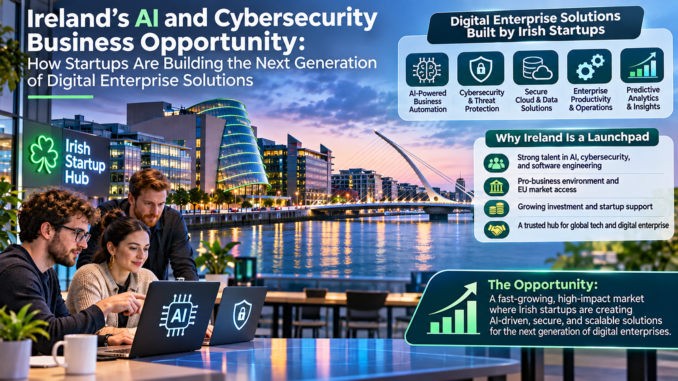
Nov 23: Ireland is emerging as an important destination for artificial intelligence (AI), cybersecurity and enterprise technology innovation. As businesses accelerate their digital transformation strategies, Irish startups are developing software and technology platforms designed to improve productivity, strengthen data protection and simplify complex business operations.
From AI-powered enterprise applications and financial technology to cybersecurity platforms and regulatory compliance software, the country’s technology ecosystem is expanding into areas that address practical business requirements. This is creating opportunities not only for startups and investors but also for international software developers, IT consulting firms and outsourcing providers.
The momentum was evident in November 2026, when Enterprise Ireland led a delegation of 28 Irish startups to Web Summit 2026. Eighteen participating companies were collectively seeking €30.45 million in investment, highlighting their ambitions to scale operations and enter international markets. Their technologies covered AI, cybersecurity, fintech, regulatory compliance and enterprise software.
At the same time, growing concerns about AI-related cyber threats are encouraging businesses to invest in stronger digital security. These developments are positioning Ireland’s AI and cybersecurity industry as an important area of business opportunity, with potential extending well beyond the country’s domestic market.
How Irish Startups Are Transforming the AI and Enterprise Technology Landscape
Artificial intelligence is changing how businesses manage information, communicate with customers and make operational decisions. Irish startups are increasingly focusing on practical AI applications that help organisations address everyday challenges rather than simply introducing new technologies.
Enterprise software is one of the major areas of development. Businesses are looking for applications that can automate repetitive tasks, analyse large volumes of information and connect different departments through integrated digital platforms.
Emerging applications include:
-
AI-powered financial planning and business analytics.
-
Automated customer service and communication platforms.
-
Intelligent document processing and data management.
-
AI-assisted sales and marketing applications.
-
Workflow automation and enterprise resource planning.
-
Predictive analytics for business operations.
The Enterprise Ireland delegation at Web Summit 2026 reflected this diversity. The participating startups represented different stages of technology development, from specialised AI applications to enterprise platforms designed for international customers.
The €30.45 million investment sought by 18 participating companies also highlights the financing requirements of startups looking to commercialise their technologies, expand development teams and strengthen their market presence.
For investors, this represents an opportunity to participate in specialised enterprise technology markets. For businesses, it offers access to a growing range of software solutions designed to improve operational efficiency.
Cybersecurity Is Creating a New Business Opportunity in Ireland
The rapid adoption of AI is also increasing the complexity of cybersecurity risks. Businesses are dealing with threats involving data breaches, compromised systems, cloud infrastructure, third-party suppliers and unauthorised access to sensitive information.
The concern is becoming particularly relevant as organisations introduce AI agents and automated decision-making systems into their operations.
The EY Ireland Cyber Leaders Index 2026, published on November 11, provides an indication of the challenge. The study surveyed 161 cybersecurity professionals and senior leaders across Ireland.
Its findings include:
-
35% identified AI-related threats as their leading cybersecurity concern.
-
47% said rapid AI developments and the changing threat environment were making cybersecurity risks harder to control.
-
34% identified direct cyberattacks as a leading resilience risk.
-
31% highlighted breaches involving third-party suppliers.
-
25% identified major outages caused by rogue AI as a resilience risk.
These findings suggest that cybersecurity is becoming closely connected with business continuity and operational resilience.
Irish startups are already exploring solutions to address these challenges. For example, Sentinari is developing cybersecurity technology to help organisations detect and respond to scams, including threats involving AI agents. Disseqt is working on AI assurance solutions that enable regulated organisations to verify AI-generated information and maintain secure audit records.
Resilium is another example, developing cybersecurity technology for industrial environments.
These developments demonstrate how Irish technology companies are moving beyond conventional security software towards specialised solutions for an increasingly AI-driven business environment.
Business opportunities in cybersecurity
The growing demand for digital protection creates opportunities across several service categories:
-
AI-powered threat detection and monitoring.
-
Cloud security and infrastructure protection.
-
Identity and access management.
-
Cybersecurity audits and vulnerability assessments.
-
AI governance and risk management.
-
Security testing for enterprise applications.
-
Incident response and business continuity consulting.
For technology service providers, cybersecurity can also become a recurring business opportunity through managed security services, regular system assessments and long-term monitoring contracts.
Fintech Innovation Is Expanding Beyond Digital Payments
Ireland’s fintech ecosystem is also creating opportunities through specialised financial software and automated business applications.
The demand for fintech solutions is expanding beyond digital payments. Businesses increasingly require technology that can simplify financial administration, automate compliance procedures and improve transaction monitoring.
AI-powered financial applications can help organisations analyse transactions, identify unusual patterns, automate documentation and improve financial reporting.
Irish startups are developing solutions across these specialised areas.
For instance, FYBRUS is innovating in payment technology, while Finperiti is developing anti-money-laundering compliance solutions. Digitax is focused on helping self-employed individuals manage tax compliance, while GreenTally is developing AI-powered accounting technology for bookkeeping, invoice processing and financial reporting.
These businesses demonstrate how fintech innovation is becoming increasingly specialised, addressing the needs of small businesses, financial institutions and professional service providers.
For international software developers, this creates opportunities in:
-
Payment gateway integration.
-
Financial data analytics.
-
Automated accounting and bookkeeping.
-
Anti-money-laundering technology.
-
Digital identity verification.
-
Financial reporting and compliance software.
-
Secure banking and transaction management platforms.
The opportunity is particularly relevant for businesses that can combine financial expertise with AI development, data security and regulatory knowledge.
Enterprise Automation Is Moving Into Industry-Specific Applications
Enterprise automation is becoming another important area of opportunity as businesses look for technology that can deliver measurable improvements in productivity.
Instead of adopting generic automation platforms, organisations are increasingly interested in software designed around the operational requirements of specific industries.
Irish startups are exploring this approach in sectors such as hospitality, construction, accounting and professional services.
For example, Otis has developed an AI-powered platform that helps restaurant groups manage costs and operations. Its technology has been deployed across more than 50 restaurant sites, with paying customers in the UK and the US.
EchoByld is applying AI to construction planning. Its platform helps automate pre-construction processes, identify missing costs and highlight project risks. The company has secured more than 45 paying customers across Ireland and the UK.
These examples demonstrate the commercial potential of industry-specific enterprise software.
For businesses, such platforms can help reduce administrative workloads, improve cost visibility and streamline decision-making. For technology developers, they provide opportunities to build customised applications for sectors where traditional software may not fully address operational requirements.
Other promising areas include:
-
Automated procurement and inventory management.
-
AI-powered customer relationship management.
-
Workforce and project management software.
-
Intelligent document processing.
-
Business intelligence and predictive analytics.
-
Supply chain automation.
-
AI-assisted financial planning.
The next stage of enterprise automation will depend on how effectively these solutions integrate with existing business systems while maintaining data accuracy, security and reliability.
Regulatory Compliance Technology Is Becoming a Specialised Market
As businesses expand across international markets, regulatory compliance is becoming more complex. Organisations must manage documentation, data protection, financial regulations, industry standards and corporate governance requirements.
This is encouraging the development of regulatory technology, commonly known as RegTech.
Irish startups are exploring AI-powered applications that can help organisations organise compliance documentation, monitor regulatory requirements and identify potential risks.
Companies such as ComplyLoft and Veridraft are working on compliance and corporate governance solutions, while RiskCortex is applying AI to regulatory compliance in the life sciences sector.
The commercial opportunity extends beyond software development. Businesses adopting these platforms may require:
-
Compliance technology integration.
-
Automated regulatory reporting.
-
Corporate governance software.
-
Data management and audit solutions.
-
Regulatory monitoring platforms.
-
AI risk assessment and documentation.
-
Ongoing technical support.
For international technology providers, regulatory compliance offers an opportunity to work with specialised software businesses and their enterprise customers.
Ireland’s AI Investment Momentum Is Attracting Global Attention
The development of Irish AI startups is supported by growing investment activity and initiatives aimed at helping founders scale internationally.
According to PitchBook analysis published by Enterprise Ireland on October 12, 2026, Irish AI companies attracted €947.3 million in venture capital across 182 deals since the beginning of 2025.
The breakdown included:
-
€691.3 million across 107 deals in 2025.
-
€256 million across 75 deals in 2026 up to the publication date.
Ireland ranked second in Europe on a per-capita basis for AI venture capital deal activity in 2026.
The investment figures indicate that Irish AI innovation is attracting interest from both domestic and international investors. However, the market is also becoming more selective, with investment increasingly concentrated in companies that demonstrate commercial traction and potential for international expansion.
Enterprise Ireland is also strengthening the startup ecosystem through its Startup Ireland initiative, announced on October 13, 2026. The programme aims to support the creation of 1,000 new startups and includes a National Startup Hub and a dedicated AI Accelerator.
The AI Accelerator is designed to connect selected startups with technology expertise, investors and international business opportunities.
These initiatives could help emerging companies access the resources required to develop products, strengthen intellectual property and establish international partnerships.
For global technology businesses, the expansion of this ecosystem also creates opportunities to collaborate with Irish startups through software development, product engineering, infrastructure support and commercial technology partnerships.
Why International IT Outsourcing Companies Should Watch Ireland
Ireland’s expanding AI and cybersecurity ecosystem offers opportunities beyond direct investment in startups. As technology companies scale, they require additional technical capabilities to develop, test, deploy and maintain their products.
This creates potential business opportunities for international IT outsourcing companies, including Indian technology service providers.
India’s established software development and IT services capabilities can complement Ireland’s growing startup ecosystem, particularly when businesses need to expand development capacity without significantly increasing fixed operational costs.
Several areas offer potential for collaboration.
1. AI development and integration
Irish startups may require external expertise to develop AI applications, integrate large language models, build data pipelines and automate enterprise workflows. Indian software development companies can support product engineering, application development and AI integration projects.
2. Cybersecurity services
The growing focus on AI-related cyber threats creates opportunities for vulnerability assessments, penetration testing, cloud security, security operations and managed cybersecurity services.
Technology providers with specialised cybersecurity teams can support Irish businesses looking to strengthen their digital infrastructure.
3. Enterprise software development
Startups developing fintech, accounting, construction and business management applications may need support with application development, testing, API integration and product maintenance.
Outsourcing partners can provide additional engineering resources during product development and expansion.
4. Fintech and compliance technology
Financial software requires reliable development, data protection and regulatory awareness. Indian IT firms can explore partnerships involving payment integration, financial analytics, automated reporting and compliance applications.
5. Cloud infrastructure and managed IT services
As startups expand internationally, managing cloud environments, databases, application performance and infrastructure security becomes increasingly important.
IT outsourcing companies can provide ongoing technical support and infrastructure management.
6. Software testing and quality assurance
AI-powered enterprise applications require extensive testing to ensure accuracy, reliability and security. Independent software testing, automation testing and AI model validation can become valuable services for growing technology businesses.
The commercial opportunity lies in building long-term technology partnerships with Irish companies rather than competing solely on project pricing.
For Indian IT service providers, developing expertise in AI, cybersecurity, fintech and enterprise automation could help them establish a stronger presence in Ireland’s technology market.
Challenges Irish AI and Cybersecurity Startups Must Address
Despite the growing opportunities, Irish technology companies face several challenges as they move towards international expansion.
Competition from global technology companies: AI and cybersecurity are attracting established software providers and well-funded startups. Smaller businesses must demonstrate clear product differentiation and measurable customer benefits.
Availability of skilled professionals: Developing sophisticated AI applications and cybersecurity platforms requires expertise in software engineering, data science, cloud computing and security architecture.
Data protection and regulatory requirements: Companies developing enterprise software must ensure that their applications meet relevant data protection, governance and industry-specific requirements, particularly when serving customers across European markets.
Customer trust: Businesses adopting AI solutions need confidence in data security, system reliability and the accuracy of automated decisions.
Commercial scalability: Startups must move beyond product development and establish sustainable revenue models, customer acquisition strategies and international distribution networks.
For technology companies, addressing these challenges will be essential to converting innovation into long-term commercial success.
What Lies Ahead for Ireland’s AI and Cybersecurity Industry?
Ireland’s AI and cybersecurity industry is entering an important phase of development. The combination of startup investment, enterprise technology innovation and increasing demand for digital security is creating opportunities across several interconnected markets.
The November 2026 Web Summit delegation highlights the diversity of Irish innovation, with startups developing solutions for cybersecurity, fintech, compliance, construction, accounting and enterprise automation.
The investment outlook further supports this momentum. With €947.3 million in venture capital attracted by Irish AI companies since the beginning of 2025, the sector is demonstrating its ability to attract significant investor interest.
However, the next phase of growth will depend on commercial adoption. Startups must demonstrate that their solutions can address genuine business requirements, integrate with existing systems and provide reliable outcomes.
For international investors, this presents opportunities across specialised software markets. For Indian IT outsourcing companies, it creates possibilities in AI development, cybersecurity consulting, fintech applications and enterprise software engineering.
Ultimately, Ireland’s technology opportunity is not limited to building more AI products. It is about developing secure, scalable and commercially viable digital solutions that help businesses operate more efficiently.
Companies that can combine technological innovation with cybersecurity, regulatory compliance and strong implementation capabilities will be well positioned to participate in the next phase of Ireland’s digital enterprise growth.
