
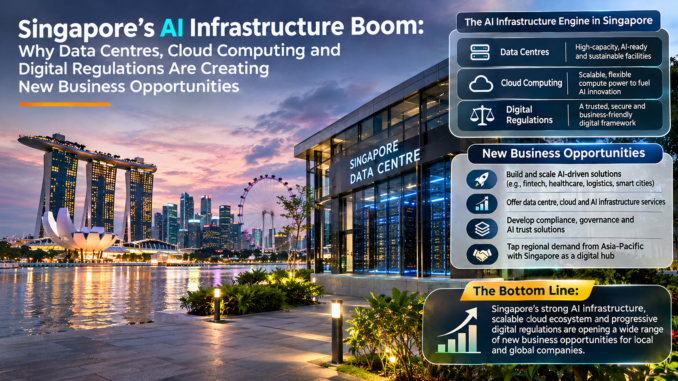
Nov 21: Artificial intelligence is transforming the digital economy, but the technology’s growth depends on something businesses cannot always see: the infrastructure powering it. Behind every AI-powered application are data centres, cloud computing platforms, high-performance servers, networking systems and advanced cooling technologies that enable businesses to process increasingly large volumes of information.
Singapore is strengthening its position as a major digital infrastructure hub in Asia, attracting investment in data centres, cloud services and supporting technology ecosystems. The country’s established international connectivity, financial services industry and technology environment are creating demand for infrastructure capable of supporting AI adoption across multiple sectors.
The momentum was particularly visible in November 2026, when Equinix opened its SG6 data centre in Singapore on November 6. The facility is designed to support AI, high-performance computing and data-intensive workloads. Another significant development was the publication of Singapore’s Digital Infrastructure Act 2026 in November, establishing a regulatory framework for major digital infrastructure providers and data centre operators.
These developments highlight a broader transformation. Singapore’s AI infrastructure opportunity is no longer limited to constructing data centres. It encompasses cloud management, cybersecurity, liquid cooling, energy efficiency, software development and specialised IT services.
For international technology companies, particularly Indian IT service providers, this expanding ecosystem offers opportunities to participate in the next phase of digital infrastructure development.
Why Singapore Is Becoming an Important AI Infrastructure Hub
Singapore’s position in the digital economy is supported by its international connectivity, established telecommunications infrastructure and concentration of multinational businesses.
Financial institutions, technology companies, logistics providers and professional service organisations depend on reliable digital systems to manage transactions, store information and deliver services across international markets.
The expansion of AI is increasing these requirements. AI applications need substantial computing power to process information, train models and deliver real-time results. Businesses also require secure cloud environments and high-speed networks to connect applications with customers, employees and business partners.
According to the Infocomm Media Development Authority’s Singapore Digital Economy Report 2026, the country’s digital economy generated S$144.1 billion in nominal value added in 2025, representing 19.3% of GDP. The digital economy grew 5.6% year-on-year, faster than the broader economy’s nominal growth of 3.1%.
AI adoption is also accelerating among enterprises. The proportion of businesses adopting AI increased from 14.7% in 2024 to 23.5% in 2025.
These figures demonstrate why digital infrastructure is becoming increasingly important to Singapore’s economic development.
The country is developing an interconnected ecosystem involving data centre operators, cloud providers, telecommunications companies, financial institutions and technology service providers. For international businesses, this creates opportunities to establish partnerships and provide specialised services to companies supporting the region’s digital infrastructure.
Equinix SG6: A New Development in Singapore’s Data Centre Market
One of the significant developments in Singapore’s AI infrastructure market was the opening of Equinix SG6 on November 6, 2026.
The facility is Equinix’s sixth International Business Exchange (IBX) data centre in Singapore and represents an initial investment of approximately US$290 million.
Designed to support AI, high-performance computing and data-intensive workloads, SG6 introduces infrastructure suited to businesses requiring high-density computing and international connectivity.
Its first phase provides approximately 1,550 server cabinets and 8 megawatts of IT capacity. Upon full build-out, the facility is expected to offer up to 20 megawatts of IT capacity.
The facility incorporates several technologies and sustainability features:
- Advanced cooling systems, including liquid-cooling capabilities.
- Rooftop and facade solar photovoltaic installations.
- Rainwater harvesting and water management systems.
- Lower-embodied-carbon construction materials.
- A target Power Usage Effectiveness (PUE) of 1.20.
- Infrastructure designed to accommodate power-intensive GPU workloads.
Equinix has also announced plans to establish a Co-Innovation Facility at SG6 in partnership with the National University of Singapore in 2027. The initiative will explore technologies such as liquid cooling, cognitive digital twins and battery energy storage.
The development demonstrates how modern data centres are evolving from conventional server-hosting facilities into specialised environments designed to support AI infrastructure and high-performance computing.
For equipment suppliers, engineering companies, software developers and infrastructure service providers, such investments create opportunities across the wider data centre supply chain.
AI Adoption Is Increasing Demand for Data Centre Infrastructure
Artificial intelligence is one of the major factors driving demand for computing infrastructure.
Generative AI applications, machine learning, enterprise automation and advanced data analytics require substantial processing capabilities. These workloads depend on powerful servers, graphics processing units (GPUs), high-speed networking and reliable storage systems.
As businesses introduce AI into customer service, financial operations, supply chain management and marketing, their dependence on digital infrastructure is increasing.
Data centres provide the physical environment required to operate these applications. They house servers, networking equipment, storage systems and supporting technologies that keep digital services running.
However, AI workloads create different infrastructure requirements compared with traditional enterprise computing.
High-performance GPUs generate considerable heat and require advanced cooling solutions. Data centres must also maintain reliable power supplies, network connectivity and operational security.
This is creating opportunities for businesses offering:
- High-density server infrastructure.
- Data centre construction and engineering.
- Server installation and maintenance.
- GPU infrastructure management.
- Data storage and backup solutions.
- Network monitoring and optimisation.
- Infrastructure automation and predictive maintenance.
For technology companies, the opportunity extends beyond building new facilities. Existing data centres also require continuous upgrades to accommodate changing computing requirements.
Cloud Computing Is Becoming Essential for AI-Powered Businesses
Cloud computing is another important component of Singapore’s expanding digital infrastructure market.
Businesses increasingly use cloud platforms to store information, operate applications and access computing resources without maintaining all their technology infrastructure internally.
AI adoption is strengthening this demand. Companies developing AI applications need scalable computing environments that can support fluctuating workloads, large datasets and specialised processing requirements.
Cloud platforms also make it easier for businesses to integrate AI tools into existing applications.
For example, financial institutions can use cloud-based AI applications to analyse transactions and identify unusual activities. Logistics companies can process supply chain information to improve delivery planning, while retailers can use AI-powered analytics to understand customer behaviour and manage inventory.
As adoption increases, businesses require more than basic cloud storage.
They need specialised services such as:
Cloud migration: Moving existing business applications and databases to cloud environments.
Hybrid cloud management: Connecting private infrastructure with public cloud services.
AI cloud infrastructure: Providing computing environments capable of supporting machine learning and generative AI workloads.
Cloud security: Protecting business information, managing access and identifying vulnerabilities.
Disaster recovery: Maintaining backup systems and business continuity during technical disruptions.
Cloud optimisation: Managing infrastructure costs, resource allocation and application performance.
This creates opportunities for managed service providers, cloud consultants, software developers and IT infrastructure companies.
Digital Infrastructure Act 2026: What Businesses Need to Understand
Singapore’s digital infrastructure expansion is also being accompanied by a more structured regulatory framework.
The Digital Infrastructure Act 2026 was passed by Parliament on October 7 and received presidential assent on October 29. It was published in the Government Gazette on November 10, 2026.
An important distinction is that publication does not mean the Act is already operational. Its commencement is subject to a date appointed by the Minister through notification in the Gazette.
The legislation establishes licensing frameworks intended to strengthen the security, resilience and environmental sustainability of major data centres and cloud service providers.
Under the framework, data centres with a critical IT load of at least 3 megawatts fall within the Act’s data centre definition. The legislation provides for licensing and regulatory requirements covering relevant operators and foundational digital infrastructure services.
Its key areas include:
- Security risk management.
- Business continuity and disaster recovery planning.
- Reporting of specified cybersecurity incidents and disruptions.
- Data centre energy efficiency.
- Operational resilience.
- Infrastructure sustainability.
- Regulatory oversight of relevant cloud and data centre services.
The framework is designed to complement Singapore’s existing Cybersecurity Act by addressing a broader range of operational risks affecting foundational digital infrastructure.
For businesses, the development highlights the growing importance of infrastructure security, operational continuity and sustainability.
For technology service providers, it creates opportunities in compliance support, infrastructure audits, cybersecurity assessments and operational risk management.
Companies planning to provide services to regulated infrastructure operators should monitor the commencement notification and subsequent implementing requirements before making compliance assumptions.
Liquid Cooling Technology Is Creating a New Business Market
One of the most interesting opportunities emerging from AI infrastructure expansion is liquid cooling.
Traditional data centres have largely relied on air-based cooling systems to manage server temperatures. However, high-performance AI computing equipment generates substantial heat, making conventional cooling less suitable for some high-density deployments.
Liquid cooling addresses this challenge by using fluids to transfer heat away from processors and other high-performance components.
As AI infrastructure expands, demand for specialised cooling technologies is creating opportunities across several business categories.
These include:
- Direct-to-chip liquid cooling systems.
- Cooling distribution units.
- Heat exchangers and thermal management equipment.
- Cooling infrastructure monitoring.
- Water-efficient cooling technologies.
- Predictive maintenance systems.
- Engineering and installation services.
Equinix’s SG6 facility includes liquid-cooling capabilities designed to support power-intensive GPU infrastructure.
The planned collaboration with the National University of Singapore also highlights the importance of research and development in improving cooling efficiency.
For engineering companies, equipment manufacturers and technology integrators, liquid cooling represents a specialised market connected to the wider expansion of AI infrastructure.
Energy Management and Sustainable Data Centres Are Becoming Business Priorities
Data centres require substantial electricity to operate servers, networking equipment and cooling systems. As AI workloads increase, managing energy consumption is becoming an important consideration for operators and businesses.
Singapore faces particular challenges because of its limited land and natural resources. The government is therefore seeking to balance digital infrastructure expansion with energy security, water management and environmental objectives.
Singapore’s Ministry of Energy and Trade and Industry has confirmed that projected electricity and water demand from data centres, including AI computing, is factored into national infrastructure planning.
Under the second Data Centre Call for Application exercise, applicants were required to power at least 50% of their data centre capacity using green energy sources.
The government is also introducing efficiency requirements, including facility-level Power Usage Effectiveness provisions under the Digital Infrastructure Act framework.
This creates opportunities for companies developing:
Energy management software: Applications that monitor electricity consumption and identify opportunities to improve efficiency.
Renewable energy solutions: Solar energy systems and renewable power procurement services for digital infrastructure operators.
Battery storage: Technologies that help manage power availability and support infrastructure resilience.
Smart cooling systems: Automated solutions that adjust cooling requirements according to server workloads and environmental conditions.
Digital twins: Virtual representations of physical infrastructure that help operators monitor performance and simulate operational changes.
Water management: Technologies that improve water usage, recycling and cooling efficiency.
The commercial opportunity is expanding from traditional energy supply towards specialised technologies that help data centres operate more efficiently.
How AI Infrastructure Is Creating Opportunities Across Different Industries
Singapore’s infrastructure expansion has implications beyond the technology sector. Businesses across financial services, healthcare, logistics and e-commerce are becoming increasingly dependent on AI-powered computing and cloud platforms.
Financial services: Banks, insurance companies and fintech businesses use digital infrastructure for transaction processing, fraud detection, customer analytics and regulatory reporting. Secure, low-latency computing environments are important for these operations.
Healthcare: Healthcare organisations are exploring AI for medical imaging, administrative automation, patient data management and research. These applications require secure storage and reliable computing infrastructure.
Logistics and supply chain: Logistics businesses can use AI-powered platforms to analyse shipment data, optimise routes, forecast demand and improve warehouse management. Cloud infrastructure supports the processing and exchange of large volumes of operational information.
E-commerce and retail: Online retailers depend on data analytics, recommendation engines, inventory forecasting and customer personalisation. AI applications require scalable computing and storage capacity, particularly during periods of high transaction volumes.
Manufacturing: Industrial businesses are using connected systems, predictive maintenance and automated quality inspection. These applications depend on reliable networks, data processing and secure cloud connectivity.
This cross-industry adoption broadens the market for infrastructure providers. Demand is not limited to technology companies; it also comes from traditional businesses seeking to modernise their operations.
Why Indian IT Companies Should Watch Singapore’s AI Infrastructure Market
Singapore’s AI infrastructure expansion offers opportunities for international technology service providers, particularly Indian IT companies with experience in software engineering, cloud computing, cybersecurity and enterprise technology.
India’s established IT services industry can complement Singapore’s growing ecosystem by providing specialised technical capabilities and additional development capacity.
Several areas offer potential for collaboration.
1. Data Centre Management and Technical Support
Data centres require continuous technical supervision, maintenance and operational support.
Indian companies can explore opportunities in server administration, infrastructure monitoring, equipment maintenance, network management and remote technical support.
2. Cloud Computing and Managed Services
Businesses moving towards AI-powered applications may require cloud migration, infrastructure management and application optimisation.
Indian IT providers can offer managed cloud environments, hybrid cloud integration, cloud cost management and technical support.
3. AI Infrastructure and Software Development
AI companies require specialised infrastructure for model training, deployment and data processing.
Software engineering firms can provide GPU infrastructure integration, AI application development, data engineering, model testing and platform management.
4. Cybersecurity Consulting
As digital infrastructure becomes more interconnected, organisations need support with cybersecurity audits, penetration testing, cloud protection, access management and risk assessments.
Specialised security providers can develop long-term service relationships through continuous monitoring and infrastructure protection.
5. Liquid Cooling and Engineering Support
Engineering and technology companies can explore opportunities in cooling equipment integration, thermal monitoring, system maintenance and infrastructure automation.
These services may be particularly relevant to companies supplying or maintaining high-density AI computing environments.
6. Energy Management Solutions
Companies developing energy monitoring platforms, automation systems and smart infrastructure technologies can serve data centre operators seeking to improve efficiency.
Software providers can also develop predictive analytics tools that help operators identify energy consumption patterns and optimise equipment performance.
7. Software Testing and Quality Assurance
AI-powered enterprise applications require extensive testing to ensure accuracy, reliability and security.
Independent software testing, automation testing, performance assessment and AI model validation can become valuable services for growing technology businesses.
For Indian IT outsourcing companies, the opportunity lies in building long-term partnerships with Singapore-based infrastructure operators, cloud providers, technology startups and enterprise customers.
Rather than competing solely on project pricing, service providers can differentiate themselves through specialised expertise in AI, cloud architecture, cybersecurity and infrastructure management.
Challenges Facing Singapore’s AI Infrastructure Market
Despite the growing opportunities, the sector faces several challenges.
Energy availability: Data centres require reliable electricity, and increasing AI workloads can intensify pressure on power infrastructure.
Land constraints: Singapore’s limited land availability makes data centre development a carefully planned investment.
High capital requirements: Building advanced data centres involves significant expenditure on construction, servers, cooling systems and power infrastructure.
Talent requirements: The industry needs professionals with expertise in cloud computing, cybersecurity, data centre engineering, AI infrastructure and energy management.
Regulatory compliance: Operators must prepare for evolving requirements involving security, operational resilience and environmental sustainability.
Technology costs: Advanced GPUs, cooling equipment and energy management systems can increase operational expenses.
Businesses entering this market must therefore consider not only the demand for AI infrastructure but also the costs, regulatory requirements and technical expertise needed to deliver reliable services.
What Lies Ahead for Singapore’s AI Infrastructure Industry?
Singapore’s AI infrastructure market is entering a new phase in which computing capacity, energy efficiency, connectivity and regulatory oversight are becoming increasingly interconnected.
The opening of Equinix SG6 demonstrates how data centre operators are investing in infrastructure designed specifically for AI and high-performance computing. The Digital Infrastructure Act 2026 reflects the government’s focus on establishing a stronger framework for security, resilience and sustainability.
Meanwhile, rising AI adoption across financial services, healthcare, logistics, manufacturing and retail is expanding the customer base for cloud computing and specialised digital services.
For data centre operators, the focus will be on improving computing capacity while managing energy and resource consumption. Cloud providers will need to strengthen their infrastructure and security capabilities, while technology companies will have opportunities to develop specialised applications and supporting services.
For Indian IT providers, Singapore offers a potential market for cloud management, AI infrastructure development, cybersecurity consulting, software engineering and energy management solutions.
The larger opportunity lies in building an ecosystem where technology, engineering and sustainable infrastructure work together.
As AI adoption continues to expand across industries, businesses that can provide reliable, secure and energy-efficient digital infrastructure will play an important role in supporting Singapore’s next phase of digital economic growth.
