
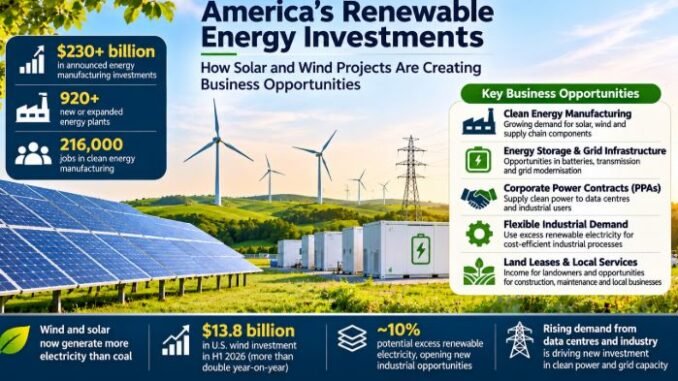
The United States’ renewable energy sector is opening new opportunities for businesses as investment in solar and wind power expands across manufacturing, energy storage, electricity networks and industrial power supply. With renewable generation becoming an increasingly important part of the country’s electricity mix, companies are exploring new ways to participate in the growing clean energy market.
The shift is creating opportunities beyond power generation itself. Manufacturers, construction companies, technology providers, infrastructure developers and industrial energy users are all becoming part of the expanding renewable energy supply chain.
According to research highlighted by the Institute for Business in Global Society at Harvard Business School, wind and solar have overtaken coal in US electricity generation. At the same time, rising electricity demand from data centres and other energy-intensive industries is creating fresh demand for reliable and cost-effective power.
Domestic Manufacturing Creates Investment Potential
The expansion of renewable energy is supporting demand for equipment and components manufactured in the United States. Solar panels, wind turbines, inverters, battery systems, steel structures and tracking equipment all form part of a supply chain that offers opportunities for manufacturers and industrial suppliers.
Figures cited by the US Department of Energy point to more than $230 billion in announced energy manufacturing investments and over 920 new or expanded plants. The wider clean energy manufacturing sector also supports hundreds of thousands of jobs across the country.
For businesses, this creates potential opportunities in component production, equipment assembly, raw material supply and specialised manufacturing services. Companies that can provide reliable domestic supplies may be well positioned as developers and manufacturers look to strengthen their supply chains.
Battery Storage and Grid Infrastructure Gain Importance
As solar and wind generation increase, managing electricity supply becomes an important business priority. Solar output is concentrated during daylight hours, while wind generation can vary depending on weather conditions. Battery storage and modern grid infrastructure can help balance these fluctuations and improve the use of renewable electricity.
This is creating opportunities for companies involved in battery development, installation, maintenance, transmission equipment and grid management technology.
Investment in transformers, transmission lines, control systems and other infrastructure will also be important as renewable projects connect to the electricity network.
For investors and service providers, the opportunity extends beyond building renewable power plants. Supporting the infrastructure that moves, stores and manages electricity could become an important area of long-term business activity.
Corporate Demand Opens Opportunities for Clean Power Contracts
Growing electricity consumption from data centres, artificial intelligence operations and industrial facilities is creating another market for renewable energy developers.
Large companies are increasingly looking for dependable electricity supplies while managing energy costs and their environmental commitments. This creates opportunities for renewable energy producers to enter into long-term Power Purchase Agreements (PPAs) and other commercial electricity supply arrangements.
Under these agreements, businesses can secure electricity from renewable projects, while developers gain a more predictable revenue stream.
The expanding power requirements of data centres and industrial users could therefore support new partnerships between energy producers, technology companies and major electricity consumers.
Industrial Businesses Could Benefit from Lower-Cost Renewable Power
An additional opportunity lies in using surplus renewable electricity when generation is higher than demand.
Research highlighted by MIT suggests that periods of excess renewable generation could support flexible industrial activities. Processes such as raw material grinding and electrified steel production may be able to adjust their operating schedules to use electricity when it is more readily available.
For energy-intensive businesses, this approach could help reduce power costs while making better use of renewable generation.
It could also encourage investment in industrial equipment and production systems designed to respond to changing electricity prices and supply conditions.
Landowners and Local Businesses Benefit from Project Development
Renewable energy projects can generate economic activity beyond the companies that develop and operate them. Wind and solar installations create demand for land, construction services, transport, engineering, equipment maintenance and other local services.
Landowners can earn income through leasing arrangements, while communities may benefit from construction activity, operational jobs and local business contracts.
The American clean energy industry has been associated with billions of dollars in annual payments to landowners and local economies. This makes renewable development relevant not only to large investors but also to agricultural businesses, rural communities and regional service providers.
Investment Growth Comes With Policy and Regulatory Challenges
Despite the opportunities, the US renewable energy market remains influenced by changing federal policies, tax incentives and regulatory requirements.
Investment momentum has continued in parts of the sector, with US wind investment reportedly reaching $13.8 billion in the first half of 2026, more than double the level recorded in the comparable period cited in the source material. However, changes to certain clean energy incentives, project leases and permitting approvals are creating uncertainty for developers.
For investors, project economics increasingly depend on factors such as access to tax credits, financing costs, land availability, grid connections and approval timelines.
Businesses considering new projects will need to assess these risks carefully rather than relying solely on the long-term growth outlook for renewable energy.
Business Outlook: Renewable Energy Creates Opportunities Across Industries
America’s solar and wind expansion is creating a broader business ecosystem that includes manufacturers, infrastructure providers, technology companies, construction firms and industrial power users.
While renewable electricity generation remains at the centre of the market, some of the strongest commercial opportunities may emerge in supporting areas such as battery storage, grid modernisation, equipment manufacturing and corporate energy contracts.
The sector’s future growth will depend on electricity demand, project economics, infrastructure development and the direction of government policy. For businesses able to manage these challenges, the expansion of renewable energy offers opportunities to enter new markets, develop long-term partnerships and support the changing energy needs of the US economy.
