
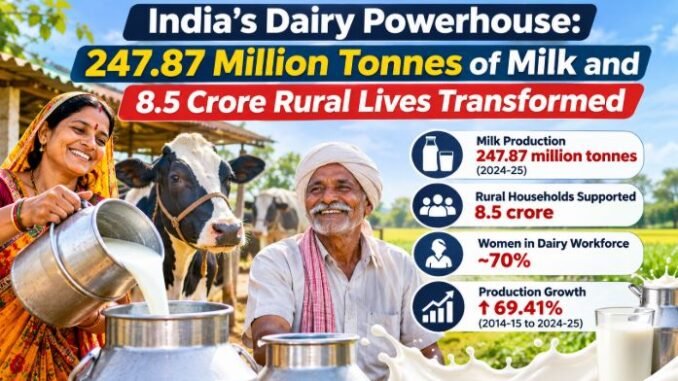
India’s dairy sector is doing more than keeping the country supplied with milk. It is supporting millions of rural livelihoods, creating opportunities for women and strengthening the country’s position in the global agricultural economy. With milk production reaching 247.87 million tonnes in 2024-25, India continues to lead the world as its largest milk producer.
As the country prepares to celebrate National Milk Day on November 26, the latest figures highlight the scale of the transformation. Milk production has increased by 69.41% over the past decade, rising from 146.31 million tonnes in 2014-15. The sector recorded an annual compound growth rate of 5.41% during this period.
The impact reaches far beyond production figures. Dairying provides livelihoods to approximately 8.5 crore rural households, making it an important source of income and economic activity in villages. Women account for nearly 70% of India’s dairy workforce, reflecting their central role in milk production and collection.
Rising production strengthens India’s dairy leadership
India’s growing milk output has been accompanied by improvements in availability and productivity. Per capita milk availability increased from 319 grams per person per day in 2014-15 to 485 grams in 2024-25.
Average bovine milk productivity also rose significantly, reaching 2,800 kilograms per animal annually in 2024-25, compared with 1,640 kilograms a decade earlier.
Uttar Pradesh leads milk production among Indian states, contributing 15.66% of national output. Rajasthan follows with 14.82%, while Madhya Pradesh, Gujarat and Maharashtra contribute 9.12%, 7.78% and 6.71%, respectively. Together, these five states account for 54.09% of the country’s milk production.
Cooperatives connect farmers with organised markets
Behind India’s dairy growth is an extensive cooperative network that links village-level producers with milk processing, procurement and marketing systems.
The country’s dairy cooperative structure includes 22 milk federations, 241 district cooperative milk unions and 28 marketing dairies. It covers approximately 2.45 lakh villages and has around 1.65 crore dairy farmers as members.
As of October 31, 2026, dairy cooperatives were procuring 690.90 lakh kilograms of milk per day and selling 462.95 lakh litres of liquid milk daily. These institutions provide farmers with organised channels to sell their produce, while many use automated collection and payment systems to transfer payments directly into farmers’ bank accounts.
Women take a leading role in dairy businesses
Women’s participation is becoming increasingly visible through farmer-owned Milk Producer Organisations. The National Dairy Development Board’s subsidiary, NDDB Dairy Services, has established 25 such organisations.
Notably, 18 of these organisations have exclusively women members, with women also serving as producer directors on their boards. Across all 25 organisations, more than 13 lakh milk producers are covered in 175 districts across 12 states. Women make up around 78% of the producers, and the organisations collectively procure approximately 70 lakh litres of milk each day.
This model aims to give producers stronger market connections, transparent pricing and direct bank payments.
White Revolution 2.0 aims to expand the cooperative network
The next phase of India’s dairy development is focused on bringing more villages into the organised cooperative system. White Revolution 2.0 aims to increase milk procurement by dairy cooperatives by 50% over five years.
By 2028-29, the initiative targets the establishment of 75,000 new dairy cooperative societies and the strengthening of 46,422 existing societies. As of October 31, 2026, 24,097 new societies had been formed and 31,394 existing societies strengthened.
The initiative also promotes more sustainable dairy practices, including the conversion of cattle dung and agricultural residues into biogas, organic manure and bio-fertilisers.
Investment in infrastructure, breeding and animal healthcare
Improving productivity requires more than increasing the number of animals. Infrastructure, scientific breeding, quality feed and accessible veterinary services are also important to the sector’s long-term growth.
The National Programme for Dairy Development has supported the organisation or revival of 40,800 dairy cooperative societies. It has also helped create milk chilling capacity of 168 lakh litres per day and supported the distribution of 94,000 milk quality testing devices.
Under the Rashtriya Gokul Mission, 50,023 rural artificial insemination technicians have been trained and equipped, while 24 in-vitro fertilisation laboratories have been established.
Animal healthcare is another priority. As of October 31, 2026, 4,019 Mobile Veterinary Units were operational across 29 states and Union Territories. They had provided doorstep services to around 1.5 crore farmers and treated approximately 3.3 crore animals.
Investment in processing is also expanding. Under the Animal Husbandry Infrastructure Development Fund, 258 dairy processing plants have received support, helping leverage investment of approximately Rs 21,797 crore.
Indian dairy products reach international markets
India’s dairy industry is also strengthening its presence in overseas markets. During 2025-26, the country exported 97,524.82 metric tonnes of dairy products, generating export earnings of USD 407.12 million.
The United Arab Emirates, Saudi Arabia, the United States, Bhutan and Bahrain were among the major destinations for Indian dairy products.
National Milk Day celebrates the people behind the White Revolution
Observed on November 26, National Milk Day marks the birth anniversary of Dr. Verghese Kurien, widely remembered as the Father of India’s White Revolution. His contribution to the cooperative dairy movement helped transform the country’s milk economy and place farmers at the centre of organised dairy development.
India’s position as the world’s largest milk producer reflects decades of work by farmers, cooperatives and dairy institutions. The next challenge will be to ensure that rising production translates into better returns for producers, stronger infrastructure, improved animal health and sustainable rural businesses.
As National Milk Day approaches, the country’s dairy story is ultimately about more than milk production. It is about the millions of farming households whose work supports India’s nutrition, rural economy and global dairy leadership.
