
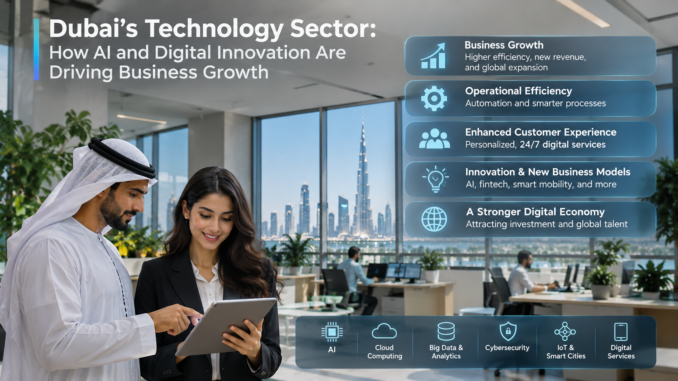
Nov 25: Dubai’s technology sector is entering an exciting phase of growth. Artificial intelligence (AI), smart infrastructure, fintech and automation are becoming important parts of the emirate’s economic development, creating opportunities for startups, established companies and international investors.
Dubai is no longer looking at technology simply as a way to modernise public services. It is increasingly using digital innovation to improve business operations, develop infrastructure and attract investment. Recent initiatives, including the Dubai State of AI Report 2026, the Chamber AI Hub and the expansion of smart-city projects, highlight how these ambitions are taking shape.
For businesses, this transformation offers opportunities across software development, AI integration, cloud computing, cybersecurity, financial technology and data analytics. It also strengthens Dubai’s position as a potential base for technology companies looking to reach customers across the Middle East and international markets.
Dubai’s AI Strategy Moves from Planning to Practical Applications
Artificial intelligence is becoming one of the main drivers of Dubai’s digital transformation. Government organisations are increasingly using AI to improve administrative processes, support decision-making and deliver services more efficiently.
The Dubai State of AI Report 2026, released on November 20 by Digital Dubai in partnership with Dubai Future Foundation, reports that more than 90 AI applications are operating across 20 government entities.
The development reflects a shift in focus. Rather than concentrating only on testing new technologies, Dubai is placing greater emphasis on how AI can deliver measurable improvements to public services and everyday operations.
For businesses, this creates opportunities in AI integration, software development, data management and technology consulting. Companies can also explore AI applications in customer service, marketing, administration and business analytics.
The growing use of AI across government and industry could encourage more private businesses to adopt digital solutions and improve their productivity.
Agentic AI Opens New Possibilities for Dubai Businesses
One of the emerging developments in Dubai’s technology ecosystem is agentic AI. Unlike conventional AI tools that mainly respond to questions or generate content, agentic AI systems can carry out connected tasks and support multi-step workflows within defined limits.
In October 2026, Dubai Chamber of Digital Economy signed partnerships with Nebius Academy and Lovable to encourage agentic AI adoption across the private sector. The initiative aims to equip 14,000 companies with the knowledge and skills required to use these technologies.
Another important development was the launch of the Chamber AI Hub on October 27. The marketplace introduced 22 specialised AI agents across seven business functions, including finance, procurement, sales, human resources, logistics, compliance and operations. The platform is expected to expand to 100 AI agents.
These developments could make advanced automation more accessible, particularly for small and medium-sized enterprises (SMEs).
For example, a smaller company could use AI agents to manage routine customer enquiries, organise internal workflows or support administrative tasks without having to build every solution from scratch.
Technology startups could also benefit by developing specialised AI applications for particular industries. However, businesses will need to consider data protection, accuracy and human oversight before relying on automated systems for important decisions.
Smart Infrastructure Is Changing How Dubai Develops
Dubai’s technology ambitions extend beyond software and business applications. The emirate is also using digital tools to improve urban planning, infrastructure management and public services.
A notable example is the Dubai Digital Twin Platform, which creates a digital representation of the city’s physical environment. It brings together information about buildings, infrastructure, public facilities and other urban assets.
The platform’s third phase includes three-dimensional models of more than 195,000 buildings, over 280,000 infrastructure assets and more than 330,000 public facilities and assets. It also incorporates more than 1,500 geospatial data layers and over 100 applications.
The technology can help authorities assess infrastructure requirements, examine development plans and understand how different parts of the city may respond to future changes.
For businesses, this creates opportunities in construction technology, engineering software, geospatial services, data analytics and infrastructure management.
Companies developing digital mapping, simulation and monitoring solutions could find growing demand as urban development becomes more dependent on connected data systems.
AI Is Reshaping Dubai’s Transportation Sector
Transportation is another area where Dubai is putting artificial intelligence to practical use.
On November 1, 2026, Dubai’s Roads and Transport Authority announced an updated AI strategy covering 41 areas across its departments and operations. The strategy includes plans to develop 40 AI products and targets more than AED 300 million in annual added value over a two-and-a-half-year implementation period.
The authority also aims to transition 50% of its operations and services towards an agentic AI ecosystem. Its priorities include improving traffic management, customer services, transport planning and operational efficiency.
These developments show how AI can support large-scale infrastructure rather than simply automate routine office tasks.
For technology companies, the initiative could create opportunities in mobility software, predictive analytics, intelligent transport systems and connected infrastructure.
As Dubai continues to expand its transportation network, digital solutions that improve traffic flow, service delivery and resource management could become increasingly valuable.
Fintech and Digital Payments Strengthen Dubai’s Digital Economy
Dubai’s technology development is also influencing its financial services industry. Digital payments, online banking, financial management platforms and cross-border payment solutions are changing how businesses and consumers handle transactions.
For retailers and e-commerce companies, digital payment systems can make transactions easier and improve the customer experience. Fintech providers are also developing solutions that help businesses manage payments, access financial tools and handle international transactions.
Dubai’s cashless strategy has supported the wider shift towards digital transactions, with a target of achieving 90% cashless transactions across government and private sectors by 2026.
This creates opportunities for fintech startups, payment technology providers and financial software developers.
As more transactions move online, businesses will also need secure payment systems, effective fraud prevention and reliable customer data protection. Maintaining trust will be essential as financial services become increasingly digital.
Cloud Computing and Data Centres Support Technology Growth
The expansion of AI and digital services depends on reliable computing infrastructure. Cloud platforms and data centres provide the processing capacity, storage and connectivity needed to support modern businesses.
Companies are increasingly using cloud-based systems to manage customer information, run applications, collaborate with employees and analyse business data. The growth of AI applications is adding to the demand for computing resources and secure digital infrastructure.
This creates opportunities for cloud service providers, software developers, data management companies and businesses offering infrastructure support.
For SMEs, cloud computing can make advanced digital capabilities more accessible. Instead of maintaining expensive in-house systems, businesses can use scalable services that grow alongside their operations.
As digital adoption increases, demand for cloud migration, infrastructure management and data security solutions could also expand.
Cybersecurity Becomes Essential for Digital Businesses
Greater digital adoption brings greater exposure to cyber risks. Businesses now depend on online platforms for payments, customer information, communication and everyday operations. A cyberattack can interrupt these activities, create financial losses and damage customer confidence.
Smaller companies may face additional challenges because they often lack dedicated cybersecurity teams and large technology budgets.
This creates opportunities for businesses offering cloud security, identity management, threat detection, data protection and cybersecurity consulting.
For companies operating in Dubai, security needs to become part of their digital transformation plans from the beginning. Protecting business information and maintaining customer trust will be important as organisations adopt more connected systems.
Dubai’s Startup Ecosystem Attracts Technology Entrepreneurs
Dubai’s expanding digital economy is creating opportunities for entrepreneurs and international companies looking to establish or grow their technology operations.
The Dubai Chamber of Digital Economy supported the establishment and expansion of 1,690 digital startups in 2025, representing year-on-year growth of 39.7%. Invest in Dubai’s technology and ICT sector overview also identifies more than 2,300 technology companies in the emirate.
The opportunities extend across AI, fintech, cloud computing, software development, robotics, digital commerce and smart infrastructure.
Dubai’s business environment also offers an important regional advantage. Companies can use the emirate as a base to build partnerships, connect with investors and explore customers across the wider Middle East, Africa and international markets.
For overseas technology businesses, this connectivity can make Dubai an attractive location for regional operations. However, successful expansion requires an understanding of local regulations, customer expectations and industry requirements.
Startups will also need to demonstrate that their products solve genuine business problems and offer a clear commercial advantage.
Challenges That Could Influence Dubai’s Technology Growth
Despite the opportunities, Dubai’s technology expansion will bring practical challenges.
The demand for skilled professionals in AI, software development, data science and cybersecurity is likely to increase. Companies will need to attract talent and invest in employee training to keep pace with changing technology requirements.
The cost of developing and maintaining advanced digital infrastructure can also be significant, particularly for startups and smaller businesses.
Data privacy, cybersecurity and responsible AI use will become increasingly important as organisations rely on automated systems. Businesses will need to establish appropriate safeguards and clear accountability.
Another challenge is ensuring that technology investments deliver measurable results. Companies must look beyond adopting new tools and focus on whether these solutions improve productivity, reduce operating costs or create better customer experiences.
The Future of Dubai’s Technology Sector
Dubai’s technology sector is moving towards a more connected business environment in which AI, automation and digital infrastructure support multiple industries.
The expansion of government AI applications, the Chamber AI Hub, the Digital Twin Platform and the Roads and Transport Authority’s updated AI strategy show how technology is becoming part of everyday operations.
For businesses, the next phase could bring opportunities in agentic AI, enterprise automation, fintech, cybersecurity, cloud computing and smart mobility.
The growing focus on practical AI adoption could be particularly important for SMEs. Access to specialised tools may help smaller companies improve productivity and compete more effectively without making the same level of technology investment as larger organisations.
Dubai’s position as an international business centre also gives technology companies an opportunity to develop regional operations and explore markets beyond the emirate.
The long-term success of this transformation will depend on attracting skilled professionals, encouraging innovation and ensuring that new technologies deliver real value to businesses and residents.
Conclusion
Dubai’s technology transformation is becoming increasingly visible across government services, transportation, financial services and urban infrastructure. AI is moving beyond pilot projects, businesses are gaining access to specialised automation tools, and digital platforms are helping the city manage its growing infrastructure.
For entrepreneurs and technology companies, this creates opportunities across AI development, fintech, cloud computing, cybersecurity and smart-city solutions.
More importantly, Dubai is building an ecosystem in which technology companies can develop solutions, work with established businesses and explore opportunities across regional markets.
As the emirate continues to strengthen its position as a global technology hub, its ability to turn digital innovation into practical business results will play an important role in shaping its future economic growth.
