
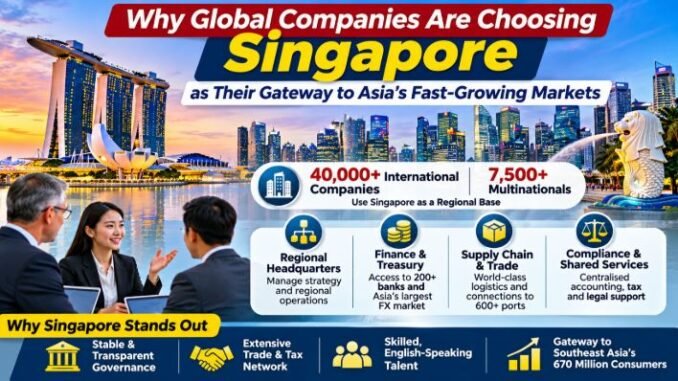
Singapore is becoming much more than an attractive destination for international investment. For thousands of global businesses, the city-state has evolved into a strategic headquarters from which they coordinate regional operations, manage financial activities and explore opportunities across Asia.
More than 40,000 international companies, including over 7,500 multinational corporations, use Singapore as a regional base. Its appeal lies in a combination of strategic location, reliable infrastructure, transparent governance, financial services and access to international markets.
As businesses look towards Asia for their next phase of growth, Singapore is increasingly serving as the central point from which they manage expansion across multiple countries.
Singapore’s role as a regional business headquarters
International companies operating across Southeast Asia often face different regulatory systems, business practices, tax structures and customer markets. Managing these operations independently can increase costs and create administrative challenges.
Singapore offers an alternative through the regional headquarters model. Companies can centralise important business functions in the city-state while maintaining local offices in countries where they manufacture, sell products or provide services.
Under this hub-and-spoke approach, regional management teams oversee strategy, finance, compliance, technology and business planning. Local teams focus on customers, partnerships, distribution and day-to-day operations.
This structure allows companies to maintain regional oversight without losing their understanding of individual markets.
For businesses targeting Southeast Asia, the opportunity is significant. The region has a population of approximately 670 million people and is supported by expanding consumer markets, investment and digital adoption.
Financial services make Singapore attractive to multinational companies
Finance is one of the most important reasons international businesses establish regional operations in Singapore.
The city-state has developed into a major financial centre, providing access to international banking, foreign exchange, wealth management, capital markets and treasury services. Its financial ecosystem includes more than 200 banks, supporting the needs of multinational corporations and regional businesses.
Companies use Singapore-based financial teams to manage cash flow, coordinate cross-border payments, oversee regional budgets and monitor financial risks.
Having these functions in one location can improve financial visibility and reduce the need to duplicate administrative operations across several countries.
Singapore’s established financial regulations and growing fintech ecosystem also support businesses looking to modernise payments and financial management.
Strategic location strengthens trade and supply-chain operations
Singapore’s geographical position gives international companies access to major Asian markets and global shipping routes. Its port connects with more than 600 ports across 120 countries, while Changi Airport provides connections to hundreds of cities worldwide.
This connectivity makes the city-state an important centre for logistics, distribution and supply-chain coordination.
A multinational company, for example, can manage regional procurement from Singapore, source components from Indonesia, oversee manufacturing in Vietnam and coordinate distribution across other Asian markets.
Singapore’s logistics infrastructure and international trade connections help businesses manage these activities more efficiently.
For companies dealing with complex supply chains, reliable transport links and access to international markets can be important advantages when choosing a regional headquarters.
Stable governance and a transparent business environment
Beyond location and infrastructure, Singapore’s regulatory environment is another major factor behind its international appeal.
Businesses operating across different Asian markets must navigate varying legal requirements, tax rules and compliance standards. Singapore offers a well-established legal system, predictable regulations and strong contract enforcement.
Its reputation for transparent governance and investor protection gives international companies greater confidence when making long-term business decisions.
The city-state also maintains an extensive network of free trade agreements and tax treaties. These arrangements can help businesses manage cross-border trade and investment, although the benefits depend on the relevant agreement and each company’s circumstances.
For multinational corporations, this combination of regulatory clarity and international connectivity makes Singapore a practical base for regional decision-making.
Shared services help companies control operational costs
Singapore is also attracting regional finance, accounting, human resources, legal, tax and technology functions.
Rather than maintaining separate administrative teams in every market, companies can centralise selected services in Singapore and provide support to their regional offices.
This approach can improve reporting standards, strengthen internal controls and reduce duplicated work.
Regional shared-service centres also help companies coordinate compliance requirements and maintain consistent operating procedures across different markets.
However, businesses must still meet local legal and regulatory obligations in every country where they operate. A Singapore headquarters does not remove the need for local expertise.
Talent and innovation support regional expansion
Singapore’s skilled, English-speaking workforce is another important advantage for international businesses.
The city-state has developed strong capabilities in financial services, technology, advanced manufacturing, professional services and logistics. Companies can access regional management talent, technical specialists and business professionals while benefiting from an established innovation ecosystem.
Its position as a technology and financial centre also makes it attractive to businesses exploring digital services, fintech, artificial intelligence and advanced manufacturing.
For international companies, Singapore can serve as both an operational headquarters and a platform for testing new business models before expanding them into other Asian markets.
What makes Singapore important for Asia’s business future?
Asia’s growing economic importance is encouraging global companies to reconsider how they organise their regional operations. The region’s combined GDP exceeded $40 trillion in 2024, accounting for nearly half of global economic output, while Southeast Asia contributed more than $4 trillion.
This expanding economic landscape creates opportunities across manufacturing, financial services, technology, logistics and consumer markets.
Singapore is well positioned to benefit from this growth because it combines international connectivity with a stable business environment. Its role is not simply to attract companies to operate within its borders, but also to help them coordinate activities across a much wider region.
Nevertheless, regional expansion requires more than a headquarters in Singapore. Companies must understand local consumer demand, employment rules, tax obligations and regulatory conditions in each target market.
Singapore’s business-hub advantage continues to grow
The growing presence of multinational corporations reflects Singapore’s importance in the international business landscape. Its financial services, trade infrastructure, legal framework and professional workforce make it an attractive location for companies seeking to manage complex regional operations.
As competition for investment and business activity increases across Asia, Singapore’s ability to connect global companies with regional opportunities will remain an important part of its economic appeal.
For international businesses planning their next stage of expansion, the city-state offers a strategic starting point: a central base for managing operations while reaching some of the world’s most dynamic markets.
