
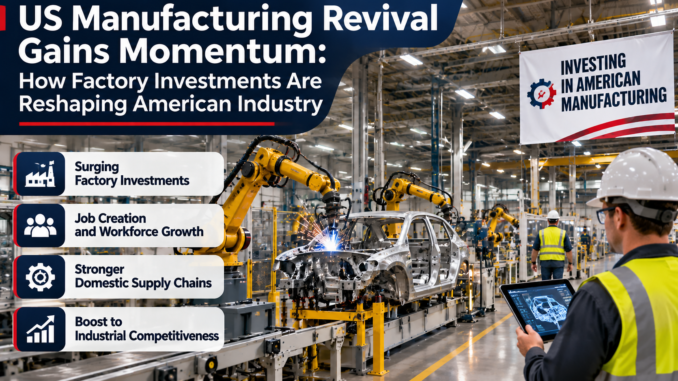
Nov 26: The United States is seeing renewed investment in domestic manufacturing as companies expand production facilities, strengthen supply chains and reassess their dependence on overseas suppliers. From electrical equipment and steel to automotive components, semiconductors and pharmaceuticals, businesses are showing growing interest in building production capacity within the country.
The trend reflects a wider shift in industrial strategy. Supply-chain disruptions, geopolitical uncertainty, rising demand for advanced technologies and the need for reliable infrastructure are encouraging companies to reconsider where and how they manufacture their products.
The National Institute of Standards and Technology’s (NIST) November 2026 report, U.S. Manufacturing Trends, Performance, and Competitiveness: Annual Report on the Manufacturing Economy, provides a useful assessment of this changing landscape. The report examines the performance of American manufacturing against international competitors, domestic industry trends and opportunities to strengthen national manufacturing competitiveness.
The Reshoring Initiative’s 2025 Annual Report offers another indication of the investment momentum. It recorded approximately 247,000 announced US manufacturing jobs linked to reshoring and foreign direct investment during 2025. These developments suggest that domestic manufacturing is becoming an important consideration in long-term business planning.
Reshoring Brings Manufacturing Back to the US
One of the major forces behind the manufacturing revival is reshoring, which involves bringing production activities back to the United States. Companies that previously relied on overseas manufacturing are increasingly evaluating the benefits of producing closer to their customers.
Supply-chain disruptions, geopolitical tensions, transportation costs and changing trade policies have encouraged businesses to reconsider their international production networks. Domestic manufacturing can provide greater control over production schedules, improve supply-chain visibility and reduce exposure to certain overseas disruptions.
According to the Reshoring Initiative’s 2025 Annual Report, domestic reshoring accounted for approximately 153,000 of the 247,000 announced manufacturing jobs recorded during the year. Foreign direct investment contributed another 94,000 announced jobs.
The report also projected approximately 309,000 manufacturing job announcements for 2026 based on activity during the first half of the year. This represents a potential increase of 25% over 2025, rather than a confirmed final employment figure.
The report identified transportation equipment, computer and electronic products, chemicals and electrical equipment among the leading industries contributing to announced manufacturing employment.
For businesses, the shift is about more than relocating factories. It involves creating production networks that can respond more quickly to customer demand while reducing exposure to international supply-chain uncertainty.
Major Factory Investments Strengthen Industrial Capacity
The growing interest in domestic manufacturing is visible through investments in facilities that produce essential industrial equipment.
A notable example is Hitachi Energy’s September 2026 announcement of a $528 million investment in a new transformer manufacturing facility in Gallman, Mississippi. The project is expected to create more than 700 jobs and increase the company’s US production capacity for critical power-grid equipment. Production at the new facility is scheduled to begin in 2029.
The investment is significant because electricity demand is increasing across several parts of the economy. Data centres, advanced manufacturing facilities, industrial electrification and infrastructure modernisation all require reliable power systems. Transformers are essential components in transmitting and distributing electricity, making domestic production capacity particularly important.
Hitachi Energy also identified additional investments in the United States, including a $457 million expansion of its large power transformer facility in South Boston, Virginia. That project is expected to create approximately 825 long-term jobs.
These projects demonstrate how manufacturing investment is extending beyond traditional consumer products. Electrical equipment, industrial machinery and infrastructure-related components are becoming important areas of expansion.
AI and Automation Are Changing the Factory Floor
The future of American manufacturing will depend not only on how many factories are built but also on the technologies used to operate them.
Artificial intelligence, robotics and industrial automation are changing how manufacturers manage production. Businesses are adopting digital systems to monitor machinery, identify operational problems, improve quality control and reduce downtime.
AI-powered tools can analyse production data, forecast equipment maintenance requirements and support more efficient inventory management. Automated machinery can improve consistency in repetitive tasks and help manufacturers increase output.
The expansion of artificial intelligence infrastructure is creating additional demand for semiconductors, electronic components, cooling systems, power equipment and specialised machinery. As data centre investment grows, manufacturers supplying these products could benefit from increased demand.
This creates opportunities beyond factory operators. Technology providers, engineering companies, automation specialists and industrial software businesses could all become important participants in the changing manufacturing ecosystem.
Automotive, Electronics and Pharmaceuticals Support Industrial Growth
Several strategically important industries are contributing to the renewed focus on domestic production.
The automotive sector remains an important part of the US manufacturing landscape. Vehicle manufacturers and component suppliers are adapting to changes in vehicle technology, including electric mobility, advanced electronics and connected systems.
Semiconductors and electronic components are also becoming increasingly important. They are required for automobiles, telecommunications equipment, data centres, industrial machinery and consumer technology.
Pharmaceutical manufacturing is another area receiving attention as companies and policymakers look to strengthen domestic production capabilities. Greater local capacity for medicines and specialised healthcare products could help reduce dependence on overseas suppliers and improve supply security.
The Reshoring Initiative’s 2025 report provides a useful picture of the industries attracting manufacturing-related employment announcements. Transportation equipment accounted for nearly 48,800 announced jobs, followed by computer and electronic products with approximately 44,900. Chemicals, including pharmaceuticals, contributed around 37,300.
These figures underline the importance of technology-intensive and strategically significant industries in the reshoring movement.
Skilled Labour and Infrastructure Remain Major Challenges
Despite the investment announcements, expanding American manufacturing will require more than capital. Companies must ensure that new facilities have access to skilled employees, reliable infrastructure and competitive operating conditions.
The NIST 2026 manufacturing economy report examines the factors influencing US industrial competitiveness and identifies approaches to strengthening the country’s position in global manufacturing. Its analysis reinforces the importance of improving productivity, directing investment towards competitive industries and developing the capabilities required for advanced production.
Workforce availability remains a significant consideration. Modern manufacturing requires employees with expertise in robotics, electrical systems, industrial maintenance, engineering and digital production technologies. Companies may need to work more closely with technical institutions and training providers to develop the skills required by new facilities.
Energy availability is another important factor. Large factories, semiconductor facilities and data centres require reliable electricity. As industrial demand grows, regional power infrastructure will need to keep pace.
Manufacturers must also consider labour expenses, equipment prices, raw material availability and financing costs. Domestic production can offer supply-chain advantages, but businesses still need to ensure that their operating costs remain competitive.
Trade policy and regulatory uncertainty can further complicate investment decisions, particularly for companies operating across international markets. Greater predictability will help businesses make long-term commitments and plan expansion projects with confidence.
Opportunities for Suppliers and Small Businesses
The expansion of manufacturing can benefit companies beyond those directly operating factories.
Industrial equipment suppliers, construction firms, logistics providers, engineering consultancies and technology companies may see increased demand as new facilities are developed. Manufacturers also require packaging, maintenance, testing, software and specialised components to keep production running.
This creates opportunities for small and medium-sized businesses to become part of larger industrial supply chains. Companies that can meet quality standards, deliver consistently and provide specialised services may find new business opportunities through partnerships with major manufacturers.
International businesses could also explore opportunities to supply components, provide technical services or establish partnerships with US-based producers. However, entering the market requires a clear understanding of local regulations, sourcing requirements and customer expectations.
Can the Manufacturing Revival Deliver Long-Term Growth?
The renewed interest in American manufacturing reflects a significant change in business priorities. Companies are increasingly considering supply-chain resilience, domestic production capacity and access to advanced technologies when deciding where to invest.
However, announced investments and projected employment figures do not automatically translate into completed factories or sustained production growth. The long-term success of the manufacturing revival will depend on whether companies can bring projects into operation and maintain commercially competitive production.
Workforce development, reliable energy supplies, modern infrastructure and access to essential components will all influence the outcome.
For now, the investment momentum signals a renewed commitment to strengthening the American industrial base. If companies can convert their plans into sustainable production capacity, the manufacturing revival could reshape the country’s industrial economy and create opportunities across the wider business ecosystem.
