
Buying a home is a major financial decision for most families. Many people depend on home loans to turn this dream into reality, often committing to monthly repayments for 15 to 25 years. During this period, changes in interest rates can affect how much they pay every month and how long it takes to repay the loan.
One important factor that influences home loan interest rates is the Reserve Bank of India’s (RBI) repo rate. When the RBI increases or reduces this rate, banks may change the interest rates on floating-rate home loans. This can increase or reduce the monthly EMI, depending on the lender’s policy.
What Is the Repo Rate?
The repo rate is the interest rate at which the RBI lends money to commercial banks. It is an important tool used by the central bank to control inflation and manage the flow of money in the economy.
When the RBI increases the repo rate, borrowing becomes more expensive for banks. They may pass on the higher cost to customers by increasing lending rates. When the RBI reduces the rate, banks may lower their lending rates, making loans more affordable.
How a Repo Rate Hike Affects Your EMI
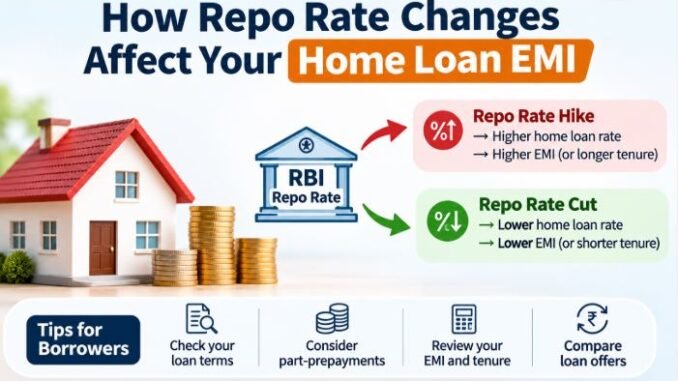
When the RBI raises the repo rate, borrowers with floating-rate home loans may have to pay a higher interest rate. As a result, their monthly EMI may increase or the loan repayment period may become longer.
For example, consider a person who has taken a home loan of ₹30 lakh for 20 years at an interest rate of 7.50%. The monthly EMI would be approximately ₹24,168.
If the interest rate increases to 7.75%, the EMI would rise to around ₹24,628, assuming the loan amount and repayment period remain unchanged. This means the borrower would pay approximately ₹460 more every month.
Although the increase may seem small, it can add to the financial burden over time.
What Happens When the Repo Rate Falls?
A reduction in the repo rate can bring relief to home loan borrowers. If banks pass on the benefit by lowering their lending rates, monthly EMIs may come down.
In some cases, lenders may keep the EMI unchanged and reduce the loan tenure instead. This allows borrowers to repay their loans earlier and save on total interest.
Does Every Home Loan Get Affected?
The impact of repo rate changes depends on the type of home loan.
- Repo-linked floating-rate loans: Interest rates are linked to an external benchmark, such as the RBI repo rate, and are revised according to the lender’s reset schedule.
- MCLR or Base Rate loans: Changes may take longer to reflect in the borrower’s interest rate.
- Fixed-rate loans: Interest rates generally remain unchanged during the agreed fixed-rate period.
Borrowers should check their loan agreements to understand the benchmark, interest rate and revision schedule.
How to Manage Changes in Home Loan Interest Rates
Borrowers can take a few practical steps to manage changes in their EMIs.
Check your loan terms: Know whether your loan is linked to the repo rate, MCLR or another benchmark. Also understand when your lender revises the interest rate.
Make part-prepayments: If you have extra savings, consider paying a part of the outstanding loan amount. This reduces the principal and can lower the total interest burden.
Review your EMI: If interest rates increase, check whether you can afford a slightly higher EMI. This may help prevent the loan tenure from becoming too long.
Compare loan offers: If another bank offers a lower interest rate, consider a home loan balance transfer. However, compare processing fees and other charges before making a decision.
Keep emergency savings: Maintaining an emergency fund can help you continue paying your EMIs during unexpected financial difficulties.
Impact on the Real Estate Market and Businesses
Changes in the repo rate affect more than individual homebuyers. They also influence the real estate market and businesses connected to the housing sector.
When interest rates rise, home loans become more expensive. Some buyers may delay purchasing a property or choose a smaller home. This can affect housing demand and property sales.
Real estate developers may also face challenges if fewer people are willing to purchase homes. Lower sales can affect project cash flow, construction activity and businesses supplying cement, steel, electrical products and other building materials.
On the other hand, when interest rates fall, home loans may become more affordable. This can encourage people to buy houses, support property sales and create more opportunities for developers, construction companies and housing finance businesses.
Banks and housing finance companies are also affected because changes in interest rates influence loan demand, repayment capacity and their lending business.
Plan Your Home Loan Wisely
Repo rate changes are an important part of the economy, but their impact is felt in everyday life, particularly by families repaying home loans. A small increase in interest rates can raise monthly expenses, while a reduction can offer some financial relief.
Borrowers should regularly review their loan details, understand how interest rate changes affect their repayments and plan their budgets accordingly. With careful financial planning, they can manage changing EMIs and continue working towards their goal of owning a home.
