
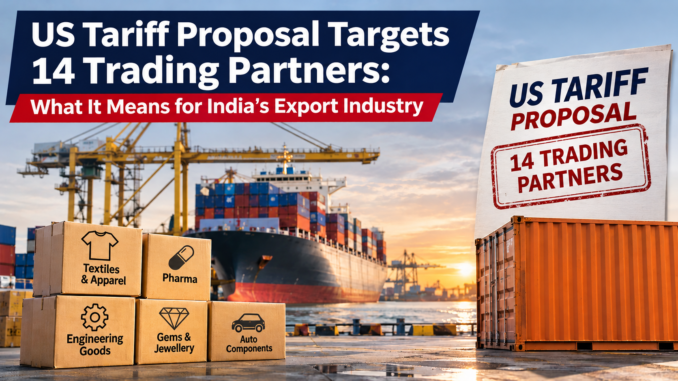
Nov 26: India’s export industry is facing fresh uncertainty after the United States proposed new tariffs on imports from 14 trading partners, including India. Announced on November 25, 2026, the proposal follows a US investigation into manufacturing capacity and industrial policies that Washington believes are affecting the competitiveness of American businesses.
The development is significant for India because the United States remains its largest export destination. According to the India Brand Equity Foundation (IBEF), India’s exports to the US reached US$87.31 billion in FY2025–26, while bilateral trade stood at approximately US$140.79 billion. Electronic goods, engineering products, pharmaceuticals, gems and jewellery and readymade garments were among India’s major exports to the American market.
Under the latest proposal, Indian goods could face tariffs of up to 25%, subject to specified exemptions and the treatment of existing duties. The US has also proposed considering a lower rate of 17% if India reaches a qualifying Agreement on Reciprocal Trade with Washington.
The proposal has not yet become a final tariff measure. Nevertheless, it puts the spotlight on India’s export competitiveness, bilateral trade negotiations and the decisions manufacturers may need to make as they plan for 2027.
Why Is the US Considering New Tariffs?
The proposed tariffs follow an investigation under Section 301 of the US Trade Act of 1974. This provision allows the US government to examine foreign trade practices that it considers unreasonable or discriminatory and that may restrict American commerce.
The Office of the United States Trade Representative (USTR) has focused its investigation on what it describes as structural excess manufacturing capacity and production practices that contribute to global oversupply.
According to the US government’s findings, industrial policies, manufacturing incentives and other practices in certain economies can encourage production beyond market demand. Washington argues that this can put pressure on international prices and make it harder for American manufacturers to compete.
The 14 economies covered by the latest determinations are India, China, the European Union, Singapore, Switzerland, Indonesia, Malaysia, Cambodia, Thailand, South Korea, Vietnam, Taiwan, Bangladesh and Japan.
The US government has proposed different tariff rates for these economies. For India, the proposed rate is up to 25%, with the possibility of considering a 17% rate if a qualifying trade agreement is reached.
These findings reflect the US government’s position in the investigation. India has presented a different view, arguing that its manufacturing incentives are intended to strengthen domestic capabilities and reduce dependence on external suppliers.
How Could the Proposal Affect Indian Exporters?
If implemented, the proposed duties could increase the cost of importing certain Indian products into the US. The extent of the impact would depend on product classification, applicable exemptions and the treatment of existing duties.
American importers could respond by absorbing some of the additional cost, negotiating lower prices with suppliers or considering alternative sourcing destinations. Each possibility could affect Indian exporters’ margins, order volumes and long-term commercial relationships.
Businesses with significant exposure to the US market may also need to review contracts and pricing arrangements for 2027. Exporters operating on tight margins could face particular pressure if buyers seek to renegotiate prices.
However, the proposed 25% rate should not be interpreted as a universal additional duty on top of every existing US tariff. The USTR notice specifies that the proposed rate would be calculated net of existing Section 301 tariffs and includes exemptions for certain products.
For companies, understanding the product-level details will be more important than relying on the headline tariff percentage alone.
Which Indian Export Industries Should Watch the Development?
The possible impact will vary across industries. India’s export profile shows that several major sectors have significant commercial exposure to the US market.
Electronics and Engineering Goods
Electronics and engineering products are among India’s largest export categories to the US. IBEF’s FY2025–26 trade data records electronic goods exports of US$24.41 billion and engineering goods exports of US$19.61 billion.
These industries include manufacturers supplying components, machinery, equipment and other products to American businesses.
Companies should examine whether their individual products fall within the proposed tariff coverage. The USTR notice identifies semiconductor articles among the proposed exemptions, but this should not be treated as a blanket exemption for all electronics or electrical equipment.
Engineering exporters will also need to check their specific tariff classifications. Businesses supplying industrial components and machinery may face different treatment depending on the products involved.
Textiles and Apparel
India’s textile and apparel industry has established relationships with American retailers, sourcing companies and distributors. Pricing, product quality and delivery reliability play an important role in maintaining these partnerships.
If the proposed duties apply to relevant textile and apparel products, Indian exporters could face additional pricing pressure. This may influence sourcing decisions, particularly when American buyers compare suppliers from India with those in Bangladesh, Vietnam and other manufacturing destinations.
The USTR has also invited comments on whether a mechanism should be introduced to allow a specified volume of textile and apparel imports to enter the US at a reduced tariff rate. This is an important development for Indian garment and home-textile businesses to monitor.
Gems and Jewellery
The US is an important market for India’s gems and jewellery industry. Exporters supply products to wholesalers, retailers and international distributors, often through established business relationships.
Any increase in import costs could influence pricing negotiations and purchasing decisions. Businesses may need to focus on design differentiation, product quality and supply-chain reliability to maintain their competitiveness.
Pharmaceuticals and Medical Products
India’s pharmaceutical industry has a substantial presence in the US market. IBEF records drugs and pharmaceutical exports to the US at US$9.47 billion in FY2025–26.
The proposed USTR exemptions include patented pharmaceutical articles. However, this does not mean that every medicine, generic drug or medical product is automatically exempt.
Companies should examine the exact product descriptions and applicable tariff classifications before assessing their exposure. Medical devices and other healthcare products also need to be evaluated separately.
Why the Proposed 17% Rate Matters for India-US Trade
The possibility of a 17% tariff rate makes the ongoing India-US trade negotiations particularly important.
The USTR has proposed considering this lower rate if India reaches an Agreement on Reciprocal Trade that addresses the concerns raised in the Section 301 investigation. This makes the final terms of any bilateral agreement important for exporters planning their next phase of growth in the American market.
A clearer trade framework could help businesses assess market-access conditions, plan investments and negotiate supply contracts with greater confidence.
However, the proposed 17% rate is conditional. It is not an already agreed reduction, and the final outcome will depend on the terms of any agreement and subsequent US decisions.
For Indian manufacturers, the difference between the two proposed rates could influence pricing decisions and the competitiveness of their products against suppliers from other countries.
How Indian Exporters Can Prepare
While the proposal is still under consideration, businesses can take practical steps to understand their exposure and prepare for different outcomes.
The first step is to review product classifications under the US Harmonized Tariff Schedule. Exporters should identify whether their goods fall within the proposed coverage, check the existing duties and examine the exemptions listed in the USTR notice.
Companies that depend heavily on American customers should also assess their revenue concentration. Exploring additional markets in Europe, Southeast Asia and the Middle East could help reduce dependence on a single destination.
Pricing strategies and supply agreements deserve attention as well. Exporters can review contract terms, discuss how potential tariff changes would be handled with buyers and evaluate different cost scenarios for future orders.
Improving operational efficiency is another important consideration. Investments in automation, quality control, inventory management and supply-chain planning can help businesses manage costs and maintain product competitiveness.
At the same time, exporters should avoid making major production or shipment decisions based solely on a proposal. Product-specific customs advice and regular monitoring of official announcements will be essential.
Could Other Export Markets Create New Opportunities?
Changes in US trade policy can influence international sourcing decisions. If importing certain products from India becomes more expensive, American buyers may explore alternative suppliers.
For Indian businesses, this highlights the importance of developing a broader international customer base. Markets in Europe, the Middle East and Southeast Asia may offer opportunities depending on product demand, trade agreements and regulatory requirements.
However, entering new markets requires more than identifying potential buyers. Exporters need to understand local certification standards, logistics costs, distribution networks and customer expectations.
The situation could also encourage manufacturers to focus on higher-value products, specialised production and stronger supply-chain partnerships. Improving quality, delivery reliability and product differentiation may help businesses compete even when international trade conditions become less predictable.
What Happens Next?
The USTR announcement marks a proposed action rather than the immediate introduction of new duties. The next stage involves public consultation and further consideration of the measures.
According to the official notice, written comments and requests to appear at the public hearings must be submitted by January 5, 2027. The hearings are scheduled to begin on January 25, 2027, at the US International Trade Commission in Washington, DC.
The consultation process will allow interested parties to submit views on product coverage, exemptions and possible adjustments to the proposed tariff rates.
Indian exporters should follow these developments closely, particularly any clarification concerning their specific products and the progress of India-US trade negotiations.
The Road Ahead for India’s Export Industry
The proposed US tariffs highlight how international trade policy can influence business decisions across manufacturing, logistics and global supply chains.
With Indian exports to the US reaching US$87.31 billion in FY2025–26, the stakes are considerable. The proposed 17% rate through a qualifying trade agreement offers one possible route towards greater clarity, while the proposed 25% ceiling creates a reason for businesses to assess their exposure.
For Indian exporters, the priority should be to understand the product-level implications, strengthen manufacturing efficiency and explore additional international markets. The outcome of the US consultation process and ongoing bilateral negotiations could shape India’s export opportunities in 2027 and beyond.
