
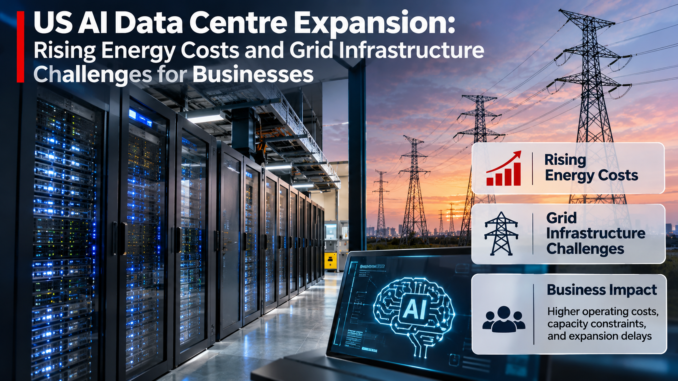
Nov 26: The rapid adoption of artificial intelligence (AI) in the United States is creating new opportunities for technology companies, infrastructure developers and investors. However, behind the growing investments in AI lies a major business challenge: the rising cost of electricity and the infrastructure required to support large-scale data centres.
AI data centres require enormous computing capacity to train advanced models, process information and support real-time applications. As a result, they consume significantly more electricity than many conventional data facilities. With technology companies expanding their AI operations, rising power demand is putting pressure on existing electricity networks and increasing the cost of developing and operating digital infrastructure.
For businesses, the challenge extends beyond electricity bills. Access to reliable power, grid connectivity, cooling systems and suitable locations is becoming central to investment decisions. The ability to manage these expenses could influence how quickly companies expand their AI infrastructure and how competitively they deliver digital services.
The Growing Demand for AI Is Increasing Electricity Consumption
The rapid adoption of generative AI, machine learning and cloud-based applications is changing the energy requirements of the technology industry. Training large AI models and operating advanced applications require powerful processors, high-performance servers and extensive data storage systems.
Unlike many conventional business facilities, data centres need to operate around the clock. Their electricity requirements also extend beyond computing equipment, as cooling systems and supporting infrastructure must remain operational to protect servers and maintain performance.
According to a 2025 update to the US Department of Energy-supported data centre energy research, American data centres consumed approximately 192 terawatt-hours (TWh) of electricity in 2024, accounting for around 4.7% of the country’s total electricity consumption. The report projects that data centre electricity consumption could reach 649 TWh by 2030 under its reference scenario, with the overall share of national electricity consumption potentially increasing to between 9.5% and 15.3%.
These projections highlight the growing importance of AI infrastructure in the American economy. However, they also raise questions about whether electricity generation and distribution systems can keep pace with the industry’s expansion.
Rising Energy Costs Could Affect Business Profitability
Electricity is one of the largest recurring expenses for companies operating large-scale data centres. As facilities become more powerful and computing workloads increase, managing energy consumption is becoming an important part of operational planning.
The challenge is particularly significant in regions where multiple data centre projects compete for electricity. Limited power availability, grid upgrades and the cost of securing additional capacity can influence the financial viability of new developments.
For cloud service providers and AI companies, higher infrastructure expenses could eventually affect service pricing and operating margins. Businesses that depend heavily on external computing services may also experience indirect cost increases.
This is encouraging companies to look beyond their initial investments in servers and computing equipment. Long-term electricity contracts, energy-efficient hardware and improved power management are becoming increasingly important considerations in business expansion decisions.
Grid Infrastructure Is Becoming a Major Bottleneck
Generating more electricity is only part of the solution. Power must also be transported through transmission and distribution networks capable of supporting the substantial requirements of modern AI data centres.
Many existing electricity networks require upgrades to accommodate the concentrated demand from large computing facilities. Transmission lines, substations and transformers may need additional capacity before new data centres can begin full-scale operations.
The growing concentration of data centres in major markets such as Northern Virginia has brought greater attention to electricity availability and grid capacity.
For developers, this creates another important consideration when selecting locations. Access to land, connectivity and favourable investment conditions may not be enough if the local electricity network cannot supply the required power.
Delays in grid connections can increase development expenses, disrupt project timelines and postpone revenue generation. Consequently, power availability is becoming a major factor in determining where the next generation of AI data centres will be built.
Cooling and Water Management Are Adding to Infrastructure Costs
The infrastructure requirements of AI data centres extend beyond servers and electricity connections. High-performance processors generate considerable heat, making effective cooling essential for uninterrupted operations.
Traditional cooling systems are increasingly being supplemented by liquid-cooling technologies and other advanced thermal management solutions. These systems can help manage the heat generated by high-density computing equipment, but they also involve additional installation and maintenance costs.
Water availability is another important consideration for developers using water-dependent cooling systems. In locations where resources are limited, companies must assess the environmental impact of their operations and the long-term availability of water.
These factors are making infrastructure planning more complicated. Businesses must balance computing performance, energy efficiency, cooling requirements and operating costs when developing new facilities.
Companies Are Exploring Alternative Energy Solutions
With electricity demand increasing, technology companies are exploring different ways to secure reliable power for their data centres.
Renewable energy agreements, particularly solar and wind power purchase agreements, are becoming an important part of corporate energy strategies. Such arrangements can help companies secure electricity over longer periods while supporting investment in renewable energy generation.
However, renewable sources are not continuously available. Battery storage, grid connections and dependable backup systems remain important for facilities that cannot afford interruptions.
Some technology companies are also exploring nuclear energy and advanced geothermal power as potential sources of reliable electricity. On-site generation and energy storage are additional options being considered by facilities facing limitations in local power supply.
These developments are creating new opportunities for renewable energy developers, power equipment manufacturers, engineering companies and businesses specialising in energy management.
What the Growing AI Infrastructure Market Means for Investors
The expansion of AI data centres is creating investment opportunities well beyond the traditional technology sector. Companies involved in electricity generation, power distribution, construction and energy management are becoming important participants in the AI infrastructure market.
Some emerging business opportunities include:
- Renewable energy: Solar and wind energy developers could benefit from growing demand for long-term electricity supply agreements.
- Battery storage: Energy storage companies can support data centre operators looking to improve power reliability and manage fluctuations in electricity supply.
- Electrical equipment: Manufacturers of transformers, switchgear, substations and power distribution systems could see increased demand.
- Cooling technologies: Businesses developing liquid cooling and energy-efficient thermal management systems could benefit from the expansion of high-performance computing.
- Infrastructure development: Engineering, construction and data centre development companies could find new opportunities as operators expand their facilities.
The US Energy Information Administration’s 2026 outlook also highlights the longer-term importance of this development. Its analysis projects that electricity consumption by data centre servers could reach between 446 billion and 818 billion kilowatt-hours by 2050, depending on the scenario.
For investors, this means the AI opportunity is extending into the energy and infrastructure sectors. Businesses providing the essential services and equipment needed to operate data centres could become important beneficiaries of this expansion.
The Future of AI Expansion Will Depend on Energy Readiness
The United States is expected to remain a major market for AI development and digital infrastructure investment. However, the pace of data centre expansion will depend on how effectively electricity generation, grid connectivity and supporting infrastructure develop alongside computing demand.
For technology companies, energy efficiency is becoming an important competitive consideration. For infrastructure developers, access to reliable power could determine the commercial viability of new projects. Meanwhile, investors may increasingly look at opportunities in electricity generation, grid modernisation, cooling technologies and energy storage.
The challenge is not simply about producing more electricity. It is about building an energy ecosystem that can support the growing requirements of AI without making infrastructure increasingly expensive or difficult to operate.
As artificial intelligence continues to reshape industries, access to affordable and reliable electricity could become one of the most important factors influencing the future of the US technology industry.
