
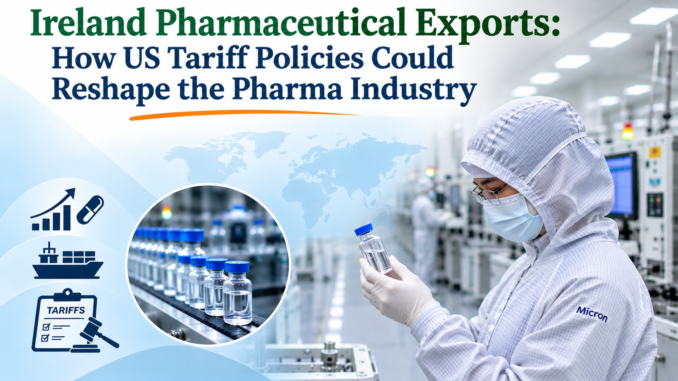
Nov 27: Ireland has become one of the world’s leading pharmaceutical manufacturing and export centres, with medicines produced in the country reaching healthcare markets across the globe. The industry is also a major contributor to the Irish economy, supported by multinational investment, advanced manufacturing facilities and a highly skilled workforce.
However, the country’s close trade relationship with the United States is entering a more challenging phase. Changes in American pharmaceutical tariff policies, drug pricing arrangements and efforts to encourage domestic manufacturing are prompting companies to reassess their international strategies.
The scale of this relationship is significant. According to a March 2026 analysis by Goodbody, prepared for the Irish Pharmaceutical Healthcare Association (IPHA), the United States accounted for approximately 59% of Ireland’s pharmaceutical exports in 2025. This level of dependence makes US trade policy particularly important for Irish manufacturers and their long-term investment plans.
For Ireland, the issue goes beyond the possibility of higher tariffs. It raises broader questions about manufacturing locations, supply-chain resilience and the country’s ability to remain competitive in the global pharmaceutical market.
Why the US Market Matters to Ireland’s Pharmaceutical Industry
The United States has been a major destination for medicines manufactured in Ireland for several decades. This relationship has developed alongside the expansion of multinational pharmaceutical companies, many of which have established manufacturing, research and development operations in the country.
Ireland offers several advantages to these businesses, including access to the European single market, an experienced workforce, established manufacturing infrastructure and a strong presence in biotechnology and advanced medicines.
The importance of the industry is reflected in the latest export figures. According to Ireland’s Central Statistics Office (CSO), exports of medical and pharmaceutical products reached €138.6 billion in 2025, an increase of 39% compared with 2024. These products accounted for 53.2% of Ireland’s total goods exports that year.
The CSO category covers medical and pharmaceutical products together, while the Goodbody analysis provides a narrower assessment of pharmaceutical trade. Both highlight the sector’s importance to Ireland’s international trade.
However, the country’s strong dependence on the American market also creates exposure to changes in US policy. Any adjustments to tariffs, drug pricing or market access requirements could influence how companies organise production and plan future investments.
What US Pharmaceutical Tariff Policies Mean for Irish Businesses
The United States introduced a separate pharmaceutical tariff framework through a presidential proclamation on April 2, 2026, under Section 232 of the Trade Expansion Act. The policy was presented as part of a broader effort to strengthen domestic pharmaceutical manufacturing and reduce reliance on overseas suppliers.
Under the framework, certain patented pharmaceutical products and associated ingredients are subject to additional duties. The proclamation sets out a 15% tariff treatment for qualifying products from the European Union, Japan, South Korea, Switzerland and Liechtenstein, subject to specific exceptions and company agreements.
It also provides preferential treatment for eligible companies that make approved US manufacturing commitments. Companies entering into qualifying most-favoured-nation pricing and onshoring agreements may receive zero-tariff treatment under specified conditions. The framework also provides zero-tariff treatment for certain specialised medicines and other eligible categories.
Importantly, generic pharmaceuticals and their associated ingredients were excluded from these Section 232 tariffs at the time of the proclamation. The measures became effective for specified companies from July 31, 2026, and for other covered companies from September 29, 2026.
For Irish pharmaceutical manufacturers, the implications depend on the type of medicine, its classification, the applicable trade arrangements and whether a company qualifies for preferential treatment. It would therefore be inaccurate to assume that every medicine exported from Ireland faces the same tariff.
The commercial challenge is that businesses must now factor US pricing agreements, investment commitments and tariff eligibility into their long-term planning.
Multinational Investment Remains Central to Ireland’s Pharma Sector
Ireland’s pharmaceutical industry has developed through decades of international investment. Major global companies have established manufacturing plants, research facilities and specialist operations across the country, creating an ecosystem that supports both production and innovation.
The Goodbody report prepared for IPHA estimates that around 75,000 people work in pharmaceutical manufacturing and related activities in Ireland, including approximately 28,000 in manufacturing.
The report also notes that Ireland hosts operations belonging to the world’s 15 largest pharmaceutical companies. Its established position in biologics and advanced therapeutics has helped the country expand beyond traditional medicine manufacturing into more specialised production.
This investment base is important as companies consider how to respond to US manufacturing policies.
Some multinational businesses may explore additional production capacity in the United States to serve the local market and qualify for preferential tariff arrangements. However, this does not automatically mean that existing Irish facilities will lose their importance.
Manufacturing decisions involve much more than tariff rates. Companies must consider workforce availability, regulatory standards, production expertise, infrastructure, research capabilities and access to other international markets.
Ireland’s established pharmaceutical ecosystem remains a significant part of that calculation.
Supply-Chain Resilience Becomes a Business Priority
Pharmaceutical production depends on complex international supply chains. Active ingredients, specialised equipment, packaging materials and finished medicines may move across several countries before reaching hospitals, pharmacies and healthcare providers.
Changes in trade policy can make these arrangements more complicated, particularly for companies serving large markets such as the United States.
Irish manufacturers may increasingly look at diversifying suppliers, strengthening production flexibility and reviewing their dependence on individual markets.
Some companies may also consider expanding manufacturing capacity in the United States or developing additional production partnerships. Such decisions could help them manage trade requirements while maintaining access to established markets.
For Ireland, the opportunity lies in continuing to develop its strengths in advanced manufacturing, biotechnology, research and specialist pharmaceutical production.
Investment in infrastructure, workforce development and innovation will also be important. The Goodbody analysis identifies constraints involving housing, water and electricity as issues that could affect the country’s ability to support further industrial expansion.
What Do the Latest Export Figures Tell Us?
Ireland’s pharmaceutical export figures for 2026 require careful interpretation.
According to the CSO’s November 18, 2026, release, exports of medical and pharmaceutical products totalled €58.4 billion in the first nine months of 2026, compared with €118.2 billion during the same period in 2025. This represented a year-on-year decline of 50.6%.
The figures are significant, but they do not necessarily indicate a comparable fall in manufacturing activity.
The Central Bank of Ireland’s third-quarter 2026 bulletin explains that much of the decline in pharmaceutical export values was linked to polypeptide hormones, a category associated with weight-loss medicines. The Bank noted that the reduction reflected lower unit values rather than a halt in production. Physical export volumes were broadly comparable with 2025 levels.
The earlier surge in exports was also influenced by companies shipping products ahead of anticipated US trade announcements, alongside strong growth in demand for certain medicines.
This distinction is important for businesses and investors. Export values can change considerably because of product mix, shipment timing and unit prices. They should not automatically be interpreted as evidence of a similar change in production capacity or employment.
The latest figures underline the importance of looking beyond headline export growth when assessing the performance of Ireland’s pharmaceutical industry.
Opportunities Beyond the US Market
Although the American market will remain important, Ireland’s pharmaceutical industry also has opportunities to strengthen its international presence.
The European market, along with destinations in Asia and other regions, offers scope for companies to diversify their export relationships. Growing demand for biologics, specialised medicines and advanced therapies could also support further investment in Ireland’s manufacturing capabilities.
There may be opportunities for businesses supplying pharmaceutical ingredients, packaging, logistics, quality-control systems and manufacturing technologies. As companies review their supply chains, demand for specialised services and production support could also evolve.
For smaller Irish businesses, working with established multinational manufacturers may create opportunities to participate in international supply networks.
The broader objective will be to build a more diversified and resilient industry without weakening the country’s existing strengths in pharmaceutical exports.
The Road Ahead for Ireland’s Pharmaceutical Industry
Ireland’s pharmaceutical industry is not facing an immediate loss of access to the US market. However, the changing American policy environment is making trade arrangements, pricing commitments and manufacturing locations increasingly important to business decisions.
The tariff framework does not apply uniformly to all pharmaceutical products, and company-specific agreements can significantly influence the treatment of eligible medicines. At the same time, the latest export figures show why businesses and policymakers need to examine trade values alongside actual production trends.
For Ireland, maintaining its position as a global pharmaceutical manufacturing hub will depend on more than favourable trade arrangements. Continued investment in research, advanced manufacturing, infrastructure and skilled talent will be essential.
As multinational companies adapt their strategies, Ireland’s established expertise and international business connections can continue to support its role in global pharmaceutical production.
