
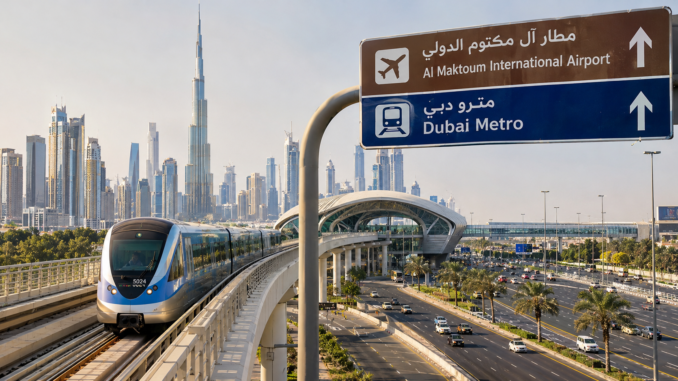
Nov 27: Dubai is taking another major step towards strengthening its transport and economic infrastructure with the approval of a AED 2 billion Metro extension to Al Maktoum International Airport. Announced by the Dubai Executive Council on November 10, 2026, the proposed 3-kilometre extension will include two new stations connecting the existing Route 2020 network to the airport’s West Terminal. Passenger services are scheduled to begin in 2031.
The project comes at an important time for Dubai’s aviation and real estate sectors. The emirate plans to transfer all commercial operations from Dubai International Airport to Al Maktoum International Airport between 2032 and 2035. As the airport takes on a larger role in international aviation, improved transport connections will become essential for passengers, employees and businesses operating in the surrounding areas.
For Dubai, this investment represents more than an expansion of its public transport network. It could help shape a new centre of commercial activity, create opportunities for logistics and hospitality businesses, and influence future residential and commercial property demand.
Dubai Metro Extension to Al Maktoum Airport: What the Project Includes
According to the Dubai Executive Council announcement, the AED 2 billion project will extend the existing Route 2020 Metro line by approximately 3 kilometres, adding two new stations. The extension will connect to the West Terminal of Al Maktoum International Airport City.
The project will be developed through collaboration between Dubai’s Roads and Transport Authority (RTA) and the Dubai Engineering Projects Establishment. It is also expected to connect with the airport express line and Etihad Rail’s high-speed rail network, creating better integration between different modes of transport.
The timing of the project is particularly significant. With Metro services expected to begin in 2031, the connection should be operational ahead of the planned transition of commercial airport operations from Dubai International Airport.
This could help Dubai prepare for increased passenger movement and employment around its expanding aviation hub while improving access to the wider city.
Better Airport Connectivity Could Attract More Businesses
Dubai’s position as an international business destination is closely linked to its ability to connect people, markets and industries. As Al Maktoum International Airport expands, accessibility will become an increasingly important factor for companies considering locations in the emirate.
The Metro extension could make the airport district more convenient for employees, business travellers and service providers. Companies involved in aviation, hospitality, international trade and professional services may find the surrounding areas more attractive for establishing offices and operational facilities.
For businesses, transport connectivity influences several practical decisions, including employee commuting, office locations and access to customers and suppliers. A reliable public transport connection can also reduce dependence on private vehicles and improve accessibility for a larger workforce.
As airport-related commercial activity grows, the surrounding area could attract companies looking to establish a presence closer to aviation and logistics operations.
Logistics and Supply Chain Businesses Could Benefit
Al Maktoum International Airport is expected to become an important centre for international aviation and cargo operations. Its expansion could create opportunities for businesses involved in freight forwarding, warehousing, e-commerce fulfilment and supply chain management.
Dubai already has an established position in international trade and logistics. The development of its southern aviation hub could strengthen this position by attracting additional companies that depend on efficient air cargo operations and access to global markets.
The Metro extension will not directly transport freight, but it could address another important requirement: workforce mobility. Easier access to the airport district could help logistics companies, aviation service providers and other employers attract workers from different parts of Dubai.
Supporting industries could also find opportunities as commercial activity increases. These include cargo handling, equipment maintenance, technology services, facilities management and transportation management.
For logistics operators, the combination of airport infrastructure, road connectivity and access to a wider workforce could make the surrounding economic zone increasingly relevant for long-term business planning.
Dubai Real Estate: Could the Airport Metro Extension Create a New Investment Corridor?
The impact of major infrastructure projects often extends into the property market. Better transport connections can improve the appeal of locations that were previously less accessible, attracting residents, businesses and property developers.
The Al Maktoum Airport corridor could benefit from this trend as the airport, Metro network and supporting commercial facilities develop.
Residential communities within convenient reach of the airport may attract aviation professionals, logistics employees and other workers seeking easier access to employment centres. Developers could also explore opportunities in apartments, serviced residences and mixed-use developments.
Commercial real estate may see additional demand as businesses establish operations around the airport. Offices, hotels, retail spaces and business centres could become increasingly important as the surrounding economic ecosystem expands.
However, infrastructure announcements should not automatically be interpreted as a guarantee of property price appreciation. Investors will need to consider actual rental demand, future housing supply, construction timelines, location and access to essential services.
The most promising opportunities are likely to emerge in locations where transport improvements are supported by employment growth, commercial activity and established residential communities.
Dubai’s Real Estate Market: What the Latest Projections Indicate
The Metro extension comes as Dubai prepares for substantial expansion across its residential and commercial property sectors.
A Dubai Land Department study on the future of the real estate market, presented to the Executive Council in November 2026, projects the development of approximately 365,000 additional residential units and around 1.1 million square metres of office and retail space by 2030.
The study also reported occupancy levels of 97% in residential properties, 98% in retail and 94% in office spaces. These figures highlight the importance of planning new developments alongside population growth, business activity and infrastructure availability.
Dubai’s Real Estate Sector Strategy 2033 further reflects the emirate’s ambitions for the industry. Its targets include increasing the sector’s contribution to GDP to AED 73 billion, raising real estate transaction volumes by 70% and taking the market’s total value to AED 1 trillion.
Against this backdrop, improved connectivity to Al Maktoum International Airport could support interest in emerging development areas.
However, the projected addition of new residential and commercial space also makes market research essential. Investors will need to assess whether population growth, employment opportunities and rental demand can keep pace with the planned supply.
Hospitality and Retail Could Find New Growth Opportunities
The airport’s expansion could create opportunities beyond aviation, logistics and property development.
Hotels, serviced apartments and other hospitality businesses may benefit from demand generated by international passengers, airline employees and professionals working in the airport district. Business accommodation could become particularly relevant as more companies establish operations in the area.
Retail businesses may also benefit from the growth of surrounding residential communities and commercial facilities. Supermarkets, restaurants, convenience stores and everyday service providers could find opportunities as the local population increases.
There may also be growing demand for IT services, recruitment, facilities management and other business support activities.
For developers and operators, the focus will be on creating commercial spaces and services that meet actual customer and business requirements. Long-term success will depend on the development of a functioning business and residential ecosystem rather than airport expansion alone.
Infrastructure Investment Supports Dubai’s Long-Term Economic Vision
Dubai’s Metro extension reflects a broader strategy to connect infrastructure development with economic growth. Aviation, public transport, logistics and real estate are increasingly interconnected, and investment in one sector can influence opportunities across others.
The new Metro connection is expected to improve access to Al Maktoum International Airport while supporting the development of surrounding commercial and residential areas. Its integration with other transport networks could also make journeys across the emirate more convenient.
For international companies, reliable infrastructure is an important consideration when choosing locations for regional operations. Better connections between airports, offices, residential communities and logistics facilities could strengthen Dubai’s competitiveness as a global business destination.
The project’s wider impact, however, will depend on timely implementation and the development of supporting infrastructure, employment centres and public services.
Conclusion
Dubai’s AED 2 billion Metro extension to Al Maktoum International Airport could become an important part of the emirate’s next phase of economic and urban development. Although the proposed extension covers just 3 kilometres, its significance lies in connecting a major aviation hub with the city’s wider transport and commercial networks.
From logistics and hospitality to office development and residential real estate, several industries could benefit as activity around the airport increases.
With Metro services expected to begin in 2031, businesses and property investors have an opportunity to monitor the development of this emerging corridor. The real estate opportunities, in particular, will depend on how effectively transport connectivity translates into employment growth, business demand and sustainable residential development.
As Dubai continues to invest in infrastructure to support its international ambitions, the Al Maktoum Airport Metro extension could help establish a new centre of business and commercial activity in the emirate.
