
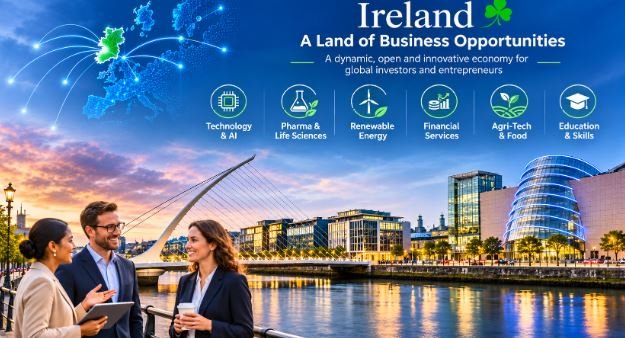
In today’s rapidly changing global economy, businesses are constantly looking for markets that offer stability, access to international customers, skilled talent and opportunities for long-term growth. Ireland has emerged as an attractive destination in this landscape, combining an open, export-oriented economy with a strong business environment, access to the European Union and a well-established network of international commercial relationships.
For entrepreneurs, investors and multinational companies, Ireland offers something more valuable than simply a place to establish a business. It provides an opportunity to become part of a connected international economy where innovation, enterprise and global partnerships play an important role in shaping commercial success.
Ireland’s economic journey is particularly interesting because it demonstrates how a relatively small country can build a strong international business presence by welcoming investment, developing human talent, encouraging entrepreneurship and maintaining close relationships with global markets.
A Free-Market Economy Built on Enterprise and Opportunity
Ireland operates as an open, market-based economy in which private enterprise, international trade and foreign investment are important drivers of economic activity. Its business environment is supported by a stable democratic system, membership of the European Union and Eurozone, a developed legal framework and policies designed to encourage investment and innovation.
The country’s approach has helped attract some of the world’s leading companies across technology, pharmaceuticals, financial services, medical technology and advanced manufacturing.
For international businesses, Ireland’s appeal lies in the combination of a skilled and internationally diverse workforce, a business-friendly policy environment, strong research capabilities and access to the European Single Market.
However, a successful business environment is not created by policy alone. It also depends on people, institutions, infrastructure and a culture that encourages businesses to innovate, compete and grow.
Ireland has worked to bring these elements together, creating an ecosystem in which both domestic enterprises and international companies can pursue new opportunities.
Why International Businesses Are Choosing Ireland
One of Ireland’s strongest advantages is its position within the European Union. Companies establishing operations in Ireland can access the EU Single Market, subject to applicable European regulations and market-entry requirements.
For businesses from India, Asia, North America and other regions, this provides an opportunity to establish a European presence and develop relationships with customers, suppliers and business partners across the continent.
Ireland also offers an English-speaking business environment, a well-developed professional services sector and an internationally connected workforce.
Its reputation as a location for research, innovation and advanced manufacturing further strengthens its attractiveness.
The presence of established multinational companies has also created valuable business networks, supporting the growth of local suppliers, specialist service providers, technology companies and professional firms.
In this way, international investment generates opportunities that extend beyond the companies making the initial investment. It can create employment, develop local capabilities, stimulate innovation and open doors for smaller businesses.
Emerging Business Opportunities Across Key Sectors
Ireland’s future business opportunities are increasingly connected with technology, sustainability, healthcare and knowledge-intensive industries.
1. Information Technology, Artificial Intelligence and Digital Services
Ireland has developed a strong international technology ecosystem. Digital transformation, artificial intelligence, cloud computing, cybersecurity and software development are creating opportunities for established companies as well as emerging enterprises.
Businesses specialising in AI applications, enterprise software, data analytics, digital payments and cybersecurity can explore Ireland as a base for developing products and serving European and international customers.
The country’s 2025–2029 investment strategy identifies digitalisation and artificial intelligence as important drivers of future growth.
2. Pharmaceuticals, Biotechnology and Medical Technology
Life sciences represent one of Ireland’s most established international business strengths.
The country has developed significant capabilities in pharmaceutical manufacturing, biopharmaceuticals, medical devices and biotechnology.
Opportunities exist in research and development, contract manufacturing, laboratory services, medical technology, specialised equipment and supply-chain management.
For Indian pharmaceutical and healthcare companies, Ireland offers possibilities for collaboration in research, manufacturing, regulatory expertise and access to international markets.
3. Financial Services and Fintech
Ireland has built a substantial international financial services industry, covering banking, insurance, investment management, aircraft leasing and financial technology.
The growth of digital banking, payment solutions, financial compliance technology and international investment services is creating further opportunities.
Businesses with innovative financial products and technology-driven solutions can explore partnerships with Irish financial institutions and international companies operating from Ireland.
4. Renewable Energy and the Green Economy
The global transition towards cleaner energy is creating new commercial opportunities in Ireland.
Renewable electricity, offshore wind, energy storage, sustainable construction, carbon management and environmental technologies are becoming increasingly important areas for investment.
Companies with expertise in renewable energy infrastructure, engineering, energy efficiency and sustainable technologies can explore opportunities arising from Ireland’s long-term transition towards a lower-carbon economy.
5. Agriculture, Food Processing and Agri-Tech
Agriculture and food production remain important components of Ireland’s economic identity.
The country has developed an international reputation for quality food products and agricultural expertise. At the same time, technology is transforming the sector through precision farming, food processing innovation, sustainable packaging and supply-chain management.
This creates opportunities for international partnerships in agricultural research, food technology, machinery, processing and sustainable farming solutions.
6. Education, Professional Services and Skills Development
Ireland’s universities, research institutions and professional education ecosystem attract international students, researchers and businesses.
There is growing scope for cooperation in higher education, executive training, vocational skills, research partnerships and technology-oriented learning.
Companies providing professional services, business consulting, engineering solutions and specialised training can also explore opportunities in Ireland’s expanding knowledge economy.
A Supportive Ecosystem for Entrepreneurs and Small Businesses
A country’s business environment must work not only for multinational corporations but also for entrepreneurs, start-ups and small and medium-sized enterprises.
Ireland recognises the importance of developing indigenous businesses alongside attracting international investment.
Enterprise Ireland supports Irish companies seeking to expand into international markets through business development assistance, trade missions, market intelligence and relevant funding programmes.
IDA Ireland plays a central role in attracting foreign direct investment and supporting international companies establishing and expanding operations in the country.
Local Enterprise Offices also provide support to eligible small businesses through advice, training and business development programmes.
These institutions help connect entrepreneurs with the resources, expertise and networks required to turn business ideas into commercially viable enterprises.
The Government’s 2027 Budget initiatives, including the proposed Start Up Ireland programme and expanded financing support for growing businesses, further reflect the emphasis on strengthening the entrepreneurship ecosystem.
India–Ireland: A Partnership with Significant Business Potential
For Indian entrepreneurs and companies, Ireland deserves greater attention as a potential destination for international business expansion.
India and Ireland have complementary economic strengths. India offers a large domestic market, a growing manufacturing base, a substantial pool of technology professionals and an expanding start-up ecosystem. Ireland offers European market connectivity, established international business networks, research capabilities and experience in high-value industries.
This creates opportunities for meaningful commercial cooperation.
Indian IT companies can explore Ireland as a European base for software development, artificial intelligence, cybersecurity and digital transformation services.
Pharmaceutical companies can examine opportunities in research partnerships, manufacturing, biotechnology and international supply chains.
Indian engineering and manufacturing businesses can explore relationships with Irish companies in medical devices, industrial technology, renewable energy and advanced manufacturing.
Similarly, Irish companies can look towards India for technology partnerships, market expansion, skilled talent, manufacturing collaboration and access to one of the world’s most dynamic consumer economies.
Educational institutions in both countries can strengthen academic partnerships, research programmes and professional skills development.
The opportunity is not limited to large corporations. Indian start-ups, family-owned businesses, exporters and emerging enterprises can also explore commercial partnerships with Irish companies.
For smaller businesses, the most practical starting point may be a distribution agreement, technology partnership, joint research initiative or carefully selected local business partner rather than immediately establishing a full-scale overseas operation.
Understanding the Challenges Before Investing
While Ireland offers considerable opportunities, responsible business planning requires a realistic understanding of the operating environment.
Companies considering investment must assess commercial property costs, housing availability, labour expenses, energy infrastructure, regulatory obligations and access to specialised skills.
Competition can also be strong in established sectors, particularly technology, pharmaceuticals and financial services.
Businesses must therefore develop a clear understanding of customer demand, pricing, taxation, employment regulations and sector-specific compliance before committing capital.
Ireland’s competitive advantages should be evaluated in terms of the overall business proposition rather than any single incentive or tax consideration.
For international investors, professional advice on company formation, taxation, immigration, intellectual property and regulatory requirements is an important part of the market-entry process.
A well-researched business plan, reliable local partnerships and a long-term commercial vision can make the difference between entering a market and building a sustainable business in it.
The Road Ahead: From Business Connectivity to Shared Prosperity
Ireland’s economic experience offers an important lesson for countries seeking to strengthen their position in the global marketplace.
International business success is not simply about attracting large companies or increasing export figures. It is about creating an environment where businesses of different sizes can innovate, access finance, develop talent, build partnerships and compete internationally.
The country’s future investment priorities increasingly focus on artificial intelligence, semiconductors, life sciences, digital transformation, sustainability and advanced manufacturing. These areas are likely to shape new business opportunities over the coming years.
For India, Ireland represents an interesting partner in building stronger commercial connections with Europe. For Ireland, India’s growing economy and expanding business capabilities offer opportunities to diversify partnerships and develop new sources of growth.
Both countries can benefit from closer engagement among business associations, chambers of commerce, universities, investors, technology companies and government institutions.
Conclusion:
Ireland’s business environment demonstrates how an open economy, international connectivity, innovation and a strong institutional framework can create opportunities for enterprises of different sizes.
Its appeal is not limited to multinational corporations. Entrepreneurs, exporters, technology start-ups, manufacturers, professional service providers and investors can all find opportunities by identifying the right market, building trusted relationships and understanding the local business environment.
For Indian businesses in particular, Ireland offers a promising platform for exploring European markets while developing mutually beneficial commercial relationships.
Ultimately, the real strength of an economy lies not merely in the volume of investment it attracts, but in the opportunities it creates for people, businesses and future generations.
Ireland’s message to the global business community is clear: sustainable growth comes through enterprise, innovation, trust and partnerships that create value across borders.
