

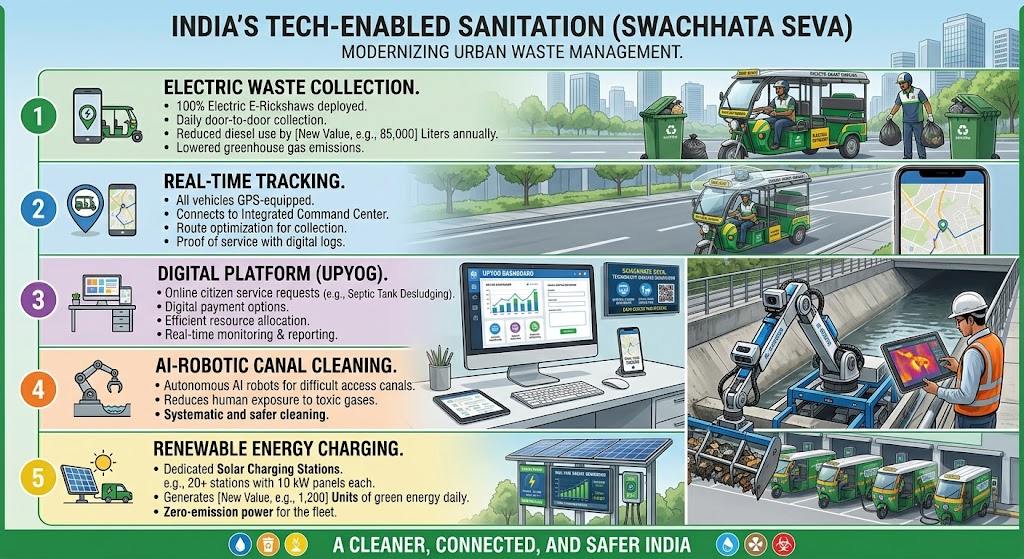
India’s cleanliness drive is increasingly moving beyond conventional methods, with artificial intelligence, digital platforms, electric vehicles and real-time tracking becoming part of everyday urban sanitation.
What started with a nationwide call for cleanliness has gradually evolved into a technology-enabled approach to waste management and public sanitation. Across cities, digital tools are helping citizens access services more easily, while automation and electric mobility are helping make sanitation operations safer, cleaner and more efficient.
The shift shows how technology can strengthen Swachhata Seva by connecting citizens, sanitation workers and municipal authorities through smarter systems.
Digital platforms bring sanitation services closer to citizens
In Raipur, technology is simplifying access to faecal sludge management services. The city’s digital Faecal Sludge Management dashboard, developed on the UPYOG platform, allows residents to request septic-tank desludging services online.
Residents can use a mobile number or property ID to locate their address, submit a request, make payments and track the service digitally. Drivers can also upload photographs after completing the work, creating a digital record that helps municipal authorities verify and monitor services.
The system reduces dependence on paperwork and repeated visits to municipal offices while helping officials plan vehicles and resources more effectively.
AI-powered robots make hazardous sanitation work safer
Technology is also addressing one of the most difficult challenges in sanitation: cleaning environments where human entry can be dangerous.
In Thiruvananthapuram, G-SPIDER, an AI-powered canal-cleaning robot developed by Genrobotic Innovations, has been deployed in the difficult-to-access section of the Amayizhanchan Canal beneath the Thampanoor railway premises.
Equipped with machine vision, sensors and a five-degrees-of-freedom mechanism, the robot is designed to identify and remove different types of accumulated waste.
The technology has an important safety dimension. By reducing the need for workers to enter spaces containing contaminated water, toxic gases and hazardous waste, robotic systems can help reduce occupational risks while enabling more systematic cleaning.
Electric vehicles make waste collection cleaner
The transformation is also visible on city streets, where electric vehicles are increasingly being used for door-to-door waste collection.
In Guntur, more than 200 electric autos equipped with GPS tracking have been introduced for waste collection. The initiative is expected to eliminate the use of more than 71,000 litres of diesel annually and reduce greenhouse gas emissions by an estimated 21,000 tonnes over 10 years.
Chennai has deployed 5,478 battery-operated e-rickshaws across all 15 zones. The vehicles cover 24,621 streets and more than 2.1 million households, while separate compartments for wet, dry and hazardous waste help integrate segregation into the collection process.
The initiative is also linked to employment opportunities for more than 6,000 people, showing how a cleaner sanitation system can also support livelihoods.
Indore connects waste management with renewable energy
Indore has combined electric waste collection with renewable-energy infrastructure. The city has deployed 100 electric vehicles for door-to-door collection in core areas, with GPS tracking connected to its Integrated Command and Control Centre.
The initiative is estimated to reduce annual carbon emissions by around 24,918 tonnes and save approximately Rs 5.97 crore a year in fuel and maintenance costs.
The city has also established 20 solar charging stations, each equipped with 10 kW solar panels. Together, the stations can generate around 800–1,000 units of green energy a day and charge approximately 80–100 vehicles daily.
Technology adds a new dimension to Swachhata Seva
The use of technology in sanitation is not simply about replacing manual processes with machines. It is about creating systems that are safer for workers, easier for citizens to access and more transparent for municipal authorities.
Digital dashboards can make sanitation services trackable. GPS systems can help monitor collection vehicles. AI and robotics can reduce human exposure to hazardous environments, while electric vehicles and solar charging infrastructure can lower the environmental impact of daily waste operations.
As more cities adopt such solutions, technology can become an important enabler of Swachhata Seva, helping urban India move towards sanitation systems that are cleaner, connected, responsive and safer for everyone.
The next phase of the cleanliness mission is therefore not just about collecting waste or cleaning public spaces. It is about using innovation to build a sanitation ecosystem where technology serves citizens, protects sanitation workers and supports cleaner cities.
