
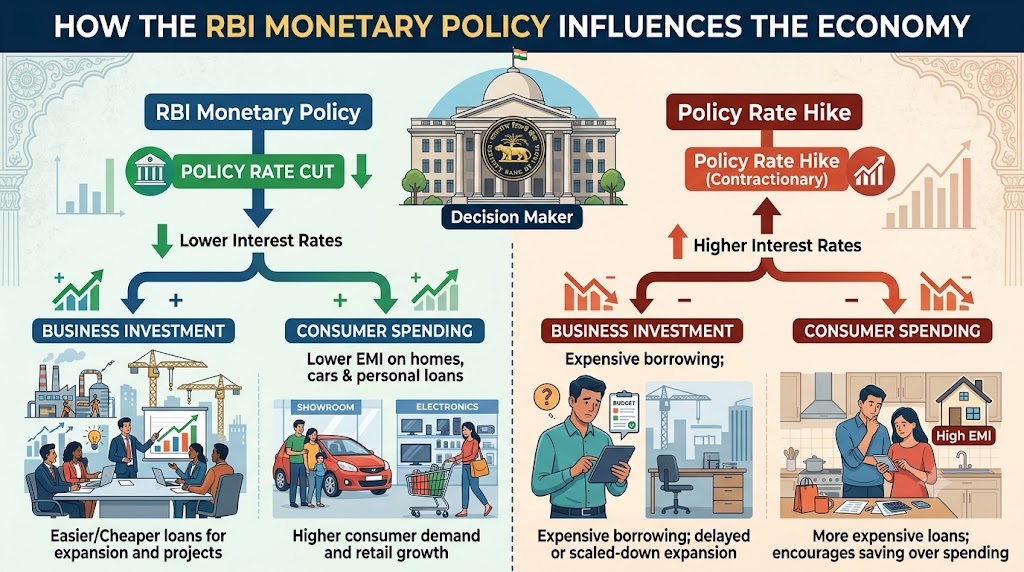
The decisions made by India’s central bank can influence everything from a company’s expansion plans to a family’s decision to purchase a home. When borrowing costs change, businesses reassess investment opportunities, consumers reconsider major purchases and banks adjust their lending strategies. These individual decisions collectively shape the direction of economic activity.
The Reserve Bank of India (RBI) plays a pivotal role in this process through its monetary policy. By adjusting the policy repo rate, managing liquidity and influencing credit conditions, the central bank seeks to maintain price stability while supporting sustainable economic growth.
The importance of this relationship has become particularly evident in October 2026. On October 7, the RBI raised the repo rate by 25 basis points to 5.50%, its first increase in nearly four years, amid renewed inflationary pressures. The central bank also raised its FY27 inflation forecast to 5.2% and revised its GDP growth projection upwards to 7.1%. The decision highlighted the challenge of containing inflation without unnecessarily weakening economic momentum.
For India’s businesses, particularly micro, small and medium enterprises (MSMEs), the consequences extend beyond financial markets. Changes in interest rates can affect working capital, production costs, hiring decisions and expansion plans. For households, they can influence loan repayments, savings returns and purchasing power.
The Repo Rate: A Key Influence on Business Investment
The repo rate is the rate at which the RBI lends short-term funds to banks against eligible securities. Changes in this benchmark influence financial conditions across the banking system and can eventually affect the cost of credit available to businesses and consumers.
When the central bank raises the repo rate to address inflation, banks may increase lending rates depending on their funding costs, lending benchmarks and competitive conditions. Businesses that depend on borrowed capital must then evaluate whether planned investments will generate sufficient returns to justify the additional expense.
Consider a manufacturing company planning to install new machinery or establish another production unit. Higher borrowing costs can increase the overall expense of the project, extending the time required to recover the investment. If demand is uncertain or profit margins are already under pressure, management may postpone expansion, reduce its investment budget or explore alternative financing arrangements.
The implications can be particularly significant for MSMEs, which often rely on working-capital facilities, cash-credit limits and business loans to purchase raw materials, pay suppliers and meet operating expenses. Higher financing costs can squeeze already narrow margins, leaving businesses with less flexibility to invest in technology, expand distribution or create jobs.
A reduction in the repo rate can have the opposite effect when banks pass on the benefit to borrowers. More affordable credit can encourage businesses to purchase equipment, open additional outlets, modernise operations or increase production capacity.
However, interest rates are only one part of the investment equation. Businesses also need confidence in future demand, predictable operating conditions and a reasonable prospect of profitability. Even when credit becomes cheaper, uncertain sales or rising input costs can discourage new investment.
Liquidity and the CRR: Why Credit Availability Matters
The cost of borrowing is only one consideration for businesses. Access to finance is equally important, particularly for smaller enterprises that must manage the gap between paying suppliers and receiving money from customers.
The RBI manages liquidity through several instruments, including the Cash Reserve Ratio (CRR). This requires banks to maintain a specified proportion of their net demand and time liabilities as cash reserves with the central bank.
A reduction in the CRR generally releases funds that banks can potentially use for lending, other things remaining equal. An increase can absorb liquidity and reduce the funds immediately available for other uses. The actual effect depends on broader banking conditions, credit demand and lenders’ assessment of risk.
For example, a small manufacturer may receive a large order but lack sufficient working capital to purchase the raw materials required to fulfil it. Timely access to credit can help the business increase production, pay workers and deliver goods without disrupting its cash flow.
The same principle applies to wholesalers, retailers and service providers that must finance inventory, manage seasonal demand or extend credit to customers. Adequate liquidity can help businesses maintain operations and respond to new opportunities.
Nevertheless, additional banking liquidity does not automatically translate into more lending. Banks must still assess repayment capacity, creditworthiness and risk. Businesses with weak financial records or excessive debt may continue to face difficulties securing affordable finance.
For this reason, effective monetary policy depends not only on the availability of funds but also on the willingness and capacity of banks to lend productively.
Consumer Spending: From Loan EMIs to Everyday Purchases
Monetary policy also influences household budgets, particularly through its effect on borrowing costs and savings returns.
When lending rates rise, borrowers with floating-rate loans may face higher equated monthly instalments (EMIs) or longer repayment periods, depending on their loan agreements and lenders’ adjustment mechanisms. Home loans, vehicle finance and other interest-sensitive borrowing can therefore become more expensive.
A household facing higher monthly repayments may postpone buying a new vehicle, delay home improvements or reduce spending on travel, entertainment and discretionary goods. These decisions can affect businesses across sectors, including retail, automobiles, consumer durables, hospitality and real estate.
The impact can extend beyond individual purchases. When consumer demand weakens, retailers may become more cautious about stocking inventory, manufacturers may moderate production plans and service businesses may delay recruitment or expansion.
Lower interest rates can support spending when the benefits reach borrowers. More affordable housing or vehicle finance may encourage households to bring forward purchases, while lower debt-servicing costs can leave more disposable income available for other expenses.
Savings behaviour also matters. Higher deposit rates may improve returns for savers and encourage some households to place more money in fixed-income instruments. Lower deposit rates may make certain savings products less attractive, although decisions depend on income, financial goals, inflation expectations and risk tolerance.
The effects are not uniform. Borrowers may feel the pressure of rising rates, while households with substantial deposits may benefit from higher interest income. The overall impact depends on the balance between debt, savings and spending needs.
Why Monetary Policy Has a Delayed Impact
An RBI policy announcement does not immediately change every bank loan, business investment decision or household budget. Monetary policy influences the economy through a sequence of adjustments that can take time.
Following a repo rate change, financial-market rates and liquidity conditions may respond first. Banks then assess their funding costs, lending benchmarks and competitive position before adjusting interest rates on different products. Borrowers experience the effects according to their loan structures and repricing schedules.
A company that secured financing before a rate increase may continue with an approved expansion project. Similarly, a borrower with a fixed-rate loan may not experience an immediate change in repayments, while a floating-rate borrower may see an adjustment only when the loan is repriced.
Business confidence also determines how strongly monetary policy influences investment. A company expecting robust sales may proceed with expansion despite higher borrowing costs. Another facing weak demand may postpone investment even if interest rates decline.
This delay is one reason the RBI must assess inflation trends, economic growth, credit conditions and financial stability together rather than judge policy effectiveness by immediate market reactions.
For business owners and consumers, the practical lesson is to monitor actual changes in lending terms instead of assuming that every policy decision will automatically alter borrowing costs.
Inflation Control Versus Growth: The RBI’s Policy Challenge
One of the central bank’s most important responsibilities is to maintain price stability while supporting sustainable economic growth. Balancing these objectives becomes difficult when inflationary pressures increase even as economic activity remains resilient.
The RBI’s October 2026 decision illustrates this challenge. The 25-basis-point repo rate increase to 5.50% came alongside an upward revision to the FY27 GDP growth forecast of 7.1%. At the same time, the inflation forecast was raised to 5.2%, reflecting concerns about price pressures. These projections underline the need to consider both growth prospects and inflation risks when assessing monetary policy.
Higher interest rates can moderate demand by making borrowing more expensive and encouraging saving. Over time, this may help ease demand-driven inflation. However, the effectiveness of rate increases is more limited when price pressures originate from supply disruptions, adverse weather conditions or higher global commodity prices.
For Indian businesses, rising food, fuel, transport and raw-material costs can affect profitability independently of borrowing rates. A company may face higher financing expenses at the same time as its input costs rise, creating pressure on margins and working capital.
Conversely, keeping borrowing costs too low when inflation remains persistent can encourage excessive demand and undermine price stability. The RBI must therefore assess whether the economy requires tighter financial conditions or whether the inflation outlook permits a more supportive stance.
The objective is not simply to make loans cheaper or more expensive. It is to maintain conditions that protect purchasing power while allowing productive investment and economic activity to continue.
What Businesses and MSMEs Should Do When Rates Change
For business owners, monetary policy is most useful when translated into practical financial planning. Companies cannot control the repo rate, but they can improve their ability to withstand changes in borrowing costs.
Review borrowing exposure: Businesses should examine outstanding loans, interest-rate benchmarks, repayment schedules and the possibility of changes in future financing expenses. This helps management identify where higher rates could place the greatest pressure on cash flow.
Strengthen working-capital management: Accurate cash-flow forecasts, timely collection of receivables and better inventory planning can reduce dependence on emergency borrowing. For MSMEs, this can be particularly important when customers take longer to pay.
Test investment plans under different scenarios: Before committing to a new factory, outlet or technology upgrade, businesses should evaluate whether the project remains viable if financing costs rise or sales fall short of expectations.
Compare suitable financing options: Firms can assess available working-capital facilities, term loans and other legitimate financing arrangements based on their cost, repayment flexibility and suitability for the business. The lowest advertised interest rate may not always represent the most appropriate option once fees and conditions are considered.
Protect productive investment: Tighter financial conditions do not necessarily mean every expansion should be postponed. Projects that improve productivity, reduce operating costs or address confirmed demand may remain commercially attractive even when credit becomes more expensive.
Households can adopt a similar approach by reviewing floating-rate loan terms, maintaining manageable debt levels and accounting for possible changes in repayments. Those considering a major purchase should assess affordability against their income and existing financial commitments rather than relying solely on expectations of future rate cuts.
The Broader Economic Significance
The effects of monetary policy reach far beyond banks and borrowers. Investment decisions influence industrial capacity, employment and productivity, while household spending supports demand across retail and service industries.
When credit remains accessible and investment opportunities are sound, businesses can expand operations, improve efficiency and create employment. Stronger household demand can, in turn, encourage companies to increase production and invest further.
However, persistently high inflation can erode purchasing power and make business planning more difficult. Equally, unnecessarily restrictive financial conditions can discourage investment and weigh on interest-sensitive consumption.
The challenge is to maintain a balance that supports price stability without undermining the foundations of long-term growth. Monetary policy is one part of that process; fiscal policy, infrastructure investment, productivity improvements and the health of the banking system also influence economic outcomes.
For India, where MSMEs, large manufacturers, retailers and service providers all contribute to economic activity, the transmission of monetary policy matters because its effects are distributed throughout the economy.
Conclusion: Connecting Central Bank Decisions with Economic Growth
RBI monetary policy is a vital link between India’s financial system and its real economy. Through the repo rate, the CRR and liquidity-management measures, the central bank influences borrowing costs, credit conditions and saving incentives.
Higher interest rates can encourage caution in business investment and household spending, while lower rates can support expansion and consumption when credit conditions improve and confidence remains strong. Neither outcome is automatic: the effects depend on banks’ lending decisions, borrowers’ financial positions, inflation trends and expectations for future demand.
For businesses, understanding these mechanisms can improve investment planning, working-capital management and financial resilience. For households, it can help inform borrowing, saving and major spending decisions.
Ultimately, monetary policy is not merely a matter of interest-rate announcements. Its significance lies in how effectively financial conditions support price stability, productive investment and the purchasing power needed for sustainable economic growth in India.
