
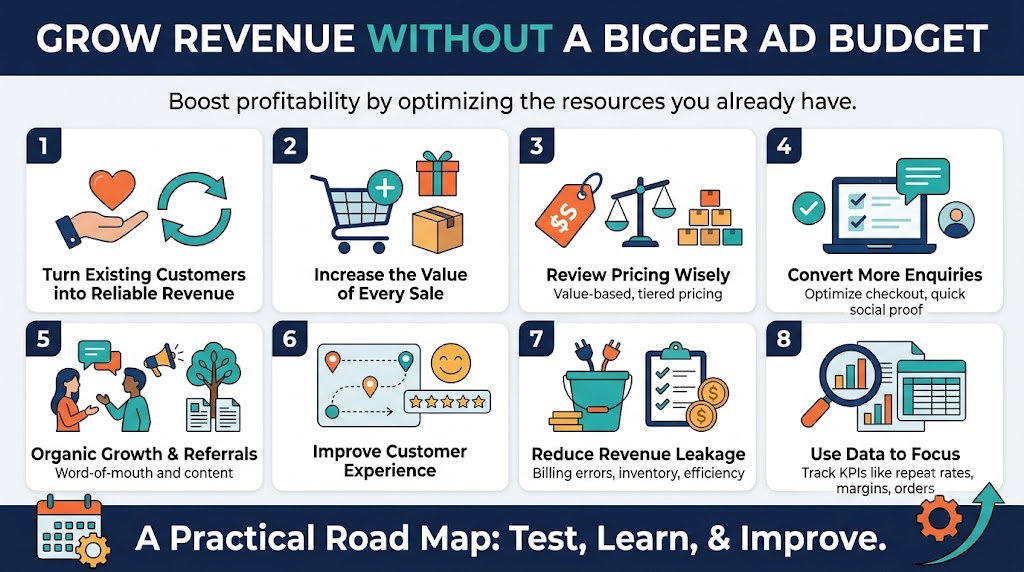
Growing revenue does not always require a bigger advertising budget. For many businesses, the most promising opportunities lie closer to home: existing customers, underused sales channels, overlooked service offerings and small inefficiencies that prevent potential buyers from making a purchase.
When marketing budgets are tight, businesses need to make better use of the resources they already have. A retailer may generate more sales by encouraging repeat visits, a service provider may increase earnings by offering value-added packages, and an online business may improve revenue simply by making its checkout process easier to navigate.
The objective is not merely to sell more. It is to build a business that converts more opportunities into sales, earns stronger customer loyalty and improves profitability without allowing expenses to rise at the same pace as revenue.
1. Turn Existing Customers into a Reliable Source of Revenue
Winning a new customer often requires considerable time, effort and promotional spending. Existing customers, however, already understand the business and have some experience with its products or services. This makes customer retention one of the most practical ways to support revenue growth without expanding the marketing budget.
Businesses can strengthen these relationships through personalised service, timely communication and consistent product quality. A retailer might inform regular customers when relevant products arrive, while a professional service firm could offer existing clients additional support based on their changing needs.
Re-engaging inactive customers can also create new sales opportunities. A thoughtful message introducing a new product, service improvement or relevant offer may encourage a former buyer to return. The key is to provide a genuine reason to reconnect rather than sending repetitive promotional messages.
Loyalty programmes, exclusive benefits and membership plans can further encourage repeat purchases. For businesses with suitable products or services, subscriptions can create a more predictable revenue stream.
The wider lesson is straightforward: customer relationships should not end when a transaction is completed. They can become a continuing source of business when supported by trust, service and relevant follow-up.
2. Increase the Value of Every Sale
Revenue can grow even when the number of customers remains unchanged. One way to achieve this is to increase the average amount customers spend during each transaction.
Upselling involves recommending a more advanced product or service that better meets a customer’s requirements. Cross-selling introduces complementary items that add value to the original purchase. For example, a technology retailer could offer installation support alongside a device, while a business consultant might combine an advisory session with implementation assistance.
Product and service bundles offer another opportunity. By grouping related offerings into convenient packages, businesses can make purchasing decisions easier while increasing the overall value of an order. The package should deliver a clear benefit, rather than simply encouraging customers to spend more.
These approaches work best when recommendations are relevant and transparent. Aggressive selling may generate a short-term transaction but damage the trust needed for repeat business.
Businesses should also review whether their existing customers know about the full range of products and services available. Sometimes, revenue opportunities are missed not because demand is absent, but because customers are unaware of suitable options.
3. Review Pricing Without Losing Customer Trust
Pricing decisions can have a direct effect on revenue and profit. Yet many businesses continue using prices established when their costs, competitive position or customer expectations were different.
A periodic pricing review can reveal whether current rates adequately reflect operating expenses, product quality, service standards and the value delivered to customers.
One approach is tiered pricing, which gives customers a choice between basic, standard and premium packages. This allows a business to serve different budgets while giving customers who need additional features or support the option to spend more.
Value-based pricing is another possibility. Rather than setting prices solely by adding a margin to costs, businesses consider the practical benefits their offering provides. A service that saves a client time, reduces waste or improves productivity may justify a different price from a comparable service that delivers fewer benefits.
Small price adjustments can improve margins, but they should not be automatic. Businesses need to consider customer sensitivity, competitors, contract terms and the risk of losing sales. Testing changes on selected products or services and monitoring the results can provide a more informed basis for decisions.
The goal is to charge a fair price that reflects the value delivered while maintaining customer confidence.
4. Convert More Enquiries into Paying Customers
Businesses may already be attracting potential customers through their websites, social media profiles, referrals, storefronts or sales teams. However, these opportunities have limited value if too many prospects abandon the buying process.
Improving conversion rates can generate additional revenue from the same level of customer interest.
For an online business, this may mean simplifying checkout, displaying delivery charges clearly, offering convenient payment options and removing unnecessary form fields. A service provider might make enquiry forms shorter, explain its packages more clearly or provide a straightforward way to book an appointment.
Clear product descriptions, transparent pricing and authentic customer testimonials can also help buyers make decisions with greater confidence. When appropriate, case studies demonstrating actual results can explain the practical value of a product or service more effectively than broad promotional claims.
Speed matters, too. When a prospective customer requests information, a prompt and useful response can prevent the opportunity from going cold. Businesses should establish a follow-up process so enquiries are not overlooked during busy periods.
Even modest improvements can make a difference when applied to a steady flow of existing prospects. Instead of immediately paying to attract more visitors, businesses should first examine how effectively they serve the people already showing interest.
5. Generate Organic Growth Through Referrals and Useful Content
Satisfied customers can help a business reach new buyers without requiring a large advertising investment. Referrals are particularly valuable when trust and reputation influence purchasing decisions.
Businesses can encourage referrals by asking happy customers to recommend their services, making the process simple and acknowledging those who help. Where appropriate, a modest referral benefit may be offered, provided it fits the business model and does not compromise the credibility of the recommendation.
Partnerships can create similar opportunities. A local retailer might collaborate with a complementary business, while a professional service provider could develop relationships with firms that serve the same customer group without competing directly.
Useful online content can support longer-term growth as well. Articles, practical guides, product demonstrations and answers to common customer questions can help potential buyers discover a business through search engines. Updating existing content and improving its clarity may be more efficient than continually producing new material.
Organic strategies generally require time and consistent effort, so they should not be treated as instant substitutes for paid promotion. Their advantage is that well-maintained relationships, partnerships and helpful resources can continue generating opportunities beyond a single campaign.
6. Improve the Customer Experience to Encourage Repeat Sales
Customer experience is often treated as a service issue, but it is also a revenue consideration. Confusing policies, delayed deliveries, inconsistent quality and slow complaint resolution can discourage customers from buying again.
Businesses should examine the complete customer journey, from the first enquiry to payment, delivery and after-sales support. Repeated complaints or abandoned purchases may point to problems that are quietly reducing revenue.
Simple improvements can include clearer communication about delivery dates, easier returns, reliable appointment scheduling and faster resolution of common issues. Staff should also have the information and authority needed to handle routine customer concerns efficiently.
Customer feedback can help identify which changes matter most. Rather than collecting opinions without acting on them, businesses should look for recurring patterns and prioritise improvements that reduce frustration or remove barriers to purchase.
A positive experience does more than protect a single sale. It increases the likelihood that customers will return, recommend the business and consider additional offerings.
7. Reduce Revenue Leakage and Improve Operational Efficiency
Higher sales do not automatically translate into stronger financial performance. Discounts that are too generous, excessive inventory, avoidable wastage, billing errors and delayed payments can weaken the benefits of revenue growth.
Businesses should regularly review which products, services and customer segments generate the strongest contribution after direct costs. An offering with high sales may deliver relatively little profit if it requires substantial labour, frequent discounts or expensive fulfilment.
Inventory management is particularly important for retailers and manufacturers. Overstocking ties up working capital, while stock shortages can result in missed sales. Better demand forecasting and regular stock reviews can help businesses strike a more effective balance.
Service businesses can examine how employees spend their time, whether routine tasks can be standardised and where delays occur. Automating repetitive administrative work, where practical and affordable, can free staff to focus on customer service and revenue-generating activities.
Payment discipline also matters. Accurate invoices, clear payment terms and timely reminders can help reduce outstanding receivables and improve cash flow. Although collecting money already owed does not create new sales, it ensures that completed work translates into cash available to run the business.
8. Use Data to Focus on What Works
Revenue growth becomes more manageable when decisions are based on evidence rather than assumptions. Businesses do not necessarily need expensive software to begin tracking performance. A well-maintained spreadsheet can provide useful insights for a small enterprise.
Start with a few practical measures: monthly revenue, gross margin, repeat purchase rate, average order value, enquiry-to-sale conversion rate and overdue payments. Depending on the business, customer acquisition costs and revenue by product or service may also be useful.
These indicators help identify where opportunities exist. If repeat purchases are declining, customer retention may need attention. If enquiries are increasing but sales remain flat, the problem may lie in pricing, follow-up or the buying process. If revenue rises but profit does not, costs and discounting deserve closer examination.
Reviewing these figures regularly helps businesses direct their time and resources towards changes that produce measurable results.
A Practical Road Map for Revenue Growth
Businesses do not need to implement every strategy at once. A focused approach can make progress easier to measure and sustain.
During the first month, review existing customers, recent sales, pricing, unpaid invoices and the most common reasons prospects do not complete purchases. Identify two or three issues with the greatest potential impact.
Over the next month, test targeted improvements. These might include re-engaging inactive customers, introducing a relevant product bundle, simplifying the enquiry process or improving follow-up times.
In the third month, compare the results with the earlier performance. Assess not only additional revenue but also gross profit, repeat purchases, customer feedback and the cost of delivering the improvement. Continue the initiatives that demonstrate value and revise those that do not.
This approach replaces scattered activity with a practical cycle of testing, learning and improvement.
Conclusion
Increasing business revenue without spending more on marketing is less about finding a single breakthrough tactic and more about making the existing business work better. Stronger customer relationships, thoughtful pricing, improved conversion rates, referrals and operational discipline can all unlock opportunities that might otherwise go unnoticed.
For small businesses and growing enterprises, these changes can be especially valuable because they do not necessarily depend on a larger promotional budget. They depend instead on understanding customers, removing barriers to purchase and using resources more effectively.
Sustainable revenue growth comes from creating more value with the relationships, products, people and systems a business already has. When these foundations improve together, a business can strengthen its earnings while building a more resilient path to long-term growth.
