
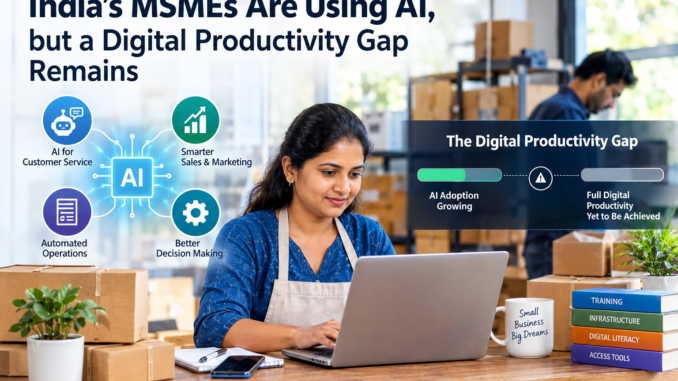
Oct 26: Artificial intelligence is becoming increasingly accessible to India’s micro, small and medium enterprises (MSMEs). Small businesses are using AI to prepare marketing content, communicate with customers, organise information and handle routine administrative tasks. Yet the real challenge lies in turning these individual uses into improvements that can be measured in business performance.
A company may use AI to draft emails in minutes but still spend hours preparing quotations, updating spreadsheets and tracking customer payments. A manufacturer may experiment with AI-powered tools while continuing to face production delays because its inventory and maintenance records are not properly organised.
These gaps highlight an important issue for India’s MSME sector. Access to technology is improving, but businesses also need the right skills, reliable data and connected systems to benefit fully from it.
As AI adoption expands, the next stage of digital transformation will depend on whether small enterprises can convert experimentation into higher productivity, better service and sustainable business growth.
AI Adoption Is Expanding, but Business Integration Remains a Challenge
AI tools are giving smaller businesses access to capabilities that previously required more specialised resources. Applications can now assist with writing, translation, customer communication, data analysis and document processing.
For an enterprise with a small team, these tools can help employees complete repetitive tasks more quickly. However, the benefits may remain limited when AI operates separately from the systems used to manage the business.
A joint Confederation of Indian Industry (CII) and Indian School of Business (ISB) study, MSMEs in India: Challenges, Opportunities and the Road Ahead, illustrates this difference. Among 2,919 surveyed MSMEs, 65.8% reported using AI tools, while 21% reported using enterprise resource planning (ERP) systems or customised business software for operations.
The study also found that respondents primarily used AI for business communication, content creation and training. Its voluntary survey design means the figures should not be treated as representative of every MSME in India. Nevertheless, the findings highlight the importance of looking beyond basic tool usage.
A business can adopt AI without changing how it manages orders, inventory, accounts or customer relationships. To improve productivity across the organisation, technology needs to fit into these wider processes.
The Digital Productivity Gap Explained
The digital productivity gap is the difference between adopting a technology and using it to produce measurable business improvements.
For MSMEs, the gap can appear in several ways:
Employees use AI to prepare content, but marketing enquiries are not tracked systematically.
Sales teams draft customer emails faster, but quotations and follow-ups remain manual.
Businesses collect sales data but do not use it consistently for inventory planning.
Manufacturers introduce digital tools without integrating production, quality and maintenance records.
Financial documents are processed digitally, but payment delays and cash-flow problems remain difficult to monitor.
These examples show why faster task completion does not always translate into better overall performance.
A business might save time preparing individual documents but see little improvement in delivery schedules, sales conversions or operating costs. The missing link is often a coordinated workflow that connects the technology to a clear business objective.
For MSMEs, closing this gap does not necessarily mean buying expensive software. It means identifying where work gets delayed, improving the information used to make decisions and selecting technology that addresses the problem.
New Research Highlights the Opportunity for MSMEs
A separate Dun & Bradstreet India report, Business Enterprises of Tomorrow – The AI Moment for India’s MSMEs, released in October 2026, examined AI adoption among 210 MSME leaders across 12 industries.
The survey found that respondents reported benefits including time savings, improved quality and accuracy, and faster decision-making. These are reported survey outcomes rather than independently verified productivity gains for the entire MSME sector.
The report identified five barriers to achieving sustained value from AI: reliability, integration, future value, talent and safeguards.
Its analysis reinforces an important point. Businesses need more than access to AI applications. They must be able to rely on the outputs, integrate technology into daily operations, develop employee capabilities and manage the associated risks.
Dun & Bradstreet also modelled a scenario in which deeper AI adoption could increase MSMEs’ contribution to India’s GDP to nearly 40% by 2030. This is a modelled outcome under an accelerated adoption scenario, not a guaranteed forecast or an observed result.
For business owners, the practical lesson is to focus on implementation quality rather than assume that AI adoption alone will deliver substantial returns.
Where AI Can Improve MSME Productivity
1. Sales and customer relationship management
Customer enquiries often arrive through emails, telephone calls, messaging applications and websites. Without a central system, businesses can struggle to keep track of quotations, pending responses and potential orders.
AI can help summarise conversations, prepare draft responses and identify follow-up tasks. When used with customer relationship management software, it can also support a more organised sales process.
For example, a small industrial supplier could record every enquiry in one system, use AI to summarise customer requirements and assign follow-up responsibilities to employees.
The business can then measure whether it is responding faster, missing fewer enquiries and converting more quotations into orders.
2. Marketing and online visibility
AI can assist with content planning, product descriptions, advertising copy and campaign ideas. It can also help businesses adapt their communication for different customer groups and languages.
However, generating more content does not automatically improve online visibility or sales. Businesses still need to understand what their customers are searching for and publish useful, accurate information.
MSMEs should evaluate marketing performance through relevant indicators such as qualified enquiries, website visits, conversion rates and customer acquisition costs.
AI should make marketing more efficient without replacing editorial judgement, factual checks or a clear strategy.
3. Inventory and supply chain management
Inventory mistakes can tie up working capital, increase storage expenses and cause delays when products are unavailable.
AI-assisted analysis can help businesses identify purchasing patterns, estimate demand and flag unusual changes in sales. When connected to reliable inventory records, these insights can support better purchasing decisions.
A distributor, for instance, could analyse past orders to identify products that sell consistently and those that experience seasonal demand.
The business should compare forecast accuracy, stock-outs and excess inventory before and after introducing the system. These measures provide a more useful assessment than simply counting the number of digital tools in use.
4. Manufacturing and quality control
Manufacturing MSMEs can explore AI for machine monitoring, visual inspection, production planning and predictive maintenance.
These applications may help identify product defects, detect unusual equipment behaviour and reduce avoidable downtime. Their effectiveness depends on the machinery involved, available data and the reliability of the system.
For smaller factories, a practical starting point may be to track breakdowns and defects more consistently before investing in advanced AI solutions.
Once the business understands the source and cost of a recurring problem, it can evaluate whether a digital or AI-based intervention is likely to deliver sufficient value.
5. Finance and administrative operations
AI-assisted document processing can help extract information from invoices, organise records and prepare summaries for review.
When combined with suitable accounting software, these tools may reduce repetitive data entry and make financial information easier to access.
However, AI cannot eliminate the need for financial controls. Employees should verify important figures, maintain approval procedures and protect confidential information.
MSMEs should also distinguish between automating administrative work and solving deeper financial problems. Faster invoice processing, for example, may improve efficiency, but it will not necessarily resolve delayed customer payments or limited access to working capital.
Why MSMEs Still Face Barriers to Effective AI Adoption
Limited budgets and uncertain returns
Software subscriptions may appear affordable individually, but implementation costs can rise when a business needs multiple applications, training, technical support and system integration.
Smaller enterprises may hesitate to invest when the expected savings are unclear.
The answer is to test solutions on a limited scale and estimate the full cost before committing to a larger rollout.
Skills and employee readiness
Employees may be comfortable with basic digital applications but lack experience in evaluating AI-generated information or incorporating it into more complex workflows.
Training should focus on practical responsibilities, including checking outputs, protecting business information and knowing when human approval is necessary.
Fragmented and unreliable data
AI tools depend on the quality of the information they receive. Inconsistent customer records, incomplete inventory lists and outdated financial data can weaken the usefulness of digital systems.
Businesses should establish consistent record-keeping practices before expecting AI to deliver reliable analysis.
Poor integration between applications
When accounting, sales and inventory systems operate separately, employees may have to enter the same information multiple times.
Connecting appropriate systems can reduce duplication and improve visibility, but integration should be proportionate to the business’s size and requirements.
Privacy, security and accountability
MSMEs need to understand how their chosen tools store and process information. Customer details, financial records, commercial agreements and proprietary data should not be uploaded to services without appropriate safeguards.
Businesses should review access permissions, vendor terms, data-handling practices and human approval requirements.
India’s AI Initiatives Could Support MSME Digital Transformation
India’s AI development efforts provide a broader foundation for technology adoption.
The IndiaAI Mission was approved in March 2024 with an outlay of ₹10,371.92 crore. Its initiatives cover areas including computing infrastructure, AI innovation, datasets, skills and responsible AI.
The IndiaAI Compute Portal also provides information about access to AI computing services for eligible users, including startups and MSMEs, subject to applicable requirements.
For smaller enterprises, the potential benefit extends beyond advanced computing. Affordable applications, accessible training and support with implementation can help businesses explore AI without building a large in-house technology team.
However, the availability of national initiatives does not mean every MSME will automatically qualify for support or achieve productivity gains. Businesses should check current eligibility criteria, application requirements and costs through official channels before making investment decisions.
A Practical Framework for Closing the Productivity Gap
MSMEs can make progress without attempting a complete digital overhaul. A step-by-step approach allows business owners to test ideas, measure outcomes and avoid unnecessary expenditure.
Step 1: Identify one recurring problem
Start with an activity that causes delays, errors or unnecessary costs. Examples include preparing quotations, managing customer enquiries, processing invoices or tracking inventory.
Choose a problem that affects business performance rather than adopting AI simply because it is widely discussed.
Step 2: Measure the existing process
Record how the task currently performs. Depending on the problem, this could include processing time, error frequency, cost per transaction, stock-out rates or customer response times.
A baseline helps establish whether the technology delivers an actual improvement.
Step 3: Organise the relevant data
Ensure that the records required for the task are accurate, accessible and consistently maintained.
A business does not necessarily need a sophisticated database, but it does need information that employees can trust and use appropriately.
Step 4: Test an appropriate tool
Run a limited trial with a defined group of employees or one business function. Check whether the tool fits existing processes and whether its outputs are reliable enough for the intended purpose.
Include software, implementation, training and maintenance costs when assessing the business case.
Step 5: Review results before expanding
Compare the results against the baseline. If the tool saves time but introduces frequent errors or expensive manual checks, its overall value may be limited.
Expand the use of AI only when the benefits are clear and the risks can be managed.
How to Measure Whether AI Is Actually Improving Productivity
A useful evaluation should connect technology use with business results.
Business function
What to measure
Sales
Response time, quotation turnaround and conversion rate
Marketing
Qualified enquiries, conversion rate and customer acquisition cost
Inventory
Stock accuracy, stock-outs and excess inventory
Manufacturing
Downtime, defect rates and production cycle time
Finance
Invoice processing time, error rate and overdue receivables
Customer service
Resolution time, repeat complaints and customer satisfaction
These indicators should be selected according to the business’s needs. Not every MSME needs to measure every metric.
For example, a service business may prioritise response times and conversion rates, while a manufacturer may focus on downtime and product defects.
The objective is to establish whether AI improves an outcome that matters to customers, employees or the business’s financial performance.
A Practical Example: An AI-Assisted Sales Workflow
Consider a small Indian supplier that sells components to local manufacturers. Enquiries arrive through several channels, quotations are prepared manually and employees sometimes forget to follow up with prospective customers.
The company introduces a central system to record enquiries and monitor quotation status. An AI tool helps summarise customer requirements and prepare draft responses, which employees review before sending.
Each enquiry is assigned to a responsible employee, and pending follow-ups become easier to identify.
The company then measures quotation turnaround time, the proportion of enquiries followed up on schedule and the percentage of quotations that result in orders.
If the process improves without creating excessive software costs or new administrative problems, the company can consider applying the same approach elsewhere.
This is an illustrative example rather than a documented company case. Its purpose is to show how AI can support productivity when it is integrated into a defined workflow and evaluated using measurable outcomes.
Opportunities for AI Service Providers and Business Consultants
The digital productivity gap creates opportunities for companies that help MSMEs implement technology effectively.
Many smaller businesses may need assistance with software selection, data organisation, workflow automation, employee training and cybersecurity. Others may require affordable tools designed for specific sectors, such as retail, distribution, manufacturing or professional services.
Service providers can differentiate themselves by solving a clear business problem rather than simply selling access to AI tools.
For example, a provider might help a distributor organise its customer database and automate order follow-ups, or help a manufacturer establish a reliable system for monitoring equipment downtime.
Clear pricing, appropriate training, dependable support and transparent performance measures can make these services more valuable to smaller enterprises.
The Road Ahead for India’s MSMEs
AI is creating opportunities for smaller Indian businesses, but the next stage of adoption will require a stronger focus on implementation.
Enterprises that combine AI with reliable information, connected processes and trained employees may be better positioned to improve efficiency and respond to changing customer needs.
For many MSMEs, progress will come from solving a small number of important operational problems rather than investing in every available technology. A well-tested improvement in sales administration, inventory management or production quality can provide a more useful starting point than a large digital transformation project without clear objectives.
As AI tools become more accessible, the ability to apply them effectively may become an important source of competitive advantage.
Conclusion
India’s MSMEs are exploring AI to improve communication, automate routine work and support better decisions. Yet adoption alone does not guarantee higher productivity.
The digital productivity gap remains when businesses use AI for isolated tasks without improving the systems and processes that determine overall performance.
Closing this gap requires accurate data, suitable software, employee training, responsible information handling and clear performance measures. Government initiatives may support the wider ecosystem, but businesses must still assess their own needs and validate the benefits of each investment.
The most effective approach is to begin with a real operational challenge, test an appropriate solution and measure the results before expanding further.
Ultimately, AI will be most valuable to MSMEs when it helps them save time, reduce avoidable costs, improve quality and build stronger, more competitive businesses.
