
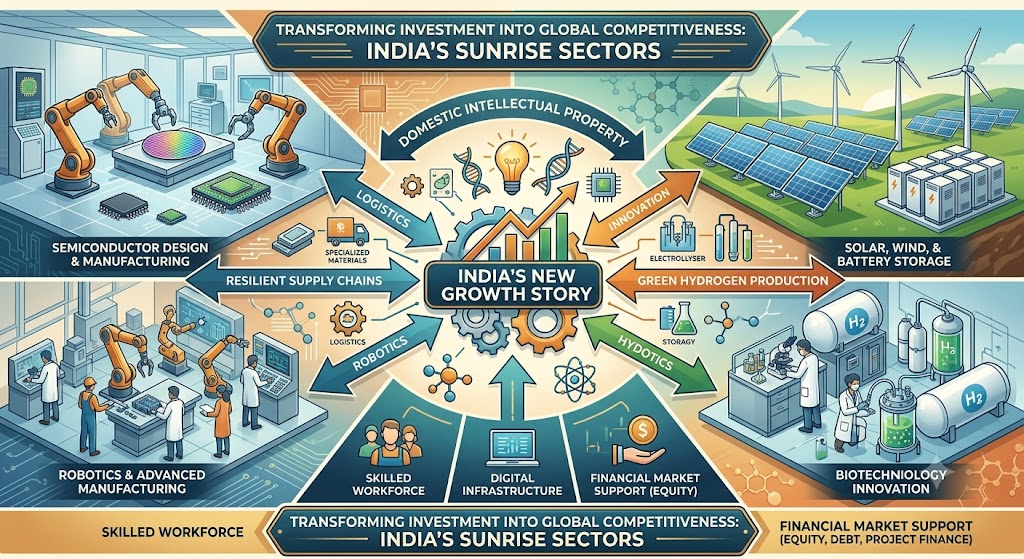
Sep 24: India is entering a phase where the next generation of businesses could be shaped by industries far beyond traditional manufacturing and services. Renewable energy, semiconductors, battery storage, green hydrogen, robotics and biotechnology are emerging as important areas for investment as global economies look for cleaner technologies, resilient supply chains and advanced production capabilities.
The shift is creating a new opportunity for India to attract capital while building its own industrial and technological capabilities. With a large skilled workforce, a growing startup ecosystem and expanding digital infrastructure, the country has several of the building blocks needed to participate in this new investment cycle.
The opportunity, however, is not simply about bringing more money into India. The bigger challenge is converting investment into factories, technologies, intellectual property, globally competitive companies and long-term employment.
Semiconductors are among the most visible examples of this transformation. The global demand for chips is expanding with the growth of artificial intelligence, electric vehicles, smartphones, data centres and connected devices. As countries seek more secure semiconductor supply chains, India has an opportunity to develop businesses across chip design, manufacturing, advanced packaging, testing, equipment and specialised materials.
The growth of renewable energy is creating another large investment market. Solar and wind projects require not only generation capacity but also transmission networks, power electronics, energy-management systems and storage infrastructure. As renewable power becomes a larger part of electricity generation, battery storage could become an increasingly important business connecting clean-energy production with industrial and consumer demand.
Green hydrogen is also attracting attention as industries look for lower-carbon alternatives for applications that are difficult to electrify directly. The development of the sector can create opportunities across renewable power, electrolyser manufacturing, hydrogen storage, transportation and industrial applications.
At the same time, robotics and biotechnology are opening new avenues for businesses. Automation can help manufacturers improve productivity and modernise production processes, while biotechnology has applications ranging from healthcare and agriculture to food processing and industrial production.
The rise of these sectors could have a wider impact on India’s financial markets. As companies move from early-stage research to commercial production, they will require funding for factories, technology, research and development and infrastructure. This could increase demand for equity capital, corporate debt, project finance and specialised lending.
Banks and financial institutions will therefore have an important role in supporting this transition. New-age industries often have different financial requirements from traditional businesses, including higher initial capital expenditure, longer gestation periods and greater technology-related risks.
For lenders, financing the new economy will require a deeper understanding of technology, intellectual property, supply chains and emerging business models. It could also encourage financial institutions to develop specialised products for sectors such as clean energy, advanced manufacturing and semiconductor production.
The economic benefits could extend well beyond the companies directly operating in these industries. A new semiconductor plant, for example, can generate business for equipment suppliers, engineering companies, logistics providers, chemical manufacturers and skilled service firms. Renewable-energy projects can create demand for components, construction, transmission infrastructure and maintenance services.
This creates the possibility of a broader industrial multiplier effect, where investment in one sunrise sector generates opportunities across several connected businesses.
For India, the focus will increasingly be on capturing more value within the country. Developing domestic technology, manufacturing capabilities and intellectual property can help Indian companies move higher up global supply chains rather than remaining primarily consumers or assemblers of imported technologies.
The transition will not be without challenges. Capital-intensive projects require large investments, while emerging technologies can face uncertain demand, rapidly changing technology and global competition. Companies will also need skilled talent, reliable infrastructure and efficient supply chains to scale successfully.
Still, the growing focus on sunrise sectors marks an important change in the direction of business investment. The next investment cycle could increasingly be driven by the technologies needed to power cleaner energy systems, smarter factories, advanced computing and new forms of healthcare and industrial production.
For India’s economy, the opportunity lies in turning this global shift into a domestic growth story — one that creates new businesses, strengthens manufacturing, attracts investment, develops skilled jobs and builds technologies that can compete in markets around the world.
