
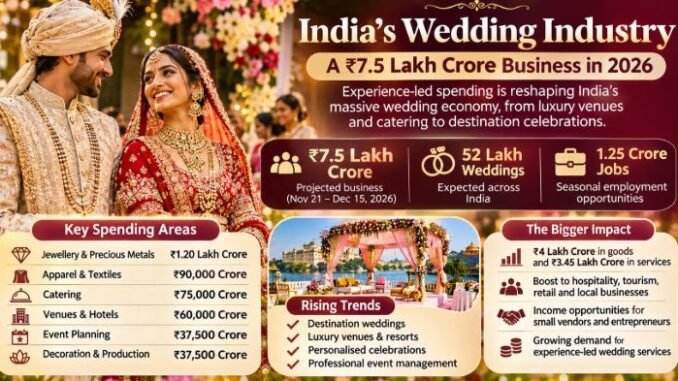
India’s wedding industry is undergoing a significant transformation as families increasingly move beyond traditional wedding shopping and invest in experiences that make celebrations more personal and memorable. From luxury venues and destination weddings to elaborate catering, customised décor and professional event management, experience-led spending is becoming an important force shaping the country’s vast wedding economy. According to estimates by the Confederation of All India Traders (CAIT), around 52 lakh weddings scheduled between November 21 and December 15, 2026, are expected to generate business worth approximately ₹7.5 lakh crore, highlighting the scale of economic activity associated with India’s wedding season.
The projected business reflects more than the purchasing power of Indian households. It also demonstrates how weddings support an extensive network of businesses, workers and entrepreneurs across retail, hospitality, tourism, transportation and entertainment.
India’s wedding industry is estimated to generate around $130 billion in annual spending. With consumer preferences evolving, the market is increasingly bringing together traditional purchases and modern celebration experiences, creating opportunities for both established companies and small businesses.
Experience-Led Spending Changes the Wedding Business
For generations, jewellery, clothing and gifts have been at the centre of Indian wedding expenditure. These purchases continue to hold considerable importance, but the way families allocate their wedding budgets is gradually changing.
Today, many couples and families are paying greater attention to the overall experience of a celebration. Venue selection, food quality, guest hospitality, photography, entertainment and personalised décor are receiving greater consideration during wedding planning.
Industry estimates suggest that catering could generate around ₹75,000 crore in business during the projected wedding season, while venues and hotels could account for approximately ₹60,000 crore. Event planning, decoration and production services are each estimated to contribute around ₹37,500 crore.
This growing demand is creating a larger market for professional wedding planners, hospitality providers, decorators, photographers and entertainment companies.
For businesses in these segments, weddings are no longer limited to providing a venue or arranging food. Customers increasingly expect complete experiences, from carefully designed celebrations to coordinated guest services.
Traditional Wedding Shopping Remains a Strong Market
Despite the growing popularity of experience-led celebrations, traditional retail continues to account for a significant portion of wedding spending.
Jewellery and precious metals are estimated to attract approximately ₹1.20 lakh crore, while apparel and textiles could account for another ₹90,000 crore.
For Indian families, these purchases are about much more than consumption. Gold jewellery often carries emotional and cultural significance, while bridal clothing and wedding gifts remain closely associated with family traditions and relationships.
This is why the changing wedding market should not be seen as a shift away from traditional shopping. Instead, families are increasingly combining conventional purchases with spending on hospitality, entertainment and personalised experiences.
The result is a broader wedding economy in which retail and services are growing alongside each other.
A Wedding Can Support an Entire Network of Small Businesses
One of the most important aspects of India’s wedding industry is its impact on livelihoods.
Behind every large wedding celebration is a network of people whose businesses and incomes depend on the event. Local caterers, flower vendors, decorators, tailors, makeup artists, photographers, musicians, transport operators and temporary hospitality workers all contribute to making a wedding possible.
According to industry estimates, the 2026 wedding season could support approximately 1.25 crore seasonal jobs.
For a small catering business, a major wedding booking can provide work for an entire team. For a neighbourhood florist, increased orders during the wedding season can significantly improve monthly earnings. Similarly, photographers, artisans and independent decorators often depend on wedding bookings for a substantial share of their annual income.
The economic benefits also reach workers who are rarely visible in the larger wedding industry narrative, including delivery personnel, daily-wage labourers, drivers, kitchen assistants and installation teams.
This makes wedding spending an important source of income generation, particularly for small enterprises and India’s informal workforce.
Destination Weddings Expand Opportunities for Hospitality and Tourism
The growing popularity of destination weddings is adding another dimension to the industry.
Families are increasingly considering resorts, hotels and scenic locations for celebrations that combine weddings with travel and leisure experiences. This trend is creating additional business opportunities for hotels, travel operators, airlines, local transport providers and tourism-related businesses.
Wedding budgets vary significantly across income groups. While some families organise celebrations within ₹4–5 lakh, luxury and destination weddings can involve expenditure exceeding ₹4–5 crore.
Delhi-NCR alone is projected to account for around five lakh weddings and approximately ₹2.5 lakh crore in business during the upcoming season.
At the same time, smaller cities and emerging destinations are becoming important markets as organised hospitality services and professional wedding vendors become more accessible.
For local economies, destination weddings can bring additional spending on accommodation, restaurants, transportation, sightseeing and local services.
Rising Wedding Budgets Bring New Financial Challenges
The expansion of the wedding economy also comes with a more complicated reality for households.
As wedding celebrations become increasingly elaborate, families can face pressure to spend more on venues, clothing, hospitality and entertainment. Social expectations and the desire to create memorable occasions can sometimes stretch household budgets.
For many families, a wedding represents years of savings and careful financial planning. While the industry benefits from higher spending, responsible budgeting remains important to ensure that celebrations do not create long-term financial stress.
There is also an opportunity for businesses to serve customers across different spending categories by offering flexible packages, transparent pricing and affordable services without compromising quality.
A stronger focus on value and accessibility could help the industry grow while making professional wedding services available to a wider range of families.
India’s Wedding Economy: More Than a Celebration
CAIT’s projection of approximately ₹7.5 lakh crore in business from 52 lakh weddings between November 21 and December 15, 2026, underlines the enormous scale of India’s wedding market. The estimated spending includes around ₹4 lakh crore on goods and ₹3.45 lakh crore on services.
These figures point to an economy that extends well beyond jewellery showrooms and luxury hotels. It includes thousands of small enterprises, independent professionals, artisans and workers who benefit from the demand generated by weddings.
The real significance of this market lies in how spending moves through different layers of the economy. A family’s decision to organise a wedding creates business for a venue, which in turn employs catering staff, decorators, cleaners, drivers and other service providers. That spending subsequently supports suppliers and local businesses.
As consumer preferences continue to evolve, experience-led services are likely to become an increasingly important part of India’s wedding industry. Traditional retail will retain its cultural and commercial importance, but hospitality, destination celebrations and professional event services are expanding the market’s possibilities.
Ultimately, India’s wedding economy is not simply about increasingly elaborate celebrations or impressive financial projections. It is about family traditions, changing aspirations, entrepreneurship and millions of livelihoods connected to one of the country’s most important social occasions.
