
Ireland has built a strong position as an international business destination, supported by a competitive corporate tax system, access to the European market and a business environment that attracts multinational companies. Over the years, its approach to corporate taxation has played an important role in encouraging foreign direct investment (FDI), particularly in sectors such as technology, pharmaceuticals, financial services and research and development.
However, the country’s tax strategy is evolving. The introduction of the OECD’s 15% global minimum tax for large multinational enterprises has changed the way international businesses assess tax advantages when choosing where to invest. Rather than relying only on a low headline tax rate, Ireland is increasingly using targeted incentives, research support and investment-friendly policies to strengthen its appeal.
For international companies considering expansion, Ireland’s corporate tax environment remains an important part of the decision. At the same time, businesses must look beyond tax rates and consider operating costs, workforce availability, market access and regulatory requirements.
Understanding Ireland’s Corporate Tax Structure
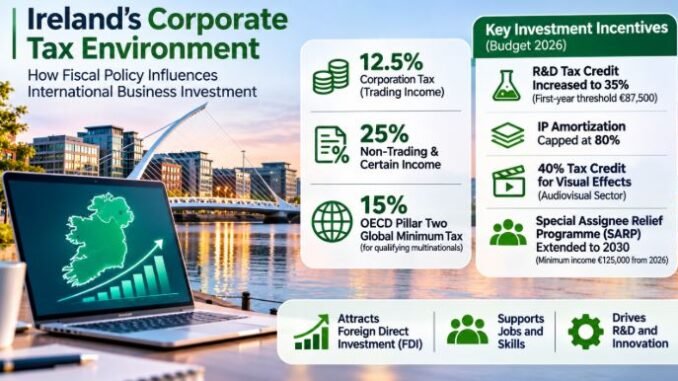
Ireland’s corporate tax system has traditionally been associated with its 12.5% corporation tax rate on qualifying trading income. This rate has helped establish the country as an attractive location for businesses looking to serve European and international markets.
A higher rate of 25% generally applies to non-trading income and certain other categories of income, including some investment and passive income. The distinction is important because a company’s tax position depends on the nature of its activities and the income it generates.
For many years, the 12.5% rate was a central feature of Ireland’s investment strategy. It gave international companies a degree of certainty when assessing the potential costs of establishing or expanding operations in the country.
However, changes in international tax rules mean that the headline rate is no longer the only consideration for large multinational groups. The focus is increasingly shifting towards effective tax rates, business activity and the economic contribution companies make in the countries where they operate.
How the 15% Global Minimum Tax Is Changing the Landscape
One of the biggest developments in international corporate taxation has been the introduction of the OECD’s Pillar Two framework.
Under these rules, multinational enterprise groups within scope are generally subject to a minimum effective tax rate of 15% in each relevant jurisdiction. The framework is designed to reduce the benefits of shifting profits between countries solely to secure lower tax rates.
For Ireland, this represents an important change. Large multinational businesses covered by the rules can no longer assess the country simply on the basis of its traditional 12.5% trading rate. Their investment decisions must also account for the minimum tax requirements and how these interact with local tax provisions.
This does not mean Ireland has lost its appeal as an international business location. Instead, the country’s competitive position increasingly depends on factors beyond the headline corporation tax rate, including skilled employees, research infrastructure, access to European markets and a well-developed business ecosystem.
For companies outside the scope of Pillar Two, the traditional tax framework may continue to be relevant, depending on their circumstances.
Targeted Tax Incentives Support Business Investment
As international tax rules evolve, Ireland is placing greater emphasis on targeted incentives that encourage companies to invest in activities with long-term economic value.
Research and development, intellectual property, innovation and specialist industries remain important areas of focus. These incentives are designed to support businesses that establish meaningful operations, develop new products and contribute to the country’s wider economy.
Some of the measures highlighted in the supplied Budget 2026 overview include:
Research and Development Tax Credit
The R&D tax credit rate is outlined as increasing from 30% to 35%, while the first-year payment threshold rises from €75,000 to €87,500. This is intended to strengthen support for companies investing in research, product development and innovation.
For technology, pharmaceutical and life sciences businesses, research incentives can influence decisions about where to locate development teams and establish research facilities.
Intellectual Property and Holding Structures
Ireland’s tax framework also includes provisions relating to intellectual property and corporate structures. The supplied overview highlights an 80% cap on IP amortisation and an expanded dividend participation exemption, including a reduction in the subsidiary residency requirement from five years to three.
These provisions are relevant to international groups managing intellectual property, subsidiaries and cross-border investments. Their practical value depends on the company’s structure and eligibility under the applicable rules.
Support for Specialist Industries and International Talent
The Budget 2026 measures also include a 40% corporation tax credit for visual effects in the audiovisual sector. In addition, the Special Assignee Relief Programme (SARP) has been extended to 31 December 2030, with a minimum income threshold of €125,000 from 2026, according to the supplied material.
Such measures reflect an effort to attract specialist skills, encourage sector-specific investment and support activities that contribute to Ireland’s international business profile.
Why International Companies Continue to Consider Ireland
Tax policy is an important factor in investment decisions, but it rarely works in isolation. Businesses also assess the wider commercial environment before deciding where to establish offices, production facilities, research centres or regional headquarters.
Ireland offers several advantages that contribute to its position as an international investment destination.
Access to the European market: Its location within the European Union gives companies a base from which to serve customers and business partners across the single market.
Skilled workforce: Access to qualified professionals is important for multinational companies operating in technology, financial services, pharmaceuticals and other knowledge-intensive industries.
Established industry clusters: The presence of international businesses in sectors such as technology, pharmaceuticals and finance creates opportunities for collaboration, specialist recruitment and knowledge-sharing.
International business connections: Ireland’s network of tax treaties and its established corporate environment can support companies managing cross-border operations, subject to relevant tax and regulatory requirements.
These factors can reinforce one another. When businesses establish operations in a particular sector, they can attract suppliers, service providers and skilled professionals, making the location more attractive to other investors.
Foreign Direct Investment and Its Contribution to the Irish Economy
Foreign-owned companies play a significant role in Ireland’s economic landscape. The supplied government assessment highlights their contribution to business activity, employment and research and development.
According to the figures provided, foreign-owned firms account for approximately 25% of economy-wide gross value added, 57.4% of business gross value added, 22% of private-sector employment and 70% of research and development activity.
These figures underline why attracting international investment remains an important part of Ireland’s economic policy.
Multinational companies can bring more than capital into the country. Their operations can create employment, support local suppliers, develop specialist skills and contribute to research and innovation. Their presence can also help strengthen Ireland’s position in international business networks.
At the same time, the contribution of foreign investment varies across sectors and companies. The long-term economic benefit depends not only on the amount of investment attracted but also on the level of real business activity, employment and knowledge development taking place within the country.
How Fiscal Policy Influences Business Investment Decisions
Corporate tax policy can influence where a multinational company chooses to locate its operations, but the decision usually involves several considerations.
A business assessing Ireland may compare its tax obligations with those in other countries while also examining labour costs, infrastructure, access to customers, regulatory requirements and the availability of specialist talent.
For research-intensive businesses, R&D incentives may carry particular importance. For companies managing intellectual property, the treatment of qualifying assets and related income may be a significant consideration. Businesses planning regional headquarters may place greater emphasis on market access, workforce availability and the ability to coordinate international operations.
International tax reforms are also changing how companies evaluate locations. With the introduction of the global minimum tax, the focus is moving away from headline tax rates alone and towards a wider assessment of business conditions and economic substance.
This makes Ireland’s overall investment environment particularly important. A competitive tax framework can help attract companies, but long-term investment is more likely to depend on whether businesses can build sustainable operations and access the resources they need.
The Fiscal Risks Ireland Needs to Manage
Ireland’s reliance on corporation tax revenue also creates challenges for public finances.
Corporation tax has become a major source of government revenue, but a significant share of receipts comes from a relatively small number of large multinational companies. This concentration means that changes in the financial performance, tax arrangements or investment decisions of a limited number of businesses can have a noticeable impact on national revenue.
The supplied material notes that corporation tax receipts reached €17.8 billion through August 2026. While strong receipts provide resources for public investment and government services, they also highlight the importance of managing revenue carefully.
A downturn in major sectors, changes in international tax rules or shifts in multinational profit allocation could affect future collections. This creates a challenge for policymakers: maintaining an attractive environment for international investment while ensuring that public spending is not overly dependent on revenue that may fluctuate.
Prudent budgeting and a broader economic base are therefore important to maintaining long-term fiscal stability.
The Future of Ireland’s Corporate Tax Strategy
Ireland’s corporate tax environment is entering a period in which international cooperation and domestic investment priorities will increasingly shape policy.
The traditional 12.5% trading income rate remains an important part of the country’s tax framework, while the 15% global minimum tax has changed the considerations for large multinational groups within its scope. Targeted incentives for research, innovation, intellectual property and specialist industries are becoming increasingly relevant to the country’s investment proposition.
For international businesses, Ireland continues to offer a combination of European market access, an established multinational business ecosystem and a tax framework that supports selected forms of economic activity.
For policymakers, the challenge is to balance competitiveness with revenue stability and ensure that foreign investment generates meaningful economic benefits.
Ultimately, Ireland’s ability to attract international businesses will depend on more than its corporation tax rates. A skilled workforce, strong infrastructure, predictable regulation, innovation support and sustainable public finances will all influence how the country competes for investment in the years ahead.
