
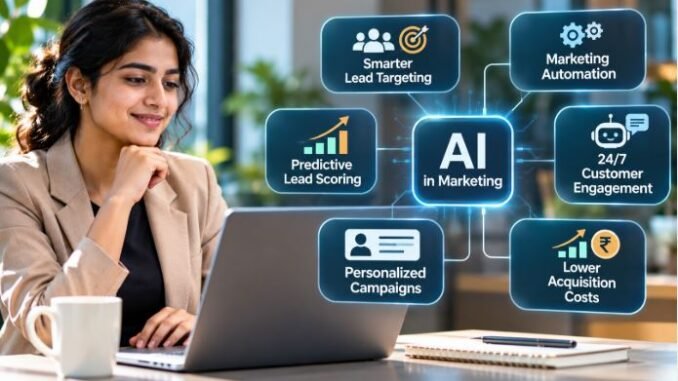
Artificial intelligence is changing the way businesses attract customers, generate leads and build relationships. Marketing, which once depended heavily on manual research, fixed advertising campaigns and repeated follow-ups, is becoming more data-driven and automated.
Businesses are now using AI-powered tools to understand customer interests, identify potential buyers and deliver more relevant messages. These systems can analyse large amounts of information, recognise patterns in customer behaviour and help marketing teams decide where to focus their efforts.
For companies looking to grow, the biggest advantage is not simply doing more marketing. It is reaching the right people at the right time while making better use of marketing budgets.
Finding the Customers Most Likely to Buy
One of the biggest changes brought by AI is the way businesses identify potential customers.
Traditionally, marketing teams collected contact details and assessed leads using basic information such as job title, company size, location and previous interactions. This process often required considerable manual work.
AI can take this further by analysing customer behaviour, past enquiries, website visits and engagement with marketing campaigns. It can identify patterns that suggest whether a person or business is likely to make a purchase.
This process is known as predictive lead scoring. Instead of treating every enquiry equally, businesses can prioritise prospects who show stronger buying interest.
For sales teams, this means spending less time following up with unqualified contacts and more time speaking to people who are genuinely interested in a product or service.
Marketing Automation Is Becoming More Intelligent
Earlier marketing automation systems generally followed fixed instructions. For example, when someone signed up for a newsletter, the system would automatically send a welcome email. If the person clicked a link, another pre-set message might follow.
AI is making these processes more flexible.
Modern systems can study how customers respond and adjust the timing, content and communication channel accordingly. A customer who regularly engages with email may receive more information through that channel, while another who prefers online interaction may be approached differently.
This allows businesses to move beyond repetitive marketing campaigns and create communication that responds more closely to customer interests.
However, automation still needs proper planning. Marketing teams must ensure that messages remain relevant and do not become excessive or intrusive.
AI Reduces the Time Spent on Customer Research
Finding potential customers often involves researching companies, checking contact information and understanding their business requirements.
AI-powered platforms can help collect and organise this information. They can assist with identifying relevant prospects, updating customer records and preparing background information before a sales conversation.
This reduces the administrative work involved in lead generation.
Sales professionals can then spend more time understanding customer requirements, arranging meetings and presenting solutions instead of manually searching for information.
Accurate data remains essential. If customer records are incomplete or outdated, automated systems may produce misleading recommendations. Businesses therefore need to maintain clean and reliable customer databases.
AI Chatbots Help Businesses Connect with Customers Around the Clock
Customers do not always visit websites during business hours. Many want immediate answers about pricing, services, product availability or delivery.
AI-powered chatbots and virtual assistants can help businesses respond to these enquiries at any time. They can answer common questions, collect contact details and identify whether a visitor needs further assistance.
For example, a visitor exploring a company’s website may ask about a particular service. A chatbot can provide basic information, understand the visitor’s requirements and pass the enquiry to the relevant sales team.
This can improve response times and reduce the chances of losing potential customers because of delayed communication.
For smaller businesses, such tools can also provide a practical way to handle a larger number of enquiries without building a large customer support team.
Personalised Marketing Is Becoming Easier to Deliver
Customers are more likely to respond to marketing that reflects their needs and interests. However, personalising every communication manually can be difficult when a business deals with thousands of potential customers.
AI helps make this process more manageable.
It can analyse customer preferences and previous interactions to help businesses prepare relevant emails, advertisements, product recommendations and website content.
Marketing teams can also use AI to test different headlines, messages and campaign formats. By comparing customer responses, they can identify which approaches are performing better and make improvements.
This can help businesses use their advertising budgets more effectively. Rather than relying entirely on broad campaigns, they can focus on audiences and messages that are more likely to generate meaningful engagement.
What This Means for Businesses
The growing use of AI in marketing is creating opportunities across industries, including retail, banking, real estate, education, healthcare services and business-to-business sales.
Companies can use these tools to improve customer research, manage enquiries, support sales teams and measure campaign performance.
For small and medium-sized businesses, AI can make some marketing activities more accessible. Tasks that once required considerable time and manpower can now be supported by automated systems.
Larger organisations can use AI to coordinate marketing activities across different channels and manage large customer databases more efficiently.
The real value, however, comes when technology is connected to a clear business strategy. Simply adopting an AI tool does not guarantee more customers or higher sales. Businesses need to understand their target audience, offer products and services that meet customer needs, and measure whether their marketing activities are producing results.
Data Privacy and Human Involvement Still Matter
As businesses collect and analyse more customer information, protecting personal data becomes increasingly important.
Companies operating in India need to pay attention to applicable data protection requirements, including the Digital Personal Data Protection Act and relevant rules. They should be clear about how customer information is collected, used and stored.
There is also a need for human oversight. AI can help identify prospects and prepare marketing messages, but it may not always understand the full context of a customer’s situation.
Sales discussions, negotiations, complaints and important customer relationships often require personal attention. Human teams remain essential for building trust, handling complex questions and making decisions that need judgement.
A balanced approach, combining AI-driven efficiency with human understanding, is likely to deliver stronger customer relationships.
Conclusion
Artificial intelligence is changing customer acquisition by helping businesses identify potential buyers, personalise communication and manage leads more efficiently. Marketing teams can now use data and automation to make better decisions while reducing time spent on repetitive tasks.
As these technologies become more widely adopted, businesses will have new ways to compete for customer attention. But success will depend on more than automation. Accurate data, responsible use of customer information, relevant communication and human involvement will remain important.
The future of marketing will not be about replacing people with technology. It will be about helping people understand customers better, respond faster and build stronger business relationships.
