
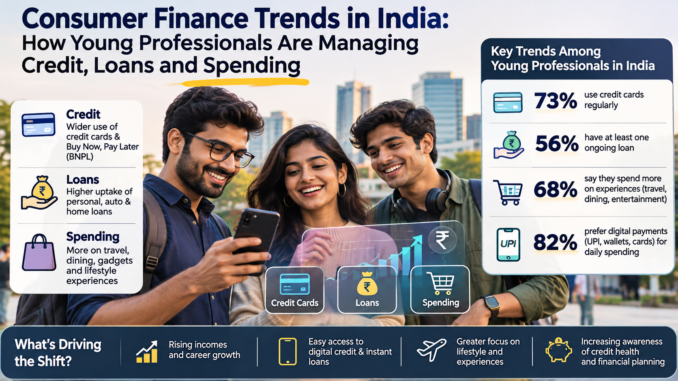
Nov 24: The way young professionals manage their money is changing. Credit cards, personal loans, digital lending apps and buy-now-pay-later services have made borrowing more convenient, but they have also changed how consumers spend and plan their finances.
For many young Indians entering the workforce, credit is no longer limited to major purchases or financial emergencies. It is increasingly used for travel, online shopping, electronic devices, lifestyle expenses and short-term cash-flow requirements. While these options offer flexibility, they can also lead to mounting repayments when spending is not planned carefully.
This shift is creating new opportunities for banks, non-banking financial companies (NBFCs) and fintech platforms. At the same time, it is raising important questions about responsible lending, consumer awareness and the ability of borrowers to manage multiple credit commitments.
The growing challenge for consumers is not simply getting access to a loan. It is understanding the cost of borrowing, choosing the right credit product and ensuring that repayments remain manageable.
India’s Consumer Credit Market Is Expanding
India’s retail lending market is evolving as more consumers participate in the formal financial system. Banks, NBFCs and fintech companies are offering a wider range of credit products to salaried professionals, first-time borrowers and households.
The Reserve Bank of India’s Quarterly Basic Statistical Return for June 2026 reported that overall bank credit grew 16.5% year-on-year. Credit to the household sector increased by 15.2%, while personal loan growth reached 12.7%. These figures indicate continued demand for borrowing across consumer and household segments.
Digital applications, faster processing and wider access to financial services are contributing to this change. Consumers can now explore loan options, submit applications and manage repayments through online platforms.
However, rising credit availability does not necessarily mean that every borrowing opportunity is financially suitable. Consumers need to consider their income, existing obligations and repayment capacity before taking on additional debt.
How Young Professionals Are Changing Their Borrowing Habits
Young professionals are approaching credit differently as digital payments and online financial services become part of everyday life.
Credit cards are commonly used for shopping, travel bookings, subscriptions and household purchases. Personal loans may help cover larger expenses, while short-term credit products offer flexibility when there is a temporary gap between income and spending.
For first-time borrowers, using a credit card responsibly can also help establish a credit history. Regular repayments and controlled credit utilisation can support a stronger credit profile over time.
Problems arise when borrowing becomes a way to maintain a lifestyle that regular income cannot comfortably support. Multiple credit cards, frequent short-term loans and overlapping instalments can gradually increase financial pressure.
Young consumers need to recognise that a higher credit limit does not mean they have more disposable income. Credit remains borrowed money, and every purchase made through it creates a repayment obligation.
Credit Cards and Buy Now, Pay Later Are Reshaping Consumer Spending
Credit cards and buy-now-pay-later (BNPL) services have changed how consumers approach everyday purchases. These payment options allow customers to purchase products immediately and pay for them later, either through a monthly bill or instalments.
For consumers, this can make larger purchases easier to manage. For retailers and financial service providers, these products can encourage online transactions and increase customer engagement.
However, the convenience can also make spending harder to track. Several small instalments may appear affordable individually but can add up to a significant monthly commitment.
Credit card users should be particularly careful about paying only the minimum amount due. The unpaid balance can attract interest, increasing the total cost of purchases. BNPL users should also understand repayment dates, late-payment charges and the terms attached to each transaction.
The important distinction is between payment flexibility and affordability. Delaying a payment does not make a purchase less expensive.
Digital Lending Is Changing the Competition Among Financial Institutions
Fintech companies are becoming an important part of India’s consumer lending ecosystem. Their digital platforms allow customers to explore loan options, complete applications and receive lending decisions without visiting a physical branch.
This is changing the competitive landscape for traditional banks and NBFCs. Financial institutions are increasingly investing in digital onboarding, faster credit assessment, personalised offers and technology-led customer services.
The Reserve Bank of India’s Financial Stability Report, published in June 2026, highlighted the growing presence of fintech companies in the small-ticket personal loan segment below ₹50,000. Their market share in this category reached 56.8% by March 2026. The report also recorded delinquencies of 6.4%, pointing to potential asset-quality risks as lending expands.
These developments highlight an important issue for the industry. Faster loan approvals and wider digital access must be supported by effective credit checks and responsible lending practices.
For borrowers, the convenience of a mobile application should not replace basic due diligence. It is important to verify the lender, understand the loan agreement and review the complete cost of borrowing before accepting an offer.
Why Responsible Borrowing Is Becoming a Priority
As consumers use more financial products, managing multiple repayment commitments is becoming an important part of personal finance.
A borrower who has credit card bills, personal loan EMIs and BNPL instalments may find it difficult to track the total amount due each month. If repayments take up too much of the salary, there may be little room left for savings, emergencies or other essential expenses.
A few practical habits can help young professionals manage credit more effectively:
- Plan monthly spending: Set aside money for essential expenses, savings and loan repayments before making discretionary purchases.
- Pay credit card bills in full: Clearing the outstanding balance whenever possible helps avoid interest on carried-forward amounts.
- Avoid unnecessary borrowing: Use credit for planned requirements rather than treating loans as a regular source of additional income.
- Track all repayments: Maintain a record of active loans, instalments, payment dates and outstanding balances.
- Build emergency savings: A financial reserve can reduce the need to rely on short-term borrowing when unexpected expenses arise.
- Review credit reports: Check credit records periodically and report inaccurate information through the appropriate channels.
These habits can help consumers maintain financial flexibility without allowing debt to become a long-term burden.
What Consumers Should Check Before Taking a Personal Loan
Personal loans can help meet important financial requirements, including emergencies, education and planned expenses. However, borrowers should compare the complete cost of a loan rather than choosing a lender only because it offers quick approval.
The annual percentage rate (APR), processing fees, repayment tenure, late-payment charges and prepayment conditions can all influence the actual borrowing cost.
A longer repayment period may reduce the monthly instalment, but it can increase the total interest paid over the life of the loan. A shorter tenure may reduce the overall interest cost, although the monthly payment will be higher.
Consumers should also verify whether the lender is regulated by the RBI and carefully review the loan agreement before accepting an offer.
The RBI’s Digital Lending Directions, 2025, set out requirements covering borrower creditworthiness, disclosures, loan servicing, grievance redressal and the collection and use of customer data. These rules are intended to improve transparency and strengthen borrower protection in digital lending.
How Banks, NBFCs and Fintech Companies Are Adapting
Changing consumer expectations are encouraging financial institutions to rethink how they design and distribute credit products.
Banks and NBFCs are investing in digital services, quicker application processes and more personalised lending options. Fintech companies are competing through convenient mobile experiences and technology-led credit assessment.
Artificial intelligence and data analytics are also helping lenders evaluate applications, identify unusual transactions and monitor repayment risks. These tools can support better decision-making, provided that financial institutions maintain appropriate safeguards and oversight.
The business opportunity is significant, but it also comes with greater responsibility. Lenders need to balance customer acquisition with sound credit assessment. Offering loans without properly evaluating repayment capacity can increase defaults and affect the quality of lending portfolios.
Institutions that combine digital convenience with transparent pricing, suitable products and reliable customer support can build stronger long-term relationships with borrowers.
The Future of Consumer Finance in India: Balancing Credit Growth and Financial Discipline
India’s consumer finance market is likely to keep evolving as digital banking, fintech innovation and formal credit access expand. Young professionals will remain an important part of this transformation as they build credit histories, make larger purchases and take on new financial responsibilities.
For banks and NBFCs, the opportunity lies in reaching more consumers with products that match their needs and repayment capacity. For fintech companies, sustained growth will depend on building trust, improving credit assessment and maintaining responsible lending practices.
For consumers, the priority should be to make informed financial decisions. Credit can help manage important expenses and provide flexibility, but excessive borrowing can limit future financial choices.
Ultimately, the success of India’s consumer finance market will depend not only on credit availability but also on whether consumers can borrow responsibly, lenders can manage risk and the financial system can support sustainable household finances.
