
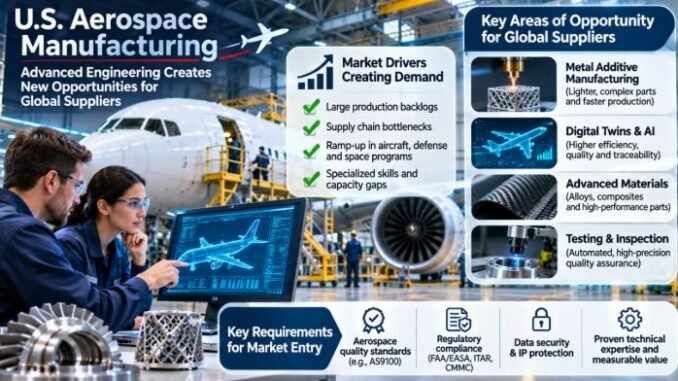
The U.S. aerospace manufacturing industry is entering a period of significant change as aircraft manufacturers, defence contractors and aerospace companies work to increase production and meet growing demand. While the sector continues to invest in advanced technologies and engineering capabilities, supply chain constraints, production delays and shortages of specialised skills are creating challenges for manufacturers.
These pressures are also opening new opportunities for global suppliers. Companies with expertise in precision engineering, advanced materials, metal additive manufacturing, testing and digital production technologies are finding potential entry points into the U.S. aerospace supply chain.
For international businesses, the opportunity is not simply to manufacture components at competitive prices. Aerospace customers require suppliers that can meet demanding technical specifications, maintain consistent quality and support production schedules without compromising safety or reliability.
As the industry looks to increase manufacturing capacity, advanced engineering is becoming an important part of the conversation around supply chain resilience, production efficiency and international business partnerships.
Rising Production Demand Is Creating Supply Chain Opportunities
U.S. aerospace manufacturers are under pressure to increase output while managing large order backlogs and complex production requirements. Aircraft programmes, defence projects and emerging space-related activities all depend on a reliable network of suppliers capable of delivering specialised components and engineering services.
However, expanding production is not always straightforward. Manufacturers must coordinate materials, machinery, skilled workers, testing facilities and quality processes across multiple suppliers. A delay in one part of the supply chain can affect an entire production schedule.
This creates opportunities for specialised global suppliers that can provide additional manufacturing capacity, reduce lead times and support demanding production requirements.
For international engineering companies, the strongest opportunities may lie in areas where domestic manufacturers face capacity limitations or where highly specialised technical capabilities are difficult to source quickly.
Rather than competing across the entire aerospace manufacturing market, suppliers can focus on specific components, processes or engineering services where they offer measurable value.
How Advanced Engineering Is Reshaping Aerospace Manufacturing
1. Metal Additive Manufacturing Is Expanding Design Possibilities
Metal additive manufacturing, commonly known as metal 3D printing, is gaining attention as aerospace companies explore new ways to produce complex components.
Traditional manufacturing methods can involve multiple machining and assembly stages, particularly when components have complicated shapes or internal structures. Additive manufacturing builds parts layer by layer, allowing engineers to create geometries that may be difficult or expensive to produce using conventional methods.
For aerospace applications, this technology offers potential benefits such as weight reduction, component consolidation and shorter development cycles.
It is also moving beyond its earlier role in prototyping towards qualified production applications. However, aerospace components must undergo rigorous testing and qualification before they can be used in critical systems.
This creates opportunities for suppliers with expertise in metal printing, material development, post-processing, inspection and component testing. Companies that can demonstrate consistent manufacturing quality and meet aerospace certification requirements may be better positioned to work with established manufacturers.
2. Digital Twins and AI Are Improving Production Efficiency
Digital technologies are becoming increasingly important in aerospace manufacturing. Digital twins, artificial intelligence and automated inspection systems are helping manufacturers improve visibility across production processes and identify potential problems earlier.
A digital twin creates a digital representation of a physical product, machine or production process. Engineers can use it to study performance, test different operating conditions and identify possible issues before making changes to physical equipment.
Artificial intelligence can support this process by analysing production information, identifying patterns and helping teams detect quality concerns. Automated vision systems can also inspect components for defects and support consistent quality checks.
These technologies are particularly valuable in aerospace manufacturing, where even small production errors can have serious consequences.
The growing use of digital engineering is creating opportunities for external technology providers. Companies specialising in simulation software, industrial AI, automated inspection equipment and manufacturing data systems can support aerospace businesses looking to modernise their operations.
3. Advanced Materials Are Driving Demand for Specialised Suppliers
Aerospace components must perform under demanding conditions, including high temperatures, vibration, pressure and mechanical stress. As aircraft, defence systems and next-generation propulsion technologies evolve, manufacturers continue to explore materials that offer improved strength, durability and reduced weight.
High-performance alloys, advanced composites and specialised metal components are becoming important areas of engineering development.
The demand extends across commercial aviation, defence, space, hypersonic applications and emerging electric vertical take-off and landing (eVTOL) aircraft.
For global suppliers, this creates opportunities in material development, precision machining, forging and specialised component production.
However, aerospace customers require more than access to advanced materials. Suppliers must demonstrate that their products meet strict performance specifications and can be manufactured consistently at the required scale.
4. Testing, Inspection and Quality Engineering Are Becoming More Important
Quality assurance is central to aerospace manufacturing. Every component must meet defined technical and safety requirements, making testing and inspection essential throughout the production process.
Non-destructive testing, automated inspection, dimensional measurement and detailed quality documentation help manufacturers verify that components meet required standards without compromising their structural integrity.
As production volumes increase, manufacturers also need inspection processes that can maintain accuracy without creating additional bottlenecks.
This is opening opportunities for companies that provide specialised testing services, inspection hardware, quality management software and engineering support.
Suppliers capable of combining technical expertise with reliable documentation and traceability can offer an important advantage to aerospace manufacturers.
Workforce and Technical Skills Gaps Add to Industry Demand
Advanced aerospace manufacturing depends on highly skilled engineers, technicians, machinists, quality specialists and software professionals. However, finding and retaining people with the right technical experience remains a challenge for parts of the industry.
As manufacturers seek to increase output and introduce more advanced production technologies, the need for specialised skills is also growing.
Global engineering service providers and manufacturing partners can help address some of these capacity pressures by offering expertise in design, simulation, production engineering, inspection and technical support.
This does not remove the need for local workforce development. Instead, international partnerships can complement domestic capabilities and help manufacturers access specialised knowledge when required.
For global suppliers, demonstrating technical competence, reliable project delivery and an understanding of aerospace production requirements will be important when building long-term relationships.
What U.S. Aerospace Companies Expect from Global Suppliers
Entering the U.S. aerospace supply chain can offer substantial business opportunities, but the barriers to entry are high. Aerospace manufacturers operate under strict quality, safety, security and regulatory requirements.
Global suppliers must demonstrate that they can meet these expectations before they can become trusted partners.
Proven Technical Expertise and Measurable Value
Aerospace supply chains are well established, and many manufacturers already work with experienced Tier 1 and specialist suppliers. New entrants therefore need to offer a clear reason for customers to consider them.
This may include faster production turnaround, improved component performance, lower weight, greater reliability or the ability to support production increases.
Suppliers that focus on specialised capabilities rather than competing only on price may have a stronger opportunity to establish themselves in the market.
Quality Certification and Regulatory Compliance
Quality and regulatory compliance are among the most important requirements in aerospace manufacturing.
Suppliers may need to demonstrate compliance with standards such as AS9100, alongside applicable FAA or EASA airworthiness requirements, depending on the nature of their work.
Non-destructive testing, component traceability and detailed production records are also important parts of aerospace quality systems.
For suppliers involved in defence-related programmes, additional requirements may apply, including International Traffic in Arms Regulations (ITAR), export-control obligations and Cybersecurity Maturity Model Certification (CMMC) requirements where relevant.
Understanding these requirements early can help international companies assess the cost, time and technical preparation involved in entering the market.
Data Security and Intellectual Property Protection
Modern aerospace engineering involves the exchange of sensitive technical information, including computer-aided design models, digital twins, manufacturing instructions and production data.
Protecting this information is essential when working with international customers and partners.
Global suppliers need appropriate cybersecurity measures, controlled access to technical files and clear arrangements for protecting intellectual property. They must also understand the regulatory restrictions that may apply to controlled technical information.
Strong data protection practices can help build customer confidence and support long-term business relationships.
Where Global Suppliers Can Find the Strongest Opportunities
The changing needs of U.S. aerospace manufacturers create opportunities across several specialised areas of the supply chain.
- Precision engineering: Manufacturing complex components that require tight tolerances and consistent quality.
- Metal additive manufacturing: Producing specialised parts and supporting post-processing, testing and qualification.
- Advanced materials: Supplying high-performance alloys, composites and precision-engineered materials.
- Digital engineering: Providing simulation, digital twin technology, AI-supported production systems and engineering software.
- Testing and inspection: Offering non-destructive testing, automated inspection and quality assurance services.
- Engineering services: Supporting design, production planning, technical documentation and specialised engineering requirements.
The best opportunities will depend on the supplier’s technical capabilities, available production capacity and ability to meet the specific requirements of aerospace customers.
The Road Ahead for U.S. Aerospace Manufacturing
The future of aerospace manufacturing will depend on more than increasing production volumes. Companies will also need to improve supply chain reliability, adopt advanced engineering technologies and maintain strict quality standards as programmes become more complex.
For global suppliers, this changing environment creates opportunities to become part of a highly specialised industrial ecosystem. Businesses with expertise in precision manufacturing, advanced materials, digital engineering and testing can potentially support U.S. manufacturers as they work to overcome production bottlenecks and strengthen supply networks.
However, entering the aerospace market requires patience, investment and a clear understanding of technical and regulatory expectations. Certification, traceability, cybersecurity and consistent production quality are not optional requirements; they are fundamental to building trust.
Ultimately, the strongest international suppliers will be those that offer more than additional manufacturing capacity. Their ability to solve specific engineering challenges, deliver reliable components and support long-term production goals will determine their position in the evolving U.S. aerospace industry.
