
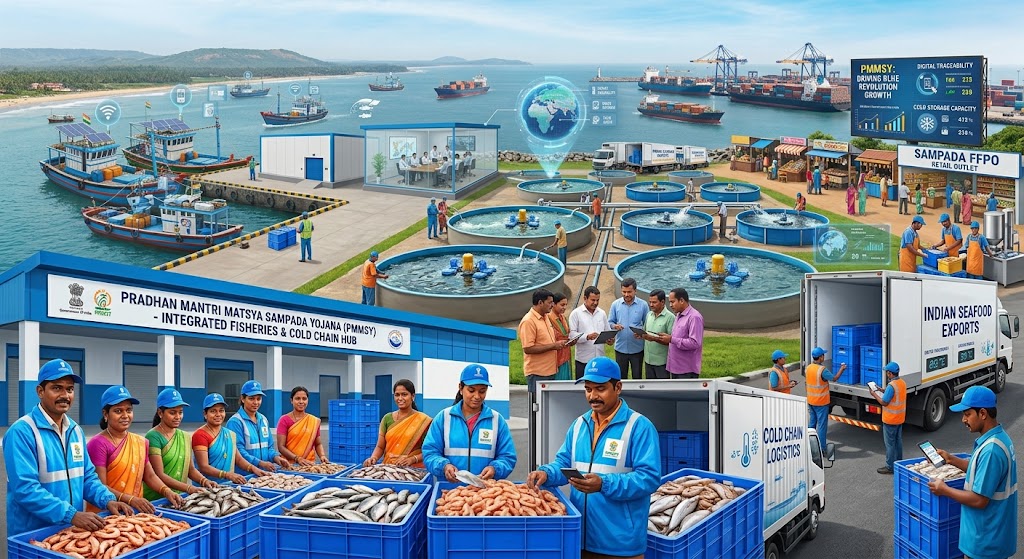
India’s fisheries sector is emerging as a stronger contributor to economic growth, rural employment and export earnings, with the Pradhan Mantri Matsya Sampada Yojana (PMMSY) helping transform traditional fishing and aquaculture into a more modern, technology-driven and investment-oriented industry.
Launched in 2020, PMMSY has focused on improving fish production, fisheries infrastructure, aquaculture, cold-chain facilities, market access, technology and the livelihoods of fishers and fish farmers. Six years into its implementation, the scheme is helping build a broader fisheries value chain that connects production with processing, logistics, domestic markets and global seafood trade.
PMMSY and India’s fisheries sector: A growing economic opportunity
The growth of the Indian fisheries sector is reflected in rising production. Fish production increased from 141.64 lakh tonnes in 2019-20 to a record 197.75 lakh tonnes in 2024-25. Fisheries exports also rose from Rs 46,663 crore in 2019-20 to Rs 73,890 crore in 2025-26. The sector has created direct and indirect employment opportunities for around 58 lakh people in fisheries and aquaculture-related activities.
This expansion has an impact well beyond fishing communities. A larger fisheries economy creates demand for fish feed, aquaculture equipment, boats, ice plants, cold storage, transportation, packaging, processing and retail services.
As a result, growth in fisheries can generate business opportunities across multiple industries while supporting income growth in rural and coastal areas.
Fisheries infrastructure investment can strengthen business growth
One of the most important areas of PMMSY is the development of fisheries infrastructure.
The government has approved significant investments in cold chains, fish transportation, ice plants, fish markets and post-harvest facilities. As of April 2026, approvals worth Rs 2,797 crore had been given for cold-chain and marketing infrastructure, including 775 cold storages and ice plants and 28,489 fish transportation and handling units.
Better infrastructure can reduce wastage, improve product quality and allow fishers and farmers to reach markets more efficiently.
For businesses, this means a more reliable supply chain and greater opportunities to invest in seafood processing, storage, logistics and organised retail.
Aquaculture in India gets a technology-led push
Aquaculture in India is becoming increasingly important to future fisheries growth. PMMSY is supporting modern production systems such as Recirculatory Aquaculture Systems, Biofloc technology and cage culture.
These technologies can improve productivity while making better use of land and water resources. The shift towards technology-based aquaculture is also creating opportunities for entrepreneurs supplying equipment, feed, water-management systems and technical services.
Recent government initiatives have highlighted RAS and Biofloc as part of the next generation of sustainable aquaculture in India.
For the economy, this transition can encourage private investment, create skilled jobs and help smaller fish farmers move towards more organised and commercially viable production.
Fisheries exports can support India’s foreign exchange earnings
The growth of seafood exports from India is another major economic opportunity.
India is already a major global seafood producer and exporter. Better cold chains, processing facilities, traceability and quality standards can help Indian seafood businesses expand their presence in international markets.
Government-approved fisheries development projects worth more than Rs 21,000 crore have included infrastructure aimed at strengthening the fisheries and seafood export ecosystem.
Higher exports can bring foreign exchange into the country while supporting employment in processing plants, logistics companies, packaging units, ports and other allied businesses.
PMMSY can create more opportunities for MSMEs
The fisheries value chain offers considerable scope for MSMEs and rural entrepreneurs.
Businesses involved in fish processing, cold storage, transportation, packaging, feed production, equipment manufacturing and retail can benefit as the sector becomes more organised.
The Pradhan Mantri Matsya Kisan Samridhi Sah-Yojana (PM-MKSSY) is also aimed at formalising the fisheries sector and improving access to institutional finance, insurance and other services. The sub-scheme has an estimated outlay of Rs 6,000 crore for 2023-24 to 2026-27.
Greater access to formal finance can help fish farmers and small businesses expand operations, purchase equipment and improve productivity.
Fish Farmers Producer Organisations can strengthen rural businesses
Collective organisations are another important part of the fisheries growth story.
Under PMMSY, projects worth Rs 544.86 crore have been approved for the formation of 2,195 Fish Farmers Producer Organisations (FFPOs) between FY 2021-22 and FY 2025-26.
FFPOs can improve the bargaining power of small fish farmers and fishers by helping them access markets, technology, finance and inputs collectively.
This can make the fisheries supply chain more efficient while giving small producers a greater share of the value generated from their produce.
Digitalisation is changing India’s fisheries economy
Technology is also becoming a key part of the fisheries sector in India.
The National Fisheries Digital Platform, launched under PM-MKSSY, is helping formalise the sector through digital identities and improved access to institutional credit, insurance and other services. It is also designed to support traceability and better market integration.
Digitalisation can make it easier for banks, insurers, buyers and other businesses to connect with fishers and aquaculture farmers.
A more formal and digitally connected sector can therefore improve transparency, financial access and investment opportunities.
Employment and rural consumption can get a boost
The economic impact of fisheries is particularly significant for rural and coastal communities.
With around 58 lakh direct and indirect employment opportunities created in fisheries and aquaculture-related activities, the sector is supporting incomes across production and allied activities.
Higher incomes can increase spending on consumer goods, housing, education, transportation and local services. This creates a multiplier effect in rural economies.
At the same time, new employment in processing, logistics, aquaculture technology and seafood businesses can further strengthen local economic activity.
PMMSY strengthens India’s Blue Economy
The growth of fisheries is closely linked to India’s Blue Economy ambitions.
India is the world’s second-largest fish producer and contributes around 8 per cent of global fish production. The country is also a major aquaculture producer and a leading shrimp producer and exporter.
The next stage of growth will depend on combining higher production with sustainable fishing practices, modern aquaculture, efficient infrastructure and responsible use of marine resources.
This creates opportunities not only for traditional fisheries businesses but also for technology companies, startups, logistics providers, exporters and investors.
What PMMSY means for India’s economic growth
The biggest impact of PMMSY on India’s economic growth could come from the expansion of the entire fisheries value chain.
Higher fish production supports processing and exports. Better cold chains reduce wastage. Modern infrastructure improves market access. Digital platforms expand access to finance. Technology-based aquaculture raises productivity. And stronger producer organisations can improve the earnings of small fishers and farmers.
Together, these developments can increase the economic value generated from fisheries while creating new employment and investment opportunities.
The government has allocated Rs 2,500 crore to PMMSY in the 2026-27 Budget, underlining the continued policy focus on fisheries development.
The road ahead for India’s fisheries industry
For the fisheries sector to become an even bigger growth engine, India will need continued investment in cold chains, processing, aquaculture technology, skilled manpower, sustainable fishing and global market access.
The opportunity is significant because fisheries sit at the intersection of rural development, food security, employment, exports and the Blue Economy.
As PMMSY continues to support modern infrastructure and technology adoption, India’s fisheries sector is moving beyond traditional livelihood activities towards a more organised, competitive and export-oriented industry.
The transformation could make fisheries an increasingly important contributor to India’s economic growth, while creating new opportunities for fishers, fish farmers, MSMEs, startups, exporters and investors.
