

Shipping errors rarely look dramatic at first glance. A slightly wrong weight here, a suboptimal pallet layout there. But in high-volume logistics, these small missteps compound fast and expensively. It is not unusual for companies to lose tens of thousands of dollars annually on avoidable shipping mistakes.
What makes it worse? Most of these issues repeat themselves silently across hundreds or thousands of shipments.
If your operation relies on manual processes or fragmented systems, you are likely paying for inefficiencies you do not even see yet.
Where the Real Money Leaks Happen
Let’s start with the usual suspects, mistakes that do not just cost money but also erode reliability.
Address inaccuracies affect up to 7 percent of shipments. At scale, that can mean tens of thousands annually in correction fees alone.
Then come weight and dimension discrepancies. More than half of LTL shipments get reclassified. Many shippers underestimate size or freight class to reduce quoted costs, but carriers catch it, and correction fees often exceed the original price.
Documentation errors are even riskier. Missing invoices or incorrect HS codes can trigger storage fees or heavy penalties.
And then there is cargo loading.
Improper cargo loading is where financial damage becomes physical. Poor weight distribution, unstable stacking, or inefficient container loading does not just waste space; it increases the risk of damaged goods and delays.
Main point: Most costly shipping mistakes are predictable and preventable.
Why Container Loading Optimization Is Still Overlooked
Many logistics teams still treat container loading as a manual task. Someone eyeballs the layout, adjustments happen on the fly, and experience replaces data.
That might work for simple shipments. But with mixed cargo and tighter margins, this approach quickly breaks down.
This is where tools designed for efficient planning and visualization of how goods fit into shipping containers and trucks make a difference. Instead of trial and error loading, planners can simulate cargo placement before anything is physically moved.
The result is straightforward, better space utilization, fewer errors, and more consistent outcomes.
The Hidden Cost of Poor Container Utilization
If a 40-foot container is loaded to only 65 percent capacity, you are leaving significant money on the table every single time.
Poor container loading also leads to:
- Uneven weight distribution
- Longer loading times
- Higher damage rates
- Complicated unloading
These inefficiencies ripple through the entire supply chain.
In short, every poorly loaded container directly impacts your margins.
How Cargo Planning Software Changes the Game
Modern cargo planning software shifts decision-making from guesswork to data.
Instead of manual planning, systems evaluate cargo dimensions, weight, stacking rules, and delivery constraints, then generate optimized loading plans in seconds.
3D visualization plays a key role. Planners can see exactly how cargo fits, test layouts, and catch issues early.
This is where container loading optimization becomes practical. You are not estimating; you are verifying.
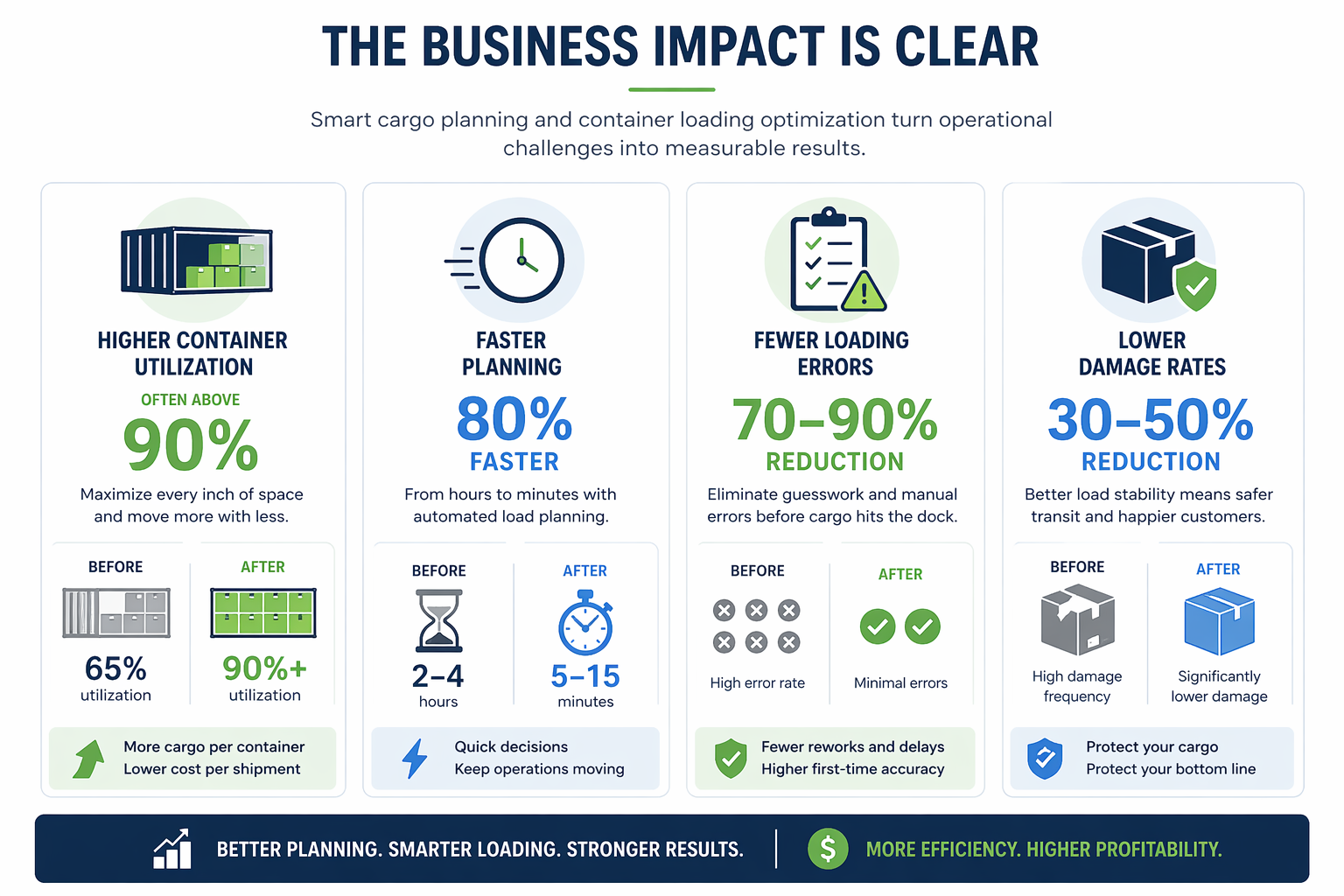
The business impact is clear:
- Higher container utilization, often above 90 percent
- Faster planning
- Fewer loading errors
- Lower damage rates
Many companies assume these tools are only for large enterprises. In reality, mid-sized operations often benefit the most.
Generated by chatGPT
Technology Alone Is Not Enough
Software helps, but only if implemented correctly.
Common pitfalls include:
- Over-reliance on automation without human oversight
- Inaccurate input data
- Poor system integration
Successful teams use these tools as decision support, not a replacement for operational thinking.
Control What You Can Measure
Shipping will never be completely error-free. But the most expensive mistakes, the ones that quietly drain your budget, are preventable.
The shift is simple: move from reactive problem solving to proactive planning.
Start by identifying where errors occur. Then focus on processes that rely on manual decisions or lack visibility.
That is where cargo loading improvements and container loading optimization deliver the highest value.
Because once you can see the problem clearly, you can fix it before it costs you.