

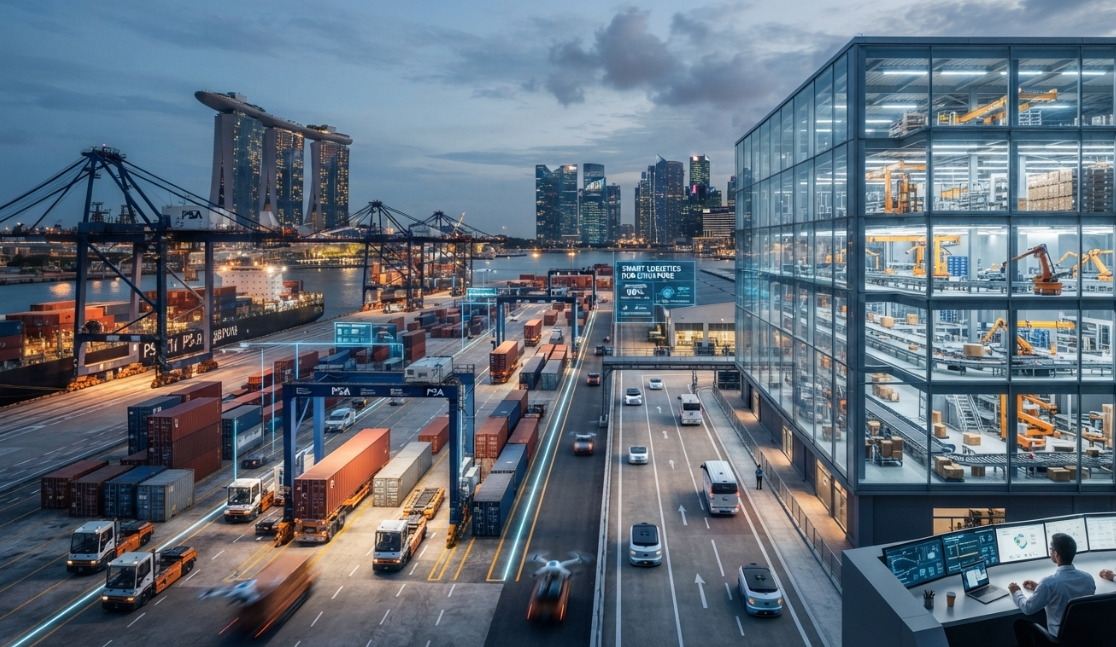
Oct 19: Singapore’s logistics industry is entering a new phase as automation, artificial intelligence and connected digital systems reshape how goods are stored, transported and delivered. For a country that plays a major role in international trade, improving supply chain efficiency is essential to maintaining its competitive position.
From robotic warehouses to automated container terminals, technology is helping logistics companies manage complex operations, improve inventory accuracy and respond to changing customer demands. These developments are also creating opportunities for software developers, automation specialists and businesses offering supply chain solutions.
A major example is Maersk’s World Gateway II distribution centre in Singapore. Officially opened in March 2026, the 1.1-million-square-foot facility uses autonomous mobile robots, automated storage and retrieval systems, and other advanced warehouse technologies. The development represents an investment of more than S$200 million and supports regional distribution and e-commerce fulfilment.
The investment reflects a wider shift in the logistics sector. Businesses are increasingly looking at automation not simply as a way to introduce new technology, but as a practical means of improving productivity, reliability and long-term growth.
Why Logistics Automation Matters in Singapore
Singapore connects international shipping networks, manufacturers, retailers and regional distribution centres. Goods move through its ports, airports, warehouses and transport networks before reaching markets across Asia and beyond.
Coordinating these activities requires accurate information and efficient operations. A delay in a warehouse or transport schedule can affect delivery commitments, inventory availability and customer satisfaction.
Logistics companies must also manage operating costs, manpower constraints, limited warehouse space and increasingly demanding delivery expectations. Automation can help by reducing repetitive manual work, improving stock visibility and enabling faster operational decisions.
However, technology alone cannot solve every supply chain problem. Businesses need to identify where delays occur, which processes consume the most resources and how an automated solution would improve performance.
For many companies, the most effective starting point is a clearly defined operational challenge rather than a complete overhaul of existing systems.
1. Warehouse Automation Is Improving Storage and Fulfilment
Warehouses are among the most visible examples of logistics automation. Traditional facilities often depend on employees to locate products, move inventory, prepare orders and update stock records. Automated systems can now perform many repetitive activities with greater consistency.
Common solutions include autonomous mobile robots, automated conveyors, robotic picking systems and warehouse management software. Automated storage and retrieval systems can also help businesses use available space more efficiently.
These technologies are particularly relevant to e-commerce companies and regional distribution centres, where order volumes can fluctuate significantly during promotional periods and seasonal peaks.
Maersk’s World Gateway II facility illustrates how several automation technologies can operate together within a large distribution centre. Its systems are designed to support faster fulfilment, improved accuracy and shorter lead times.
Smaller logistics businesses can also benefit without investing in a fully automated warehouse. Digital inventory tracking, barcode scanning and automated sorting may deliver worthwhile improvements at a more manageable cost.
The right approach depends on order volumes, warehouse layout, product characteristics and the expected return on investment.
2. Smart Port Technology Is Strengthening Cargo Operations
Singapore’s port network is another important area of automation. Container terminals must coordinate ships, cranes, yard equipment and transport vehicles while moving large volumes of cargo safely and efficiently.
Automated guided vehicles and digital planning systems can help coordinate container movements and reduce unnecessary handling. When combined with reliable operational data, these technologies can also improve scheduling and resource allocation.
Tuas Port is central to Singapore’s long-term maritime strategy. According to the Ministry of Transport, the port is being developed to become the world’s largest fully automated port when completed in the 2040s, with a planned capacity of 65 million twenty-foot equivalent units annually.
For shipping companies, freight forwarders and transport operators, more efficient port operations can improve the coordination of cargo collection, onward transportation and warehouse deliveries.
Technology providers may find opportunities in automation equipment, sensors, predictive maintenance, software integration and port logistics analytics. As port operations become more connected, reliable data exchange and cybersecurity will also become increasingly important.
3. Artificial Intelligence Is Making Supply Chains More Responsive
Artificial intelligence is helping logistics businesses move beyond manual planning and fixed operating schedules.
By analysing sales patterns, historical shipments, inventory levels and transport data, AI-powered systems can support demand forecasting, delivery planning and resource allocation.
For example, a retailer can use predictive analytics to anticipate demand before a major sales event and adjust stock levels accordingly. A transport operator may use route optimisation software to plan deliveries more efficiently, while a warehouse manager can analyse operational data to identify recurring bottlenecks.
These applications can help businesses make better-informed decisions and respond more quickly when conditions change.
However, AI is only as useful as the data it receives. Inaccurate records, disconnected software systems and incomplete shipment information can undermine its recommendations.
Businesses also need appropriate oversight to ensure automated decisions remain practical and reliable. The strongest results are likely to come from combining useful technology with the experience of people who understand the realities of logistics operations.
4. Real-Time Tracking Is Improving Supply Chain Visibility
Knowing where goods are and when they are expected to arrive is essential for businesses managing international supply chains.
GPS tracking, connected sensors and digital logistics platforms can provide updates on shipment location, delivery progress and, where relevant, storage conditions. These capabilities are particularly valuable for products that require careful handling, including pharmaceuticals, fresh food and sensitive electronic components.
Singapore is also developing digital infrastructure to improve information exchange across supply chain participants. The Singapore Trade Data Exchange, known as SGTraDex, provides a data-sharing framework designed to help organisations exchange supply chain information more efficiently.
Better information sharing can reduce reliance on manual paperwork and help businesses respond earlier to delays or changes in delivery schedules.
For example, when a shipment is delayed, timely updates can help a warehouse adjust its receiving schedule or allow a retailer to communicate more accurately with customers.
For technology companies, opportunities include shipment tracking platforms, data integration, analytics and tools that connect information across different logistics systems.
5. Automation Can Support More Sustainable Logistics
Efficiency and sustainability are increasingly connected in supply chain management. Better route planning, improved vehicle utilisation and more efficient warehouse operations can help businesses reduce wasted resources.
Automation can support these goals by identifying unnecessary vehicle movements, improving inventory planning and reducing avoidable handling. Electric vehicles and energy-efficient equipment may offer additional benefits when they are suitable for the operation.
Singapore’s long-term port development plans also emphasise technology and operational efficiency as part of maintaining maritime competitiveness.
Still, automation does not automatically reduce environmental impact. Robotics, warehouse equipment and digital infrastructure consume energy, and the results depend on how the systems are designed and used.
Businesses should measure outcomes such as fuel consumption, electricity use, empty trips and vehicle utilisation to establish whether a new system is delivering meaningful environmental benefits alongside operational improvements.
Business Opportunities in Singapore’s Logistics Automation Market
As logistics companies modernise their operations, opportunities are emerging for technology businesses and specialist service providers.
-
Warehouse technology: Robotics, inventory management software, automated sorting and warehouse integration services.
-
AI and analytics: Demand forecasting, route optimisation, operational dashboards and predictive maintenance.
-
Supply chain visibility: Shipment tracking, connected sensors, data-sharing platforms and delivery monitoring.
-
Automation support: Installation, maintenance, technical consulting and employee training.
-
Cybersecurity: Protection for connected logistics systems, operational data and digital supply chain infrastructure.
Small and medium-sized enterprises can participate by solving specific problems rather than developing expensive technology from scratch. A business might specialise in connecting warehouse software with transport management systems or provide analytics that helps smaller operators understand delivery performance.
For technology providers, understanding customer needs is essential. Logistics companies want solutions that fit their existing operations, deliver measurable value and can be maintained without excessive cost or complexity.
Challenges Businesses Must Address
Despite its potential, logistics automation requires careful planning.
The upfront costs of robotics, software, equipment and system integration can be substantial. Businesses must also consider maintenance, staff training, cybersecurity and the possibility of disruption during implementation.
Compatibility is another challenge. New systems may not work smoothly with existing warehouse, transport or inventory platforms without additional development.
Workforce development is equally important. As repetitive tasks become automated, employees may need training in equipment monitoring, technical support, data analysis and system management.
A phased implementation can help businesses manage these risks. Starting with a pilot, setting measurable performance targets and gathering feedback from employees can reveal problems before a wider rollout.
Companies should assess improvements in order accuracy, processing time, operating costs and delivery performance rather than judging success solely by the number of automated systems installed.
The Future of Logistics Automation in Singapore
Singapore’s logistics industry is moving towards more connected, data-driven and automated operations. Investments in warehouse robotics, smart port infrastructure, AI-powered planning and digital tracking are changing how businesses manage goods across international supply chains.
For logistics operators, manufacturers and retailers, these developments offer opportunities to improve reliability, respond to demand and manage complex operations more effectively. For technology providers, they create potential markets for software, automation equipment, data integration and specialist support services.
The most successful businesses will not necessarily be those that adopt the most technology. They will be the ones that identify genuine operational problems, choose appropriate solutions and integrate them effectively into daily workflows.
As Singapore continues to strengthen its position as a global logistics hub, automation will remain an important part of its supply chain transformation. Businesses that combine technological investment with workforce development, strong data management and clear performance goals will be better prepared for the industry’s next stage of growth.
