
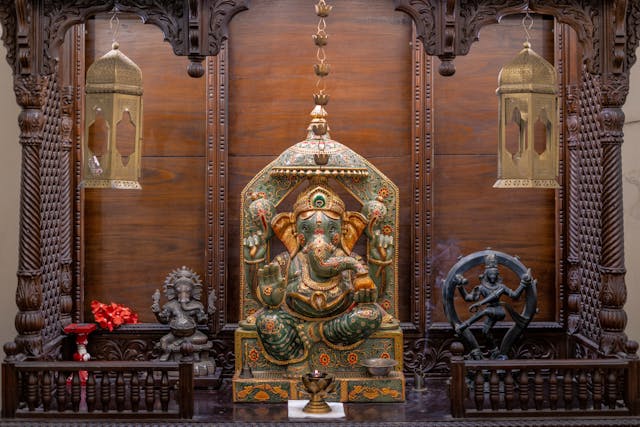

A pooja room today is no longer confined to heavily ornate, enclosed corners. In contemporary homes, it is being reinterpreted as a quiet architectural pause within the house—a space where design restraint meets spiritual intent. One of the most refined expressions of this shift is the Mid-Century Modern pooja room design featuring a skylight and a stone backdrop, where natural elements and clean geometry come together in quiet harmony.
This design language is not about decoration. It is about removal—removing noise, clutter, and excess—until only presence remains.
A design language built on restraint, proportion, and purpose
Mid-Century Modern design is defined by clarity: simple lines, honest materials, and a strong connection to nature. When translated into a pooja space, it creates a setting that feels intentional rather than ornamental.
Instead of traditional heavy carvings or layered motifs, the focus shifts to:
- A compact wooden mandir with precise geometry
- Smooth surfaces with minimal visual interruption
- A restrained palette of walnut, ivory, stone grey, and muted gold
The result is a space that does not demand attention—it naturally draws it inward.
Skylight as a symbolic and spatial element
The skylight becomes the emotional core of this design. Positioned directly above the sanctum, it transforms the pooja room into a vertical connection between earth and sky.
Throughout the day, the quality of light changes the experience of the space:
- Morning light feels soft and restorative
- Midday light becomes pure and direct
- Evening light turns warm and contemplative
This shifting illumination replaces artificial grandeur with something more subtle and powerful—time itself becomes part of the ritual.
In practical terms, the skylight also reduces dependence on artificial lighting and improves ventilation, but its true value lies in the atmosphere it creates: quiet, evolving, and deeply grounded in nature.
Stone backdrop: grounding stillness in texture
Behind the mandir, a stone-clad wall anchors the entire composition. Whether crafted from slate, sandstone, granite, or textured natural stone, the surface introduces a tactile depth that contrasts beautifully with the minimal structure in front of it.
Unlike polished decorative finishes, stone carries an inherent imperfection that feels honest and timeless. It brings:
- Visual weight without heaviness
- Texture without distraction
- A sense of permanence within a changing home
The stone backdrop subtly reminds one of stability—an ideal emotional foundation for a sacred space.
Material dialogue: where warmth meets earth and light
The beauty of this concept lies in how three primary elements interact: wood, stone, and natural light.
- Wood introduces warmth and human touch
- Stone provides grounding and quiet strength
- Light adds movement, energy, and spiritual openness
Together, they form a balanced composition where no single material dominates. Instead, each supports the other, creating a space that feels both designed and naturally evolved.
Spatial thinking: integrating spirituality into modern homes
In Mid-Century Modern interiors, the pooja room is often not isolated as a closed shrine but integrated into the home’s architectural flow. It may appear as:
- A recessed niche in a living area
- A softly partitioned corner with wooden screens
- A linear wall installation with subtle depth
This integration ensures that the sacred space is present in daily life without becoming visually overpowering.
Even in compact urban apartments, this design adapts well because it relies more on composition and light than on scale.
The emotional experience of the space
Beyond aesthetics, this type of pooja room changes how the space is experienced. The absence of excess decoration shifts attention inward. The skylight introduces natural rhythm. The stone wall provides grounding stillness.
Together, they create a mood that is less about ritual performance and more about quiet presence.
It becomes a space where:
- The mind slows down naturally
- Rituals feel less mechanical and more reflective
- Silence itself feels structured and meaningful
Conclusion
A Mid-Century Modern pooja room with a skylight and stone backdrop is not just a design choice—it is a philosophy of reduction and balance. It replaces visual complexity with emotional clarity, allowing light, material, and space to carry spiritual meaning.
In its quietest form, it achieves something rare in contemporary interiors:
a space that feels both architecturally modern and spiritually timeless, where nothing is added unnecessarily—and nothing essential is missing