
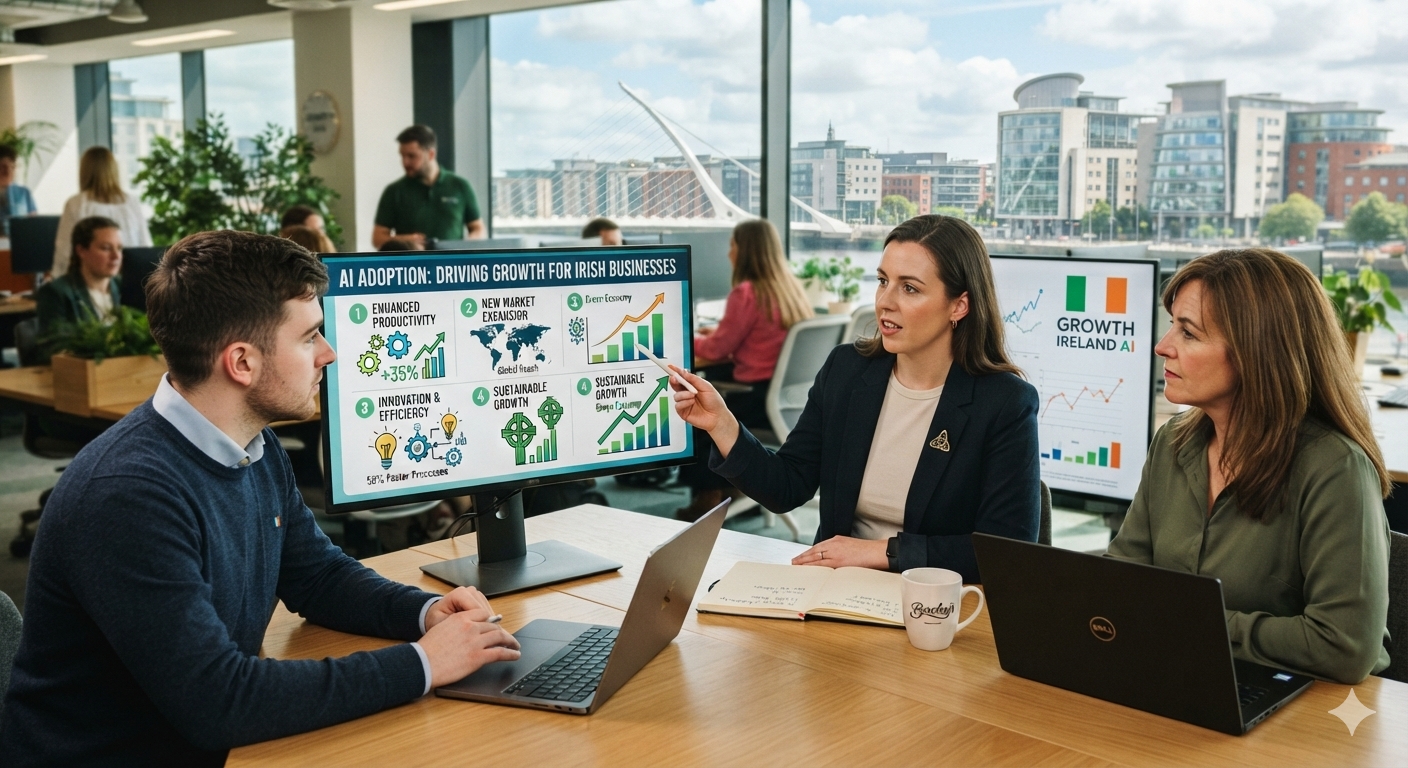
Oct 14: Artificial intelligence (AI) is creating new growth opportunities for Irish businesses by helping companies improve productivity, reduce operating costs and respond more effectively to customer needs. From technology startups in Dublin to agricultural businesses, manufacturers and tourism operators across Ireland, AI is becoming a practical tool for improving business performance and exploring new revenue streams.
As competition increases and customer expectations evolve, businesses are looking for ways to work more efficiently without compromising service quality. AI adoption in Irish businesses is helping address this challenge by making advanced tools more accessible to companies of different sizes. The opportunity lies in applying these technologies to real business problems rather than adopting them simply because they are becoming popular.
AI Adoption Is Gaining Momentum in Ireland
Ireland’s established technology ecosystem, skilled workforce and growing startup community provide a strong foundation for AI adoption. Businesses are increasingly exploring generative AI, predictive analytics and automation to improve everyday operations and support long-term growth.
According to Ireland’s Central Statistics Office (CSO), 20.2% of enterprises used AI technologies in 2025, compared with 15.2% in 2024 and 8.1% in 2023. Adoption varied by business size, reaching 57.7% among large enterprises, 28.6% among medium-sized enterprises and 17.2% among small enterprises.
These figures highlight both the progress being made and the opportunities available to smaller companies. While larger organisations may have more resources to invest in technology, SMEs can also benefit from readily available AI tools for administration, customer support, marketing and business analysis.
Improving Productivity Without Increasing Workloads
One of the most immediate benefits of AI is its ability to handle repetitive tasks that take employees away from more valuable work. Businesses can use AI to organise emails, summarise documents, prepare reports, manage routine enquiries and analyse operational information.
For example, an Irish professional services firm could use AI-assisted tools to organise documents and speed up routine research. A manufacturer could analyse production data to identify inefficiencies, while a retailer could use sales forecasts to improve stock planning.
These applications can help businesses make better use of existing staff and resources. Employees can spend more time on customer relationships, problem-solving and strategic planning instead of manually completing repetitive tasks.
The commercial benefit depends on how well the technology fits into existing workflows. Companies should identify specific bottlenecks, test suitable solutions and measure the time or costs saved before expanding their investment.
New Growth Opportunities for Irish SMEs and Startups
AI is giving smaller businesses new ways to research markets, test ideas and compete with larger organisations. Entrepreneurs can use AI-assisted tools to analyse customer feedback, develop early product concepts, research competitors and prepare initial marketing campaigns.
For startups, these capabilities can reduce the time required to test a business idea before committing significant resources. Established SMEs can use AI to improve lead management, support sales teams and identify opportunities to retain existing customers.
Consider a small Irish online retailer seeking to expand its customer base. AI-powered recommendations and customer analysis could help the business understand which products appeal to different audiences. A growing consultancy could use automation to manage routine enquiries and organise client information more efficiently.
However, AI-generated content, research and recommendations should be reviewed for accuracy. Businesses that combine automation with industry knowledge and human judgement are better placed to turn efficiency gains into sustainable growth.
Transforming Customer Experience and Digital Marketing
Customer experience is another area where AI can make a measurable difference. Consumers increasingly expect quick responses, relevant recommendations and convenient digital services. AI-powered chatbots can answer common questions, provide information outside business hours and direct more complex enquiries to the appropriate employee.
Businesses can also analyse customer behaviour to understand purchasing patterns, improve product recommendations and identify opportunities for repeat sales.
For Irish SMEs competing online, AI can support keyword research, content planning, campaign analysis and audience segmentation. These tools can help marketing teams identify relevant search terms, understand which campaigns perform well and make better use of limited budgets.
Nevertheless, automated communications need appropriate human review. Businesses must also handle personal information responsibly and comply with applicable data protection requirements, including the General Data Protection Regulation (GDPR).
How AI Can Support Ireland’s Key Industries
AI’s commercial potential extends well beyond the technology sector. Businesses across Ireland’s established industries can explore applications suited to their particular needs.
Tourism and hospitality: Hotels, tour operators and visitor attractions can use AI to respond to enquiries, personalise travel recommendations and analyse seasonal booking patterns. Better demand forecasting can also help businesses plan staffing and manage resources during busy periods.
Agriculture: Agricultural businesses can explore AI-assisted monitoring, weather analysis and resource management. When combined with suitable data and equipment, these technologies may help farmers make more informed decisions about crop conditions, irrigation and farm operations.
Manufacturing: Manufacturers can use AI to analyse production data, identify quality issues and support predictive maintenance. Detecting potential equipment problems earlier may help reduce unplanned downtime.
Financial and professional services: Businesses can use AI to support document processing, customer service, fraud detection and data analysis. Sensitive applications require careful oversight and compliance with relevant regulations.
These examples illustrate how AI can support both traditional industries and newer digital businesses. The strongest opportunities often arise when companies apply technology to specific operational challenges rather than pursuing broad, expensive transformation projects.
Using Data to Make Better Business Decisions
Business decisions are only as useful as the information behind them. AI-powered analytics can help companies identify patterns in sales, operating costs, customer behaviour and market demand.
Retailers may use predictive analytics to anticipate seasonal demand and reduce excess inventory. Logistics businesses can examine delivery patterns to improve route planning, while companies considering international expansion can analyse customer trends to identify promising markets.
AI can also help managers assess business performance more regularly, giving them additional information when deciding where to allocate resources or which products to develop.
However, AI predictions are not guarantees. Poor-quality data, changing market conditions and flawed assumptions can produce misleading results. Businesses should validate important findings and combine analytical insights with experience and commercial judgement.
Building an AI-Ready Workforce
Successful AI adoption depends on employees as much as technology. Staff need to understand which tasks can benefit from AI, how to check its outputs and when human intervention is necessary.
Irish businesses can begin with practical training in AI-assisted workflows, data literacy, cybersecurity and responsible technology use. Clear workplace policies should explain which tools employees may use, what information can be shared and who is responsible for reviewing the results.
Companies should also involve employees when identifying opportunities for automation. People who understand daily operations are often well placed to recognise repetitive tasks and suggest improvements.
Regular training can help organisations adapt as tools evolve and new applications emerge. It also helps employees use AI more confidently without treating its outputs as automatically correct.
Managing Data Protection and AI Risks
AI adoption brings important responsibilities. Inaccurate outputs, cybersecurity threats, confidential-data exposure, biased results and intellectual property concerns can create risks for businesses and their customers.
Irish companies operating in the European Union should assess their obligations under applicable data protection rules and the EU AI Act. Requirements vary depending on the intended use of a system, its risk classification and the organisation’s role.
Businesses should establish safeguards before introducing AI into sensitive workflows. These may include restricting access to confidential information, reviewing outputs before publication, documenting important decisions and maintaining human oversight where appropriate.
Responsible adoption can help protect customer trust while reducing the risk of costly mistakes. Data security and governance should be part of the implementation process from the beginning.
How Irish Businesses Can Start Adopting AI
Businesses do not need to introduce AI across every department at once. A focused approach can help them test its value before committing to wider investment.
-
Identify a clear business problem: Choose a task that consumes significant time or creates recurring operational difficulties.
-
Select a suitable tool: Evaluate solutions based on cost, reliability, security and compatibility with existing systems.
-
Run a pilot project: Test the tool with a limited workflow before introducing it across the organisation.
-
Measure the results: Track indicators such as time saved, error rates, customer satisfaction and operating costs.
-
Train employees and review risks: Ensure staff understand the technology and follow appropriate data protection and security practices.
If a pilot delivers measurable benefits, the business can gradually expand its use of AI. This approach helps organisations focus their investment on applications that support their commercial objectives.
The Future of AI-Driven Business Growth in Ireland
As AI tools become more accessible, Irish businesses will have more opportunities to improve operations, develop services and reach new customers. SMEs may benefit from affordable automation, while larger organisations can explore more complex applications across manufacturing, finance, logistics and product development.
The challenge will be turning growing interest into meaningful business results. Companies need reliable data, skilled employees and clear objectives to ensure that technology investments deliver practical value.
Businesses that approach AI strategically can use it to strengthen existing operations while exploring new ways to compete in Ireland and international markets.
Conclusion
AI adoption is creating new growth opportunities for Irish businesses by improving productivity, supporting innovation and helping companies make better-informed decisions. From small enterprises seeking to streamline daily operations to established organisations exploring new markets, AI offers practical ways to strengthen competitiveness.
The most effective strategy is to start with clear business needs, invest in employee skills, measure results and maintain appropriate safeguards. By combining AI with human expertise and a strong understanding of their industries, Irish businesses can build more efficient operations and pursue sustainable long-term growth.
