

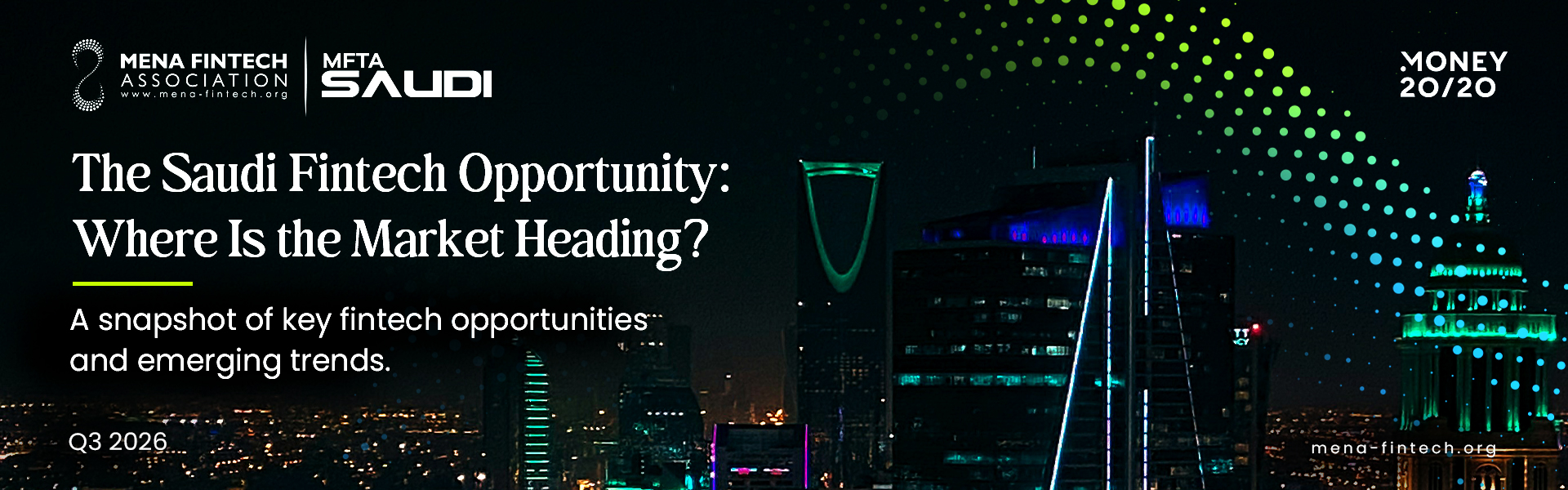
Dubai, UAE – Oct 19 – The MENA Fintech Association (MFTA), in collaboration with Money20/20 Middle East, has released The Saudi Fintech Opportunity: Where Is the Market Heading?, a strategic playbook examining the next phase of fintech growth in Saudi Arabia and identifying emerging opportunities for founders, investors, financial institutions, and technology providers.
Drawing on insights from the MFTA × Money20/20 Middle East webinar, alongside data from Saudi Arabia’s financial regulators, Vision 2030 reporting, and regional venture market sources, the playbook examines how the Kingdom’s fintech landscape is evolving beyond the initial expansion of digital payments towards deeper financial infrastructure, enterprise technology, and underserved customer segments.
Saudi Arabia’s fintech market has expanded fifteenfold since 2019, from 20 companies to 301 in 2025. With the Financial Sector Development Programme targeting 525 active fintech firms by 2030, the next phase of growth will depend not simply on the number of new entrants, but on their ability to address specific market needs, navigate regulatory requirements, and build commercially sustainable businesses.
From Market Growth to Market Opportunity
The playbook highlights several indicators of the Kingdom’s fintech maturity and the opportunities that remain:
●85% of retail payment transactions were electronic in 2025, up from 79% in 2024 and 70% in 2023, across 14.6 billion electronic transactions. This signals a market where the opportunity increasingly lies in building on established payment infrastructure rather than introducing digital payments for the first time.
●Saudi Arabia attracted USD 1.72 billion in venture funding across 257 deals in 2025, a 145% year-on-year increase, with fintech receiving more than USD 500 million. However, venture funding declined to USD 219 million in the first half of 2026, underscoring the importance of disciplined capital planning and realistic growth timelines.
●SMEs remain a significant opportunity. Saudi Arabia had more than 1.7 million SMEs in 2025, employing approximately 8.8 million people and contributing 22.9% of GDP. While MSME credit facilities reached around SAR 467 billion by the end of 2025, SMEs accounted for only around 9% of bank loan books, compared with a Vision 2030 target of 20% by 2030.
●Cross-border and pilgrimage finance offer distinctive opportunities. Expatriate remittances from Saudi Arabia reached a record SAR 165.5 billion in 2025, while international Umrah arrivals exceeded 16.9 million in 2024. These flows create potential for more efficient remittances, local payment acceptance, savings products, and financial services designed around international visitors.
Where the Next Opportunities Lie
Rather than treating Saudi Arabia as an extension of other Gulf markets, the playbook emphasizes the need for market-specific strategies. It identifies several areas where demand may be particularly compelling, including banking infrastructure and middleware, SME digitisation, WealthTech for underserved affluent customers, locally adapted RegTech, InsurTech beyond compulsory insurance lines, and technology infrastructure supporting AI-enabled financial services.
The report also highlights the importance of understanding the Kingdom’s regulatory landscape. The Saudi Central Bank (SAMA), the Capital Market Authority (CMA), and the Insurance Authority each oversee distinct areas of financial activity. Companies must identify the relevant regulatory pathway early and account for licensing, compliance, security, and institutional integration in their market-entry plans.
The playbook notes that companies may need to plan for approximately two years for licensing, followed by a further year for institutional adoption, depending on their business model and route to market. This makes early regulatory planning, sufficient funding runway, and a clearly defined commercial proposition essential to successful entry.
A further insight concerns the relationship between digital adoption and enterprise readiness. While consumers have rapidly embraced digital payments, selling into banks and other financial institutions can involve lengthy procurement processes, security reviews, compliance checks, and technical integration. The report therefore encourages fintechs to demonstrate clear economic value and build solutions around specific institutional needs.
A Practical Guide to Entering and Growing in Saudi Arabia
Designed for fintech founders, operators, investors, banks, payment providers, and financial services leaders, the playbook provides a practical framework for evaluating opportunities and preparing for market entry.
It covers the regulatory landscape, licensing timelines, bank integration, product localisation, distribution partnerships, funding requirements, and emerging opportunities across the financial services value chain.
The central message is that Saudi Arabia’s fintech opportunity is moving beyond market entry and adoption towards solving deeper structural challenges. Companies that understand local customer behaviour, build around existing infrastructure, and address specific operational or financial gaps may be better positioned to establish sustainable businesses in the Kingdom.
Nameer Khan, Chairman of the MENA Fintech Association, said:
“Saudi Arabia’s fintech story has moved beyond proving that digital financial services can scale. The next phase is about identifying where meaningful gaps remain and building solutions that address them with commercial discipline, regulatory understanding, and a clear view of local market needs. This playbook brings together data and practical insights to help founders, investors, and financial institutions assess those opportunities more effectively. The strongest outcomes will come from combining the infrastructure already in place with solutions designed specifically for the needs of Saudi businesses and consumers.”
Through this initiative, MFTA and Money20/20 Middle East aim to support informed decision-making, strengthen cross-border knowledge exchange, and help industry stakeholders better understand the opportunities and practical considerations shaping Saudi Arabia’s next phase of fintech development.
The playbook offers a clear perspective: the next generation of fintech growth in Saudi Arabia will be shaped not only by the size of the opportunity, but by how effectively businesses solve real problems, navigate the market, and translate innovation into sustainable impact.
