

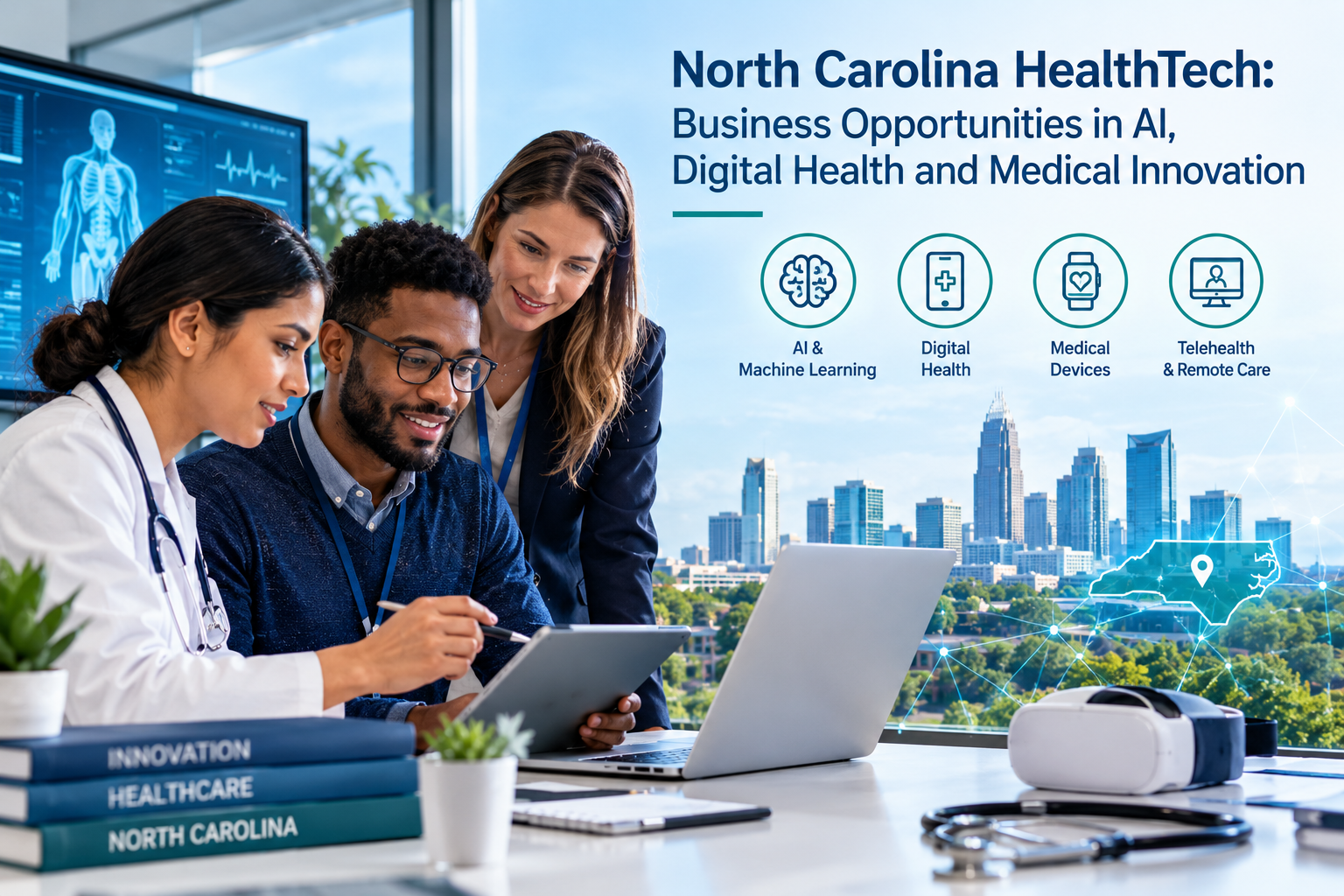
Oct 19: North Carolina is strengthening its position as a destination for life sciences and healthcare innovation, creating opportunities for businesses working in artificial intelligence, digital health, medical devices and healthcare software. With established research institutions, healthcare providers and a growing life sciences industry, the state offers a promising environment for companies looking to turn technology into practical healthcare solutions.
The scale of investment provides an indication of the industry’s momentum. According to the North Carolina Biotechnology Center, 18 life sciences companies announced expansions, relocations or new facilities in the state during 2025, representing $3.79 billion in investment and an expected 1,380 jobs.
For entrepreneurs and established technology companies, this environment creates opportunities beyond pharmaceutical research and medical manufacturing. Businesses can develop software for healthcare providers, introduce digital patient services, improve data security and help medical organisations adopt emerging technologies.
The challenge is identifying solutions that address genuine healthcare needs while meeting the sector’s technical, regulatory and commercial requirements.
Why North Carolina Is Attracting Healthcare Technology Businesses
North Carolina’s healthcare technology sector benefits from the connection between life sciences companies, research institutions, healthcare providers and technology specialists.
The state has an established base of biotechnology and pharmaceutical businesses, particularly around Research Triangle Park and other life sciences centres. This creates opportunities for companies offering services such as software development, data management, laboratory technology, cybersecurity and technical consulting.
The wider industry also provides a potential customer base for specialised technology providers. Research organisations may need better tools for managing complex datasets, while healthcare providers may seek more efficient ways to handle appointments, patient records and administrative tasks.
For smaller companies, this means innovation does not always require developing an entirely new medical product. Improving an existing process or helping healthcare organisations use their current technology more effectively can also create a viable business opportunity.
Digital Health Is Creating New Market Opportunities
Digital health is one of the most accessible areas for businesses exploring healthcare technology. It includes platforms and services that support communication between patients and providers, remote consultations, digital records and ongoing care management.
Healthcare software companies can develop appointment-management systems, patient engagement platforms and tools that help providers coordinate follow-up care. Businesses specialising in system integration can also help healthcare organisations connect different applications and reduce repetitive administrative work.
Telehealth offers another area for innovation, particularly when patients need to communicate with providers without travelling long distances. However, successful solutions must account for internet access, ease of use, privacy and the needs of people who may be unfamiliar with digital services.
The commercial opportunity lies in solving a specific problem rather than simply adding more features. Products that save staff time, improve access or make routine processes easier to manage have a clearer value proposition for prospective customers.
Healthcare AI Offers Opportunities for Startups
Artificial intelligence is creating new possibilities for healthcare software developers and technology service providers. Potential applications include clinical documentation support, administrative automation, medical research, data analysis and tools that help healthcare professionals organise information.
For North Carolina businesses, opportunities may emerge through partnerships with hospitals, research organisations and established healthcare technology companies. Startups can develop specialised applications, integrate AI into existing systems or help providers evaluate and implement suitable tools.
Healthcare AI requires a careful approach, however. Systems used in clinical settings need appropriate evaluation and professional oversight. Businesses must also consider data privacy, security, accuracy and the consequences of unreliable outputs.
A practical entry point may be a lower-risk administrative application that addresses a measurable problem, such as reducing repetitive documentation or helping staff manage workflows. Companies can then build on demonstrated results rather than relying on broad claims about what AI can achieve.
Medical Devices and Healthcare Software Remain Important Growth Areas
Medical devices and healthcare software create opportunities for businesses involved in product design, engineering, testing, manufacturing and technical support.
Some companies may develop monitoring equipment or diagnostic technologies, while others may provide software that helps healthcare professionals manage information generated by existing devices. Specialist suppliers can also support product development, quality assurance and integration.
North Carolina’s life sciences ecosystem offers a potential setting for collaboration between technology developers, researchers and established companies. However, businesses need to understand the development and commercialisation requirements associated with their products.
Depending on the intended use, medical devices and certain software products may be subject to US Food and Drug Administration requirements. Companies should assess applicable rules early, alongside testing, cybersecurity, manufacturing and quality-management needs.
A clearly defined customer problem, realistic development plan and credible evidence of product performance can help businesses make more informed investment decisions.
Rural Healthcare Innovation Creates Opportunities for Digital Solutions
Rural healthcare is another important area for technology businesses in North Carolina. Providers may need support with digital infrastructure, electronic health records, cybersecurity and access to remote services.
In September 2026, North Carolina announced its Rural Health Innovation Fund, which is designed to distribute approximately $20 million annually for up to five years to help eligible rural healthcare providers modernise their infrastructure. Potential projects include telehealth expansion, electronic health record upgrades, cybersecurity improvements and AI-enabled clinical decision support.
The initiative creates a relevant market signal for businesses developing digital healthcare solutions. However, the fund is intended to support eligible healthcare providers through a competitive process; technology companies should not assume they can apply directly for funding or that a contract is guaranteed.
Instead, vendors and service providers can explore whether their products meet the needs of eligible organisations, monitor procurement opportunities and establish partnerships where appropriate.
For rural healthcare customers, affordability and ease of implementation are particularly important. A solution that requires extensive technical support or expensive infrastructure may be difficult to sustain. Businesses that understand local operating conditions can develop more practical offerings.
Research Partnerships Can Help Businesses Develop New Solutions
Healthcare innovation often depends on collaboration between people with different areas of expertise. Researchers may understand the science behind a problem, clinicians can explain patient and operational needs, and technology teams can develop and test potential solutions.
North Carolina’s research institutions, universities, hospitals and life sciences companies provide opportunities for these kinds of relationships.
For startups, partnerships can help identify unmet needs, test product assumptions and understand how a technology might fit into real healthcare environments. They may also provide access to specialist knowledge that would be difficult for a small company to develop independently.
Before entering a partnership, businesses should establish clear agreements covering intellectual property, access to data, confidentiality, research responsibilities and commercial rights. These details are especially important when a project could lead to a new product or service.
Strong partnerships can support development, but commercial success still depends on demonstrating that customers need the solution and are willing and able to adopt it.
How Businesses Can Build a Sustainable HealthTech Model
Entering healthcare technology requires more than a promising product. Companies need to understand who will purchase the solution, how purchasing decisions are made and what evidence customers will expect before adopting it.
A startup developing healthcare software, for example, may need to demonstrate improved efficiency, reliable integration and appropriate security controls. A medical device company may require a longer development process involving testing and regulatory assessment.
Businesses should consider several priorities:
-
Identify a specific problem: Speak with healthcare professionals and prospective customers to understand where existing processes fall short.
-
Assess compliance requirements: Determine what privacy, cybersecurity, product safety and regulatory obligations apply.
-
Develop a realistic commercial plan: Account for product development costs, integration work, procurement procedures and potentially lengthy sales cycles.
-
Explore partnerships: Work with healthcare providers, research organisations and established suppliers where these relationships offer a clear benefit.
-
Measure results: Use pilots and customer feedback to assess whether the product delivers meaningful improvements before expanding.
Potential funding and support may come from investors, accelerators, research collaborations and eligible grant programmes. Availability depends on the business, its development stage and the conditions attached to each opportunity.
Challenges Healthcare Technology Companies Must Address
North Carolina offers a supportive setting for healthcare innovation, but businesses still need to overcome several challenges.
Regulatory requirements can increase the time and cost needed to bring certain products to market. Healthcare organisations may also use different software systems, making integration complicated. Meanwhile, patient information requires strong protection, and customers need confidence that new tools will not introduce unnecessary risks.
Adoption can be another obstacle. Even a technically advanced product may struggle if staff find it difficult to use, if implementation disrupts existing operations or if its benefits are unclear.
Businesses can reduce these risks by involving users early, testing products in appropriate settings and providing clear evidence of value. A focused solution that performs reliably may be more commercially useful than a complex product that attempts to solve too many problems at once.
North Carolina HealthTech Outlook: Turning Innovation into Business Growth
North Carolina’s established life sciences industry, research capabilities and healthcare infrastructure create opportunities for companies working across digital health, AI, medical devices and healthcare software.
The potential is not limited to major research breakthroughs. Businesses can also contribute by improving administrative systems, strengthening cybersecurity, supporting rural healthcare providers and making existing technology easier to use.
For entrepreneurs, the most promising approach is to connect innovation with a clear customer need. Understanding healthcare operations, planning for compliance and building relationships with prospective customers can help transform a technical idea into a sustainable business.
As healthcare organisations continue to assess new ways to deliver services and manage information, companies that combine technical expertise with practical knowledge of the healthcare sector will be better positioned to compete in North Carolina’s evolving HealthTech market.
