
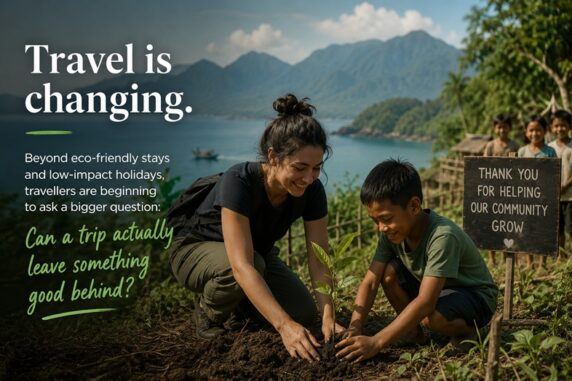

Travel is changing. Beyond eco-friendly stays and low-impact holidays, travellers are beginning to ask a bigger question: Can a trip actually leave something good behind?
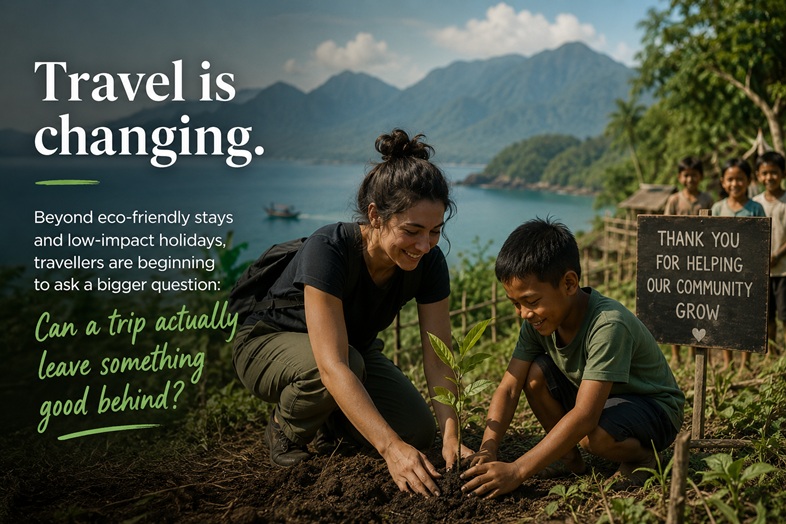
For most people, travel is about what they take away from a destination—the photographs, the memories, the food they tasted and the stories they bring home.
But what if we started thinking about travel from the other side?
What do we leave behind?
That question is becoming increasingly relevant as travellers look for more meaningful and responsible ways to explore the world.
The shift is visible in recent travel research. Booking.com’s 2026 Sustainable Travel research found that 85% of travellers consider more sustainable travel important or very important, while 74% consider extreme-weather risks when choosing destinations or travel timing. The research, based on 32,500 travellers across 35 markets, also found that 43% plan to avoid crowds and 42% plan to travel outside peak season.
The conversation is therefore moving beyond simply reducing waste or avoiding plastic. It is opening the door to a bigger idea—regenerative tourism, where travel aims to contribute positively to nature, local communities and culture.
Sustainable Travel vs Regenerative Travel
The difference is simple but important.
Sustainable tourism asks how travel can reduce its negative impact.
Use less water. Reduce waste. Lower emissions. Protect wildlife. Avoid damaging fragile ecosystems.
Regenerative tourism asks a bigger question: Can tourism actively help a destination become stronger?
That could mean restoring an ecosystem, supporting local livelihoods, reviving traditional crafts, protecting cultural heritage or directing tourism revenue towards community development.
In other words, sustainability is about doing less harm.
Regeneration is about creating a positive contribution.
Both approaches matter, but regenerative tourism pushes the conversation further.
Imagine a Holiday That Gives Something Back
Consider a stay at a property where part of the revenue supports local conservation.
Or a wildlife tour where tourism income helps fund habitat protection while creating employment for communities around a protected area.
Or a village experience where visitors stay with local families, eat locally produced food and buy directly from artisans.
The holiday is still a holiday.
But the money spent by the traveller becomes part of something larger.
This is where regenerative tourism becomes interesting. The destination is not simply a place to consume. It becomes a place to connect with and contribute to.
Local Communities Should Be Part of the Story
Regeneration is not only about forests, oceans and wildlife.
It is also about people.
Tourism can create jobs and income, but that does not automatically mean local communities benefit fairly. When hotels, tour operators and experiences are controlled largely by outsiders, much of the economic value can leave the destination.
A more community-focused model can change that.
Choosing a locally owned homestay, hiring a local guide, eating at independent restaurants or buying directly from an artisan can help keep more tourism spending within the community.
This is increasingly relevant as travellers themselves become more conscious of tourism’s social impact. Booking.com’s 2025 research found that 53% of travellers were conscious of tourism’s impact on local communities as well as the environment, while 73% wanted the money they spend to go back to local communities and 69% wanted to leave destinations better than they found them.
India Already Has Examples of the Model
India offers a useful glimpse of how community-focused tourism can work.
The Ministry of Tourism’s Best Tourism Village initiative recognises villages that preserve natural and cultural assets, promote community-based values and demonstrate commitments to economic, social and environmental sustainability. In the 2023 and 2024 editions, 71 villages were selected as Best Tourism Villages.
Villages such as Dhordo in Gujarat, recognised as a Best Tourism Village by UN Tourism in 2023, demonstrate how rural destinations can use tourism to showcase local culture and strengthen their position as tourism destinations.
The significance goes beyond attracting visitors.
When tourism supports local accommodation, food, crafts, guides and cultural experiences, the destination has a greater opportunity to retain the economic value created by tourism.
That is close to the heart of regenerative thinking: the destination should benefit from being visited.
Culture Should Not Become a Souvenir
There is another side to giving back that deserves attention: culture.
Many destinations are known for their crafts, food, architecture, music and traditions. But these can become difficult to sustain when there is little economic incentive for younger generations to carry them forward.
Tourism can help change that—if it is done thoughtfully.
Buying directly from a craftsperson is different from buying a mass-produced souvenir.
Learning to cook a regional dish with a local family is different from simply ordering it at a tourist restaurant.
Staying in a restored heritage home is different from staying in a generic property that could exist anywhere.
These experiences allow travellers to experience culture while helping give it continued economic value.
The Traveller Is Becoming More Conscious
The modern traveller has not suddenly stopped caring about comfort.
People still want good hotels, beautiful landscapes, exciting experiences and convenient travel.
But there is growing interest in knowing what sits behind the experience.
Who owns the property?
Who benefits from the money?
Where does the food come from?
Are animals being treated responsibly?
Is the destination being protected?
These questions are slowly becoming part of travel decision-making.
And that could change the way tourism businesses design their experiences.
Staying Longer, Experiencing Deeper
Regenerative travel could also change the way people plan holidays.
Instead of trying to cover five destinations in seven days, some travellers may prefer to spend a week in one place and actually get to know it.
A longer stay can mean more time for local restaurants, guides, artisans and small businesses to benefit from tourism.
It can also create a deeper connection between the traveller and the destination.
Rather than collecting destinations, the focus becomes experiencing them more deeply.
Travelling outside peak periods can also help distribute visitor demand more evenly and reduce pressure on overcrowded destinations. Booking.com’s 2026 research found that 42% of travellers plan to travel out of season, while 43% intend to avoid crowds.
Hotels and Tour Operators Have a Bigger Role
Travellers cannot do this alone.
Hotels, resorts, tour operators and destination authorities have a major role in making regenerative tourism practical.
A hotel could source food from nearby farmers.
A resort could support a local conservation project.
A tour operator could create experiences led by residents.
A destination could invest tourism revenue into protecting natural and cultural assets.
These initiatives can also create a stronger identity for tourism businesses.
A hotel that simply says it saves water may be responsible.
A hotel that can show how guest stays help restore a local ecosystem has a much bigger story to tell.
Purpose can become part of the travel experience.
But Giving Back Must Be More Than a Marketing Claim
As regenerative tourism becomes more popular, there is a risk of the term becoming another piece of travel marketing.
Simply calling a holiday “regenerative” does not make it regenerative.
Travellers should look for evidence.
If a property claims to support the local community, how?
If it says it protects nature, what is actually being restored or conserved?
If a tour promises a community experience, are local people genuinely involved and benefiting?
Real regeneration needs evidence, transparency and long-term commitment.
Otherwise, it risks becoming another form of greenwashing.
How Travellers Can Give Back
The good news is that travellers do not need to completely change the way they holiday.
A few thoughtful choices can make a difference.
Stay local: Consider locally owned hotels, homestays and guesthouses.
Eat local: Choose regional food and businesses that source from nearby producers.
Buy directly: Purchase crafts and products from the people who make them.
Choose ethical wildlife experiences: Avoid activities that put animals under unnecessary stress or encourage exploitation.
Explore responsibly: Consider lesser-known destinations while being mindful of their capacity and local needs.
Stay longer: Spend more time in fewer places rather than rushing through a long checklist.
Travel outside peak periods: Where practical, consider off-season travel to spread demand more evenly.
Look for genuine conservation initiatives: Choose experiences where your spending has a clear connection to restoration or protection efforts.
None of these choices requires giving up the pleasure of travel.
They simply make the experience more considered.
India’s Tourism Growth Makes the Conversation More Important
India’s tourism scale makes this conversation particularly important.
According to the Ministry of Tourism’s official 2025 dashboard, India recorded 4.29 billion domestic tourist visits in 2025, up 45.6% from 2024. Tourism accounted for an estimated 5.22% of GDP and supported about 84.63 million jobs during the year.
Those numbers demonstrate the enormous economic importance of tourism—but they also highlight the responsibility that comes with continued growth.
The question cannot simply be how many people visit a destination.
It also needs to be:
What happens to the destination because they visited?
Did local incomes increase?
Were traditional crafts sustained?
Was biodiversity protected?
Were natural resources restored?
Did communities gain a stronger role in tourism?
These questions could become just as important as visitor numbers and tourism revenues.
India’s Ministry of Tourism already has a National Strategy for Sustainable Tourism, alongside strategies for rural tourism, rural homestays and ecotourism, creating a policy foundation for more responsible destination development.
The next opportunity is to move the conversation from simply minimising tourism’s footprint to understanding how tourism can create lasting local value.
The New Measure of a Good Holiday
For generations, we have measured a great holiday by what we experienced.
The perfect sunset.
The unforgettable meal.
The beautiful hotel.
The photograph that makes everyone jealous.
Perhaps there is another measure worth adding.
What did your visit contribute?
Maybe it helped a local family earn an income.
Maybe it supported an artisan.
Maybe it helped protect a forest.
Maybe it contributed to restoring a fragile ecosystem.
Maybe it simply helped a small local business stay open.
That is the promise behind regenerative tourism.
The future of travel may not be about travelling less.
It may be about travelling more thoughtfully.
Because the best journey might not simply be the one that takes you somewhere beautiful.
It could be the one that helps make sure that place remains beautiful—and meaningful—for the people who live there and the travellers who come after you.
