
The Goods and Services Tax (GST) has brought greater uniformity to India’s indirect tax system, helping businesses operate within a common tax framework. However, filing GST returns accurately remains a challenge for many enterprises, particularly micro, small and medium enterprises (MSMEs), startups, retailers and service providers. Even minor errors in invoices, tax calculations or input tax credit claims can create financial complications, disrupt cash flow and attract scrutiny from tax authorities.
For businesses, GST compliance involves much more than submitting returns before the deadline. It requires accurate accounting, regular reconciliation, proper documentation and a clear understanding of applicable tax rules. As companies increasingly adopt digital accounting systems, establishing a disciplined approach to GST management has become essential for reducing compliance risks and supporting sustainable growth.
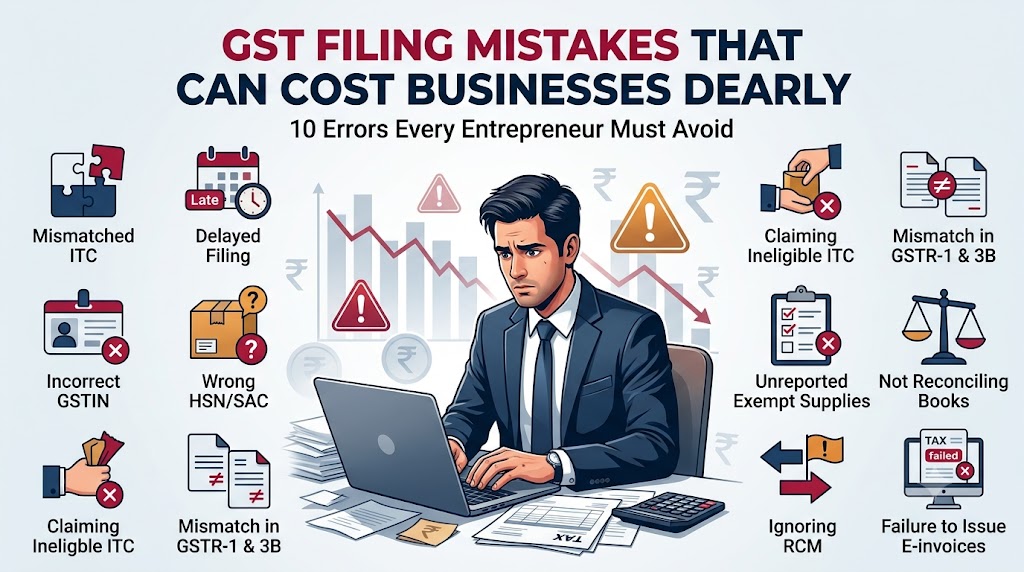
Here are 10 common GST filing mistakes businesses should watch out for and practical ways to prevent them.
1. Missing GST Registration Requirements
Businesses sometimes delay registration because they are unaware of the applicable turnover thresholds or specific registration conditions. Others may choose an unsuitable registration category without fully understanding the implications.
Delayed registration can lead to tax liabilities, penalties and difficulties in meeting statutory obligations. Entrepreneurs should regularly review their turnover, business activities and supply arrangements to determine whether registration is required. Since the rules can vary according to the nature and location of supplies, businesses should verify their eligibility before making a decision.
2. Using Incorrect GST Rates or HSN/SAC Codes
Applying the wrong GST rate or selecting an incorrect Harmonised System of Nomenclature (HSN) code for goods or Service Accounting Code (SAC) for services can result in underpayment or excess payment of tax.
Such errors may also affect customers who depend on accurate invoices to claim eligible input tax credit. Businesses should verify the applicable classification and GST rate before issuing invoices, particularly when introducing new products, changing service offerings or updating their price lists.
Accounting software with regularly updated tax classifications can help reduce manual errors, but the final classification should still be checked against the applicable rules.
3. Entering Incorrect Invoice Details
GST invoices must contain the prescribed information, including supplier and recipient details, GST identification numbers where applicable, invoice number and date, taxable value, tax amounts and place of supply.
An incorrect GSTIN, duplicate invoice number or inaccurate tax calculation can create reconciliation problems for both the supplier and the customer. Businesses should establish a standard invoicing process and use validation checks before generating invoices in bulk.
Correcting errors promptly and maintaining a clear record of amendments can help prevent discrepancies from carrying over into subsequent returns.
4. Claiming Ineligible Input Tax Credit
Input tax credit (ITC) allows eligible businesses to offset GST paid on qualifying business purchases against their output tax liability. However, not every purchase qualifies for credit.
Personal expenses, certain motor vehicle-related costs, goods lost or destroyed and free samples may fall within the blocked-credit provisions under Section 17(5) of the Central Goods and Services Tax Act, subject to applicable exceptions.
Businesses should review purchase invoices carefully, confirm that statutory conditions are satisfied and distinguish eligible business expenditure from restricted or personal expenses. Incorrect ITC claims can result in reversal of credit, interest and other consequences under the law.
5. Mismatches Between GSTR-1 and GSTR-3B
GSTR-1 reports details of outward supplies, while GSTR-3B is used to declare summary tax liabilities and eligible input tax credit for the relevant period.
Differences between the two returns may arise from incorrect data entry, missed invoices, amendments or errors in calculating tax liability. Such discrepancies can create problems for suppliers and customers and may lead to notices or additional compliance requirements.
A monthly reconciliation before filing can help businesses identify differences early. Sales registers, invoice records and tax calculations should be reviewed together to ensure that reported figures are consistent.
6. Failing to Reconcile Input Tax Credit with GSTR-2B
Another common mistake is claiming input tax credit without adequately checking the relevant details in GSTR-2B, the auto-drafted statement used to help taxpayers review ITC information.
Businesses should compare their purchase registers with GSTR-2B and identify invoices that are missing, incorrectly reported or inconsistent. They should also verify the other statutory conditions governing credit, as the appearance of an invoice in the statement does not automatically establish eligibility.
Following up with suppliers for missing or incorrect invoice reporting can help resolve discrepancies and reduce the risk of ineligible credit claims.
7. Filing Returns After the Due Date
Late GST return filing can result in late fees, interest where applicable and other compliance consequences. Persistent delays may also interfere with business processes and increase the administrative burden on finance teams.
The amount payable depends on the type of return, the period of delay, the tax liability and the applicable provisions or notifications. Businesses should therefore avoid relying on a single general penalty figure for every situation.
Maintaining a compliance calendar, setting automated reminders and reviewing return data well before the deadline can make timely filing easier. Even businesses reporting no transactions should verify whether a nil return is required and submit it within the prescribed time.
8. Overlooking Reverse Charge Mechanism Obligations
Under the Reverse Charge Mechanism (RCM), the responsibility to pay GST shifts to the recipient for specified categories of supplies and transactions.
Businesses may overlook these obligations when dealing with certain legal services, qualifying goods transport agency services or imported services, depending on the applicable provisions and conditions. Failure to identify an RCM transaction can lead to unpaid tax liabilities, interest and reporting errors.
Finance teams should review vendor invoices, service agreements and import-related payments to identify transactions covered by reverse charge. Applicable tax payments and return disclosures should then be completed according to the prescribed requirements.
9. Incorrect Reporting of Credit Notes and Debit Notes
Returns, cancellations, pricing adjustments and certain post-sale changes may require credit notes or debit notes, depending on the circumstances.
If these documents are not issued correctly or reported in the appropriate return period, a business’s taxable turnover and tax liability may be misstated. Such errors can also create disagreements between suppliers and customers over invoice values and ITC adjustments.
Businesses should maintain proper documentation for every adjustment and verify the applicable reporting conditions and time limits before making changes to their GST returns.
10. Neglecting Regular Reconciliation and Compliance Reviews
Some enterprises review their GST records only after receiving a notice or encountering a discrepancy. By that stage, small errors may have accumulated across several tax periods.
Periodic reviews of sales, purchases, bank records, GST returns, tax payments and eligible credit can help identify problems before they become more difficult to resolve. Businesses should also monitor notices and communications on the GST portal and respond within the applicable deadlines.
Depending on the size and complexity of the enterprise, periodic reviews by an accountant or GST professional can provide an additional layer of oversight.
Technology and Record-Keeping Can Make a Difference
Digital accounting tools can help businesses organise invoices, track filing deadlines, reconcile transactions and maintain accessible records. Cloud-based systems may be particularly useful for MSMEs that need to coordinate accounting information across multiple locations or teams.
However, technology is effective only when the underlying information is accurate. Businesses should restrict access to sensitive financial records, maintain backups and review automated calculations instead of assuming that software eliminates every compliance risk.
Maintaining separate business banking records, keeping supporting documents organised and reconciling accounts regularly can further improve financial transparency. A dedicated business current account can support clearer transaction tracking, although it does not replace the need to meet GST’s documentation and record-keeping requirements.
Accurate GST Compliance Supports Business Growth
GST return filing should be treated as an ongoing financial management responsibility rather than a routine administrative task. Errors can affect working capital, interrupt business operations and create unnecessary costs, particularly for smaller enterprises operating with limited financial resources.
By checking invoices, verifying tax classifications, reviewing ITC eligibility, reconciling returns and responding promptly to notices, businesses can strengthen their compliance systems and reduce avoidable risks.
For entrepreneurs, the long-term benefit extends beyond avoiding penalties. Accurate GST records improve financial visibility, support better cash-flow decisions and help build confidence among customers, suppliers, lenders and business partners.
In an increasingly competitive business environment, a systematic approach to GST compliance can help enterprises spend less time correcting preventable mistakes and more time focusing on productivity, investment and expansion. Ultimately, accuracy, timely filing and consistent financial discipline are the foundations of effective GST management.
