
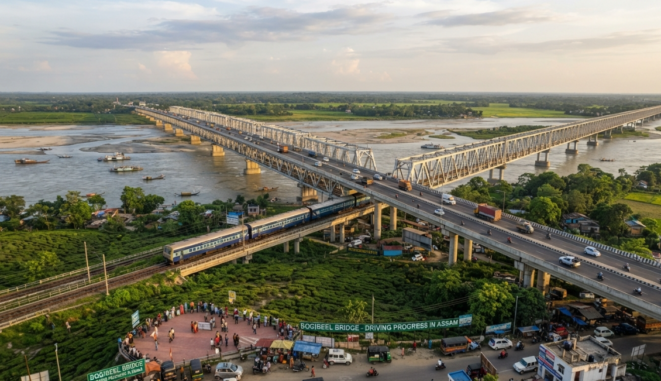
Oct 19: Spanning the mighty Brahmaputra River, Bogibeel Bridge is more than an engineering landmark in Assam. The rail-cum-road bridge connects Dibrugarh on the southern bank with Dhemaji on the northern bank, improving regional connectivity and supporting the movement of people and goods across Upper Assam.
Since its inauguration in December 2018, the bridge has become an important part of the region’s transport infrastructure. Its wider significance is now closely linked to tourism development, inland-waterway transportation, cross-border trade and employment opportunities. With new investments in river infrastructure and maritime skills, Bogibeel and its surrounding areas have the potential to emerge as an important economic corridor for Assam.
Bogibeel Bridge: History and Development
The story of Bogibeel Bridge is connected to the Assam Accord of 1985, which included commitments intended to support Assam’s development. The project’s foundation stone was laid on January 22, 1997, by then Prime Minister H. D. Deve Gowda. The bridge was sanctioned during 1997–98, while construction was formally inaugurated in 2002 under Prime Minister Atal Bihari Vajpayee.
The project took years to complete because of its scale and the technical challenges involved in building across the Brahmaputra. Its completion represented a major step in improving transport connectivity in the Northeast.
On December 25, 2018, Prime Minister Narendra Modi dedicated Bogibeel Bridge to the nation and flagged off the first passenger train to cross it. The date coincided with Vajpayee’s birth anniversary, observed as Good Governance Day. PM Modi’s inauguration marked the completion of a long-running infrastructure project that had passed through successive governments.
The bridge’s development history therefore includes the early foundation under Deve Gowda, the start of construction under Vajpayee and the inauguration under Modi. Its economic importance lies in the connectivity it provides and the opportunities that supporting infrastructure can create.
How Bogibeel Bridge Improves Connectivity
Bogibeel Bridge provides a direct road and rail connection across the Brahmaputra between Dibrugarh and Dhemaji. It makes travel between the two banks easier and strengthens access to markets, educational institutions, healthcare services and commercial centres.
For residents, improved connectivity can reduce the difficulty of travelling for work, education and business. For companies, it can make it easier to coordinate operations across the region, transport supplies and reach customers.
The bridge is also strategically important for connectivity in the Northeast, including access towards Arunachal Pradesh. However, its wider economic impact depends on factors beyond the bridge itself, such as road conditions, railway services, freight capacity and last-mile transport infrastructure.
Bogibeel Bridge and Assam’s Tourism Potential
Bogibeel Bridge and Bogibeel Ghat offer opportunities to strengthen Assam’s river tourism sector. The landscape around the Brahmaputra, the scale of the bridge and the region’s cultural heritage can appeal to visitors looking for experiences beyond conventional sightseeing.
River cruises, houseboats, guided excursions and riverfront activities could help attract more visitors to the Dibrugarh region. These experiences can also be linked with Assam’s tea gardens, local cuisine, cultural attractions and other destinations across Upper Assam.
The tourism opportunity extends to small businesses. Homestays, hotels, restaurants, local transport providers, handicraft sellers and tour operators could benefit from increased visitor movement. Local guides and boat operators may also find new sources of income as tourism services expand.
For these opportunities to translate into lasting benefits, the region needs visitor amenities, clear travel information, trained guides, reliable transport, responsible waste management and community participation. Tourism development should protect the Brahmaputra’s natural environment while ensuring that local communities share in the economic benefits.
How Bogibeel Bridge Can Create Economic Opportunities for Assam
1. Supporting Agriculture and Tea Businesses
Assam’s economy has strong links with agriculture, tea production and related industries. Better connectivity can help farmers, tea producers and food-processing businesses reach buyers, distributors and markets more efficiently.
The bridge can support the movement of workers, supplies and products across the Brahmaputra. When combined with suitable storage, freight and distribution facilities, improved connectivity may reduce transport difficulties and make business operations more predictable.
The scale of these benefits will depend on actual logistics costs, market demand, transport availability and the quality of supporting infrastructure. Nevertheless, stronger connections between producers and markets can contribute to the competitiveness of businesses in Upper Assam.
2. Developing Inland-Waterway Trade
One of the most significant opportunities around Bogibeel is the development of the Brahmaputra as a commercial waterway. National Waterway-2 runs along the Brahmaputra, creating the possibility of moving cargo by river and connecting Assam with other parts of the region and international markets through established waterway routes.
In February 2026, the Ministry of Ports, Shipping and Waterways announced the inauguration of infrastructure projects in Dibrugarh, including a customs and immigration complex at Bogibeel. The facility forms part of the modern tourist-cum-cargo terminal and is intended to support cargo operations, passenger movement and trade through the Indo-Bangladesh Protocol routes.
An important milestone followed on October 5, 2026, when a barge carrying 540 metric tonnes of methanol produced by Assam Petro-Chemicals Limited at Namrup departed from Bogibeel for Dhaka, Bangladesh. According to the Ministry of Ports, Shipping and Waterways, it marked the first cargo shipment from Upper Assam to a foreign port since Independence.
The voyage demonstrated the potential of the Brahmaputra to serve as a freight corridor connecting Assam with overseas markets. If such services become commercially viable and operate more regularly, businesses could gain another option for moving industrial goods. Related opportunities could emerge in cargo handling, warehousing, vessel operations, logistics, customs support and river-port services.
However, one successful voyage does not by itself establish a permanent trade corridor. Regular cargo volumes, competitive transport costs, navigability, suitable vessels and dependable cross-border arrangements will determine how far this opportunity develops.
3. Creating Skilled Employment Through Maritime Training
Bogibeel’s economic prospects are also linked to investment in skills and workforce development.
On March 13, 2026, Prime Minister Narendra Modi performed the bhoomi pujan for a ₹188-crore Regional Centre of Excellence at Bogibeel in Dibrugarh. According to the government announcement, the centre is planned as a maritime skills and research hub for Northeast India, with capacity to train more than 5,000 students annually in vessel operations, inland navigation and maritime logistics.
The proposed centre could help young people develop skills relevant to the growing inland-waterways sector. Potential career areas include vessel operations, cargo management, navigation support, logistics, port administration and related technical services.
The wider benefit could extend to businesses that need trained employees to manage vessels, handle freight and coordinate transport operations. To maximise local participation, training programmes will need to align with industry requirements and provide pathways into actual employment.
4. Encouraging Small Businesses and Local Enterprise
Improved connectivity and the expansion of tourism and river transport can create opportunities for small and medium-sized enterprises around Bogibeel, Dibrugarh and nearby communities.
Restaurants, accommodation providers, vehicle operators, packaging businesses, repair services, handicraft sellers and local suppliers may find new customers as passenger and cargo activity increases. Businesses that support vessels and logistics operations could also benefit from demand for equipment, supplies, maintenance and other services.
These opportunities are not limited to large investors. Local entrepreneurs could participate by providing tourism experiences, regional food products, transport services and other goods and services suited to visitors and commercial operators.
Access to finance, business training, market connections and suitable commercial spaces will be important in helping local enterprises benefit from this growth.
5. Strengthening Regional Investment and Trade
Better road, rail and waterway connectivity can improve the conditions for investment in Upper Assam. Businesses considering warehousing, food processing, transport, tourism and distribution may benefit from more accessible connections to suppliers and markets.
Bogibeel’s potential is particularly significant when viewed as part of a wider network rather than as a standalone bridge. Road and rail connections can move people and goods across the region, while inland waterways may provide an additional freight option where commercially and operationally suitable.
If these modes are coordinated effectively, the region could strengthen its role in connecting Assam with other Northeastern states and cross-border markets. The resulting economic benefits will depend on reliable services, efficient cargo handling, supportive business conditions and continued infrastructure development.
Narendra Modi’s Connection with Bogibeel’s Wider Development
Narendra Modi’s connection with Bogibeel Bridge dates to its inauguration on December 25, 2018. He dedicated the bridge to the nation and flagged off the first passenger train to cross it, marking a major milestone in the project’s long history.
More recent developments have focused on expanding the economic potential of the Brahmaputra beyond road and rail connectivity. In February 2026, the government announced new inland-waterway facilities at Bogibeel, including the customs and immigration complex. In March 2026, Modi participated in the launch of further waterways initiatives and performed the bhoomi pujan for the ₹188-crore Regional Centre of Excellence at Bogibeel.
The March 2026 announcements formed part of a wider ₹526-crore package of waterways-related projects in Assam. These included cruise terminals at Biswanath Ghat and Neamati, as well as an elevated road corridor connecting Pandu Port in Guwahati to National Highway 27.
Together, the initiatives reflect a broader development approach that links transport, tourism, trade and skills. Their eventual impact will depend on implementation, commercial use and the extent to which businesses and communities can access the opportunities created.
Challenges That Need Attention
Bogibeel’s economic potential is substantial, but infrastructure alone cannot guarantee sustained growth. Tourism requires safe facilities, trained service providers and environmental protection. River freight requires reliable navigation conditions, suitable vessels, competitive costs and consistent cargo demand.
Local businesses also need access to finance, skills and markets if they are to participate in the emerging economy. Infrastructure development should therefore be accompanied by community engagement, transparent planning and support for small enterprises.
Environmental considerations are especially important along the Brahmaputra. Tourism and cargo operations must account for the river’s changing conditions and the ecological needs of the surrounding area. Sustainable planning can help ensure that economic activity does not undermine the natural assets on which tourism and local livelihoods depend.
The Road Ahead: Turning Connectivity into Growth
Bogibeel Bridge offers Assam an opportunity to connect infrastructure development with wider economic growth. Its role in improving road and rail connectivity can be complemented by river tourism, inland-waterway trade, maritime training and local entrepreneurship.
The October 2026 methanol shipment to Bangladesh provides a tangible example of the potential for international cargo movement from Upper Assam. Meanwhile, the proposed Regional Centre of Excellence could strengthen the skilled workforce needed to support waterways and logistics activity.
For communities around Dibrugarh and Dhemaji, the long-term opportunity lies in ensuring that these developments create practical benefits: jobs, new customers for local businesses, better access to markets and more diverse sources of income.
Conclusion
Bogibeel Bridge has evolved from a long-planned infrastructure project into an important part of Assam’s connectivity network. Its history reflects milestones under successive prime ministers, from H. D. Deve Gowda and Atal Bihari Vajpayee to Narendra Modi, while its future economic value will be shaped by how effectively the region uses the connectivity it provides.
With river tourism, cargo transportation, cross-border trade and maritime skills development gaining attention, Bogibeel has the potential to support a broader economic corridor in Upper Assam. Sustained investment, reliable services, environmental responsibility and local participation will be essential to turning that potential into lasting economic opportunities for Assam.
