

Pradhan Mantri Jan Dhan Yojana accounts reached 59.09 crore as of 19 August 2026, up from 14.72 crore in 2015, according to an August government release. Nearly 46 crore of them are in rural and semi-urban India, almost 33 crore belong to women, and deposits have grown from ₹15,670 crore in March 2015 to more than ₹3.17 lakh crore. The Financial Inclusion Index rose from 53.9 in 2018 to 67 in 2026.
The accounts are open. Service now has to reach the people holding them, in their languages and on their terms, and that is where AI in fintech and banking meets its real customer. Rwazi records training data on request, in India and across 190+ countries, for teams that hit this gap.
Where the bank account meets the recording gap
A model carries the market it was recorded in. Generative AI in banking, trained on urban customer service logs in English, meets a new account holder and misses:
- A first-time customer asking about a deposit in Bhojpuri.
- A passbook photo sent from a phone in place of a form.
- A failed payment explained in two languages over traffic noise.
- A woman opening her first account through a business correspondent in her village.
Banks want AI customer service that scales, and technical teams are already building. This is where those projects stall, and the cost is countable: calls escalated to a human, complaints that repeat, and a chatbot that serves the metros and loses everyone else.
Recorded in the customer’s own district
Conversational AI companies often train on recordings from metro call centres. A bank serving new account holders needs its customers recorded in their own districts and languages, to a written brief. That is the work Rwazi does: speech datasets recorded with first-time bank customers, branch, helpline, and business correspondent conversations with transcripts.
- A banking brief usually carries three things together. A speech dataset across accents, noise, and code-mixed sentences for a voice bot serving a rural account holder. An image dataset of passbooks, forms, and handwritten slips.
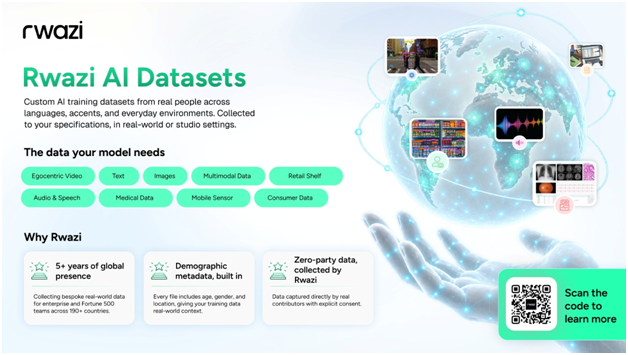
- Text in the script customers actually use. Rwazi records nine types of real-world AI training data, from speech and video datasets to multimodal data, and one brief can mix them.
- Every item is supplied by the person who recorded it; nothing is inferred. The data collection runs under a master service agreement and a statement of work, with samples checked before anything scales.
Send a brief, and get a sample back. Type, languages, districts, volume, date, or just the one line that matters: what the model keeps getting wrong, and where. Rwazi’s AI datasets team records a sample in the markets with the brief names, with no fee and before any agreement is signed. Send the brief to Rwazi’s AI datasets team.
“India has opened a bank account for crores of first-time customers,” said Joseph Rutakangwa, CEO, Rwazi. “The next step is a bank that understands the account holder when they call, in the language they call in.”
What this decides
India has built one of the largest financial inclusion programs in the world. The banks and fintechs serving it will be judged on whether their systems understand customers who are new to formal finance, and that comes down to what was recorded, in which languages, and in which villages. The accounts opened first. The data decides who gets served well.
