
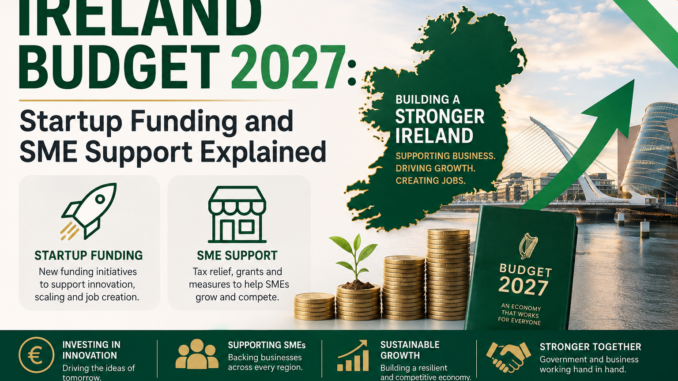
Oct 26: Ireland’s Budget 2027 is opening up new opportunities for startups and small and medium-sized enterprises (SMEs) seeking finance, investment and support for innovation. Announced on October 6, 2026, the €8.65 billion budget package includes €7 billion in public spending and €1.65 billion in tax measures.
For entrepreneurs, the announcements cover several stages of business growth, from launching a new venture to expanding operations, investing in technology and entering international markets. Key measures include €3 million for Start Up Ireland, an expanded €1 billion Growth and Sustainability Loan Scheme and a €1 billion investment programme for startups and scaling companies through 2030.
However, not all these measures provide direct grants. Some offer repayable loans, others involve commercial investment, and tax incentives have their own eligibility requirements. Understanding the differences is essential for businesses deciding where to seek support.
Ireland Budget 2027: Key Funding Opportunities for Startups and SMEs
The following table highlights the principal measures relevant to entrepreneurs and growing businesses.
| Programme | Funding announced | Potential benefit |
|---|---|---|
| Start Up Ireland | €3 million initial allocation | Startup support, mentoring and connections |
| Growth and Sustainability Loan Scheme | €1 billion total lending capacity | Long-term business investment |
| ISIF startup and scaling programme | €1 billion through 2030 | Commercial investment for growing companies |
| Venture capital allocation | €100 million | High-growth, innovation-led businesses |
| Disruptive Technologies Innovation Fund | €37.5 million total funding for 2027 | Collaborative research and technology development |
| Local Enterprise Offices | Additional €4.5 million | Small-business support and energy-efficiency improvements |
| National AI Office | Additional €2.3 million | AI regulation, capability and literacy |
| Technology centres | Additional €7.5 million | Business-led research and innovation |
These amounts represent different types of allocations and investment capacity. They are not all grants available directly to businesses. Applicants should confirm the latest eligibility criteria, application deadlines and programme conditions with the relevant official agency.
1. Start Up Ireland Aims to Support 1,000 New Startups
One of the key announcements is Start Up Ireland, a national initiative led by Enterprise Ireland. Budget 2027 provides an initial €3 million allocation, and the initiative aims to support the creation of 1,000 new startups.
The programme is designed to make it easier for founders to connect with investors, experienced entrepreneurs, universities, industry partners and business support organisations. Planned initiatives include a National Startup Hub, founder support services, accelerator programmes and stronger international connections.
These services could be valuable for entrepreneurs who have a business idea but need help validating demand, developing a business model or preparing to approach investors.
The initiative also includes a specialist AI accelerator intended to help selected companies access technical expertise, customers and investors. This could be particularly relevant to founders developing AI products and other technology-led businesses.
Entrepreneurs should check the official Enterprise Ireland announcement for details of the support available and any separate application requirements.
2. Growth and Sustainability Loan Scheme Expands to €1 Billion
Access to affordable, long-term finance can be a major consideration for SMEs planning to purchase equipment, expand production, improve digital systems or invest in energy efficiency.
Budget 2027 is accompanied by an expansion of the Growth and Sustainability Loan Scheme from €500 million to €1 billion in total lending capacity. The scheme has also been extended until June 30, 2029, or until it is fully subscribed, whichever comes first.
Eligible businesses can access loans ranging from €25,000 to €3 million, with repayment terms of seven to 10 years. Loans of up to €500,000 may be available without security, subject to the scheme’s terms and the lender’s requirements.
The scheme supports eligible SMEs, small mid-cap businesses, farmers, foresters and fishers. It can support qualifying investments in areas such as business expansion, innovation, digitalisation, research and development, energy efficiency and renewable energy.
For example, a manufacturer could explore financing for machinery upgrades, while a growing service company might consider investment in digital infrastructure. A business planning to reduce its energy consumption could investigate whether its proposed investment qualifies.
These are loans, not grants, so businesses must assess repayment obligations, interest rates and the expected return before borrowing.
3. A €1 Billion Investment Programme for Scaling Companies
Startups that have established a viable product or service often face a new challenge when they begin expanding. Hiring employees, entering new markets and increasing production can require more capital than a young business can generate from its existing revenue.
Ireland’s Strategic Investment Fund (ISIF), working with Enterprise Ireland, is set to support a €1 billion startup and scaling investment programme through 2030. The programme includes a dedicated €100 million venture capital allocation for high-growth, innovation-led businesses.
The aim is to strengthen access to commercial capital for Irish companies with international growth potential.
This could be relevant to technology businesses, innovative manufacturers and other companies seeking to scale their operations.
However, commercial investment differs from a government grant. Equity investment generally involves sharing ownership with investors, while debt investment creates repayment obligations. Founders should consider company valuation, ownership rights, decision-making responsibilities and future financing needs before accepting an offer.
Businesses seeking investment should prepare financial projections, demonstrate customer demand and explain how additional capital would support sustainable growth.
4. Research and Development Funding for Innovative Businesses
Research and development (R&D) can help businesses create new products, improve existing technology and develop more efficient processes. These activities can be expensive, particularly when commercial returns may take years to materialise.
Budget 2027 includes enhancements to Ireland’s R&D Tax Credit. The potential benefit will depend on the applicable tax rules, qualifying expenditure and each company’s circumstances.
Businesses should maintain clear records of research activities and costs and consult official tax guidance or a qualified adviser before making a claim.
The budget also provides an additional €6.5 million for the Disruptive Technologies Innovation Fund (DTIF), bringing its total funding for 2027 to €37.5 million.
The fund supports collaborative projects involving businesses and research organisations working on disruptive technologies. It may be relevant to companies developing advanced manufacturing processes, digital technologies and other innovative solutions.
The government has also announced €40 million under DTIF Call 8, with applications scheduled to remain open until February 3, 2027. Businesses interested in this opportunity should check the official Department of Enterprise announcement for the latest application details.
For SMEs, research partnerships can provide access to specialist expertise, facilities and technical capabilities that might otherwise be too expensive to develop independently.
5. AI and Digital Transformation Receive Additional Support
Artificial intelligence and digital tools are becoming increasingly important for businesses looking to improve productivity, customer service and operational efficiency.
Budget 2027 provides an additional €2.3 million for Ireland’s National AI Office, bringing its total allocation to €3.8 million. The funding supports implementation of the EU AI Act, development of an AI regulatory sandbox and efforts to improve national AI capability and literacy.
The budget also provides an additional €7.5 million for technology centres, including Irish Manufacturing Research and CeADAR, Ireland’s AI technology centre. Their combined allocation will rise to €32.5 million.
These measures aim to strengthen links between businesses, researchers and technology expertise.
For SMEs, the practical opportunity lies in identifying where technology can solve a real business problem. A retailer might use digital tools to improve inventory management, while a manufacturer could explore automated quality checks or production monitoring.
Before investing, businesses should consider implementation costs, staff training, cybersecurity, data protection and measurable outcomes. Choosing technology based on a clear operational need is more likely to produce lasting benefits than adopting it simply because it is a current trend.
6. Local Enterprise Offices Receive Additional Funding
Local Enterprise Offices (LEOs) provide advice and business development support to small companies across Ireland. They help entrepreneurs identify relevant programmes, access training and explore opportunities to improve their operations.
Budget 2027 provides an additional €4.5 million for LEOs, including support for energy-efficiency improvements for small businesses and modernisation of the LEO network.
For eligible companies, this could be useful when considering equipment upgrades, digitalisation or ways to reduce operating costs.
A small business planning to replace older equipment, for example, could compare its current energy consumption with the expected savings from a more efficient alternative. It could then check whether its proposed investment qualifies for any available support.
Funding conditions and eligibility vary. Businesses should contact their local office to confirm which programmes are available, what expenses qualify and what documentation is required.
7. Tax Incentives May Influence Business Investment
Tax measures can affect decisions about investment, company ownership and business expansion.
Budget 2027 includes a reduction in the standard Capital Gains Tax rate from 33% to 31%, according to the announced measures. The impact on an individual or business depends on the transaction, the asset involved and the applicable rules.
The budget also includes measures involving established entrepreneurship and investment incentives such as the Employment Investment Incentive, Start-Up Relief for Entrepreneurs, the Start-Up Capital Incentive and Angel Investor Relief.
These schemes have specific eligibility requirements and conditions. Entrepreneurs and investors should check the latest rules and implementation details before relying on a particular tax benefit.
8. Regional Businesses Could Find New Growth Opportunities
Ireland’s enterprise measures may also create opportunities for businesses operating outside the country’s largest commercial centres.
Investment in tourism, manufacturing, research and technology can create demand for local suppliers and specialist services. Smaller companies may find opportunities through supply-chain partnerships, tourism development or contracts connected to larger investment projects.
Additional funding for regional tourism development and international marketing could also be relevant to eligible tourism operators and businesses developing visitor experiences.
For regional SMEs, identifying demand is an important first step. Businesses should consider which products or services are needed locally, whether they can meet the requirements of larger customers and what investment would be required to expand.
Improving supplier relationships, developing digital capabilities and exploring export opportunities can help companies prepare for sustainable growth.
How Startups and SMEs Can Prepare for Funding
Budget announcements do not guarantee that a particular business will receive financial support. Companies should match their needs with the relevant programme and prepare before applying.
Identify the appropriate funding route. A startup developing a new product may need mentoring, research support or equity investment. An established SME purchasing machinery may be better suited to a business loan. Determine whether the requirement is for a grant, loan, investment or tax incentive.
Prepare a realistic business plan. Explain the business model, target customers, competitive position and growth strategy. Include realistic revenue forecasts, costs and potential risks.
Keep financial records up to date. Accounts, cash-flow forecasts and supporting documentation can help demonstrate that the business is prepared to manage funding responsibly.
Verify eligibility and deadlines. Check sector requirements, company size limits, eligible expenses, application deadlines and any matching-funding requirements. Not every programme is open to every business.
Assess the expected return. Estimate how the proposed investment could affect productivity, sales, employment or operating costs. A clear commercial rationale can help determine whether the funding is appropriate.
Use official sources. Check programme administrators for current details rather than relying solely on summaries of budget announcements.
What Ireland Budget 2027 Means for Business Growth
Ireland’s Budget 2027 brings together measures designed to support entrepreneurship, investment and innovation. Start Up Ireland aims to strengthen the startup ecosystem, while the expanded Growth and Sustainability Loan Scheme provides additional lending capacity for eligible businesses.
The ISIF investment programme is intended to help companies scale, and additional support for research, AI, technology centres and Local Enterprise Offices addresses other business development needs.
The impact will depend on programme implementation, funding availability and individual eligibility. Companies should distinguish between grants, repayable loans, commercial investment and tax relief when evaluating their options.
For founders and SME owners, the most practical next step is to identify a clear business objective, estimate the finance required and check which official programmes align with that need.
Conclusion
Ireland’s Budget 2027 introduces a range of opportunities for startups and SMEs seeking finance, innovation support and sustainable expansion. From startup ecosystem development and long-term lending to research funding and investment for scaling companies, the measures address different stages of business growth.
Access to support will depend on eligibility, programme conditions and the strength of each company’s business case. Entrepreneurs who prepare realistic financial plans, maintain accurate records and verify official requirements will be better placed to evaluate the available options.
For businesses planning their next stage of growth, understanding the support landscape is an important first step towards making informed investment decisions.
