

Nagpur/Kolkata: Dr. Gyanshankar P. Mishra, Associate Professor, Department of Respiratory Medicine, Indira Gandhi Government Medical College and Hospital (IGGMC), Nagpur, received the prestigious Dr. O. A. Sarma Oration Award 2026 at the National Conference on Pulmonary Diseases (NAPCON 2026), organised by the Indian Chest Society in Kolkata. He was also conferred the Fellowship of the Indian Chest Society (FICS) during the conference.
Dr. Gyanshankar P. Mishra receiving the Dr. O. A. Sarma Oration Award 2026 at NAPCON 2026, Kolkata, in recognition of his meritorious contribution to the field of tuberculosis.
Instituted by the Indian Chest Society in 2001, the Dr. O. A. Sarma Oration Award recognises meritorious contributions in the field of tuberculosis. Dr. Mishra delivered the award oration on October 31, 2026, titled “Guiding TB Towards a Safer Cure: Rethinking Tuberculosis Treatment in India.”
The oration brought together evidence from his research on rational anti-tuberculosis prescribing, treatment-associated adverse drug reactions, drug-sensitive and drug-resistant tuberculosis, clinical trials and therapeutic drug monitoring. Its central message was that successful tuberculosis treatment must go beyond achieving a cure: treatment should also be safe, tolerable and appropriate for individual patients.
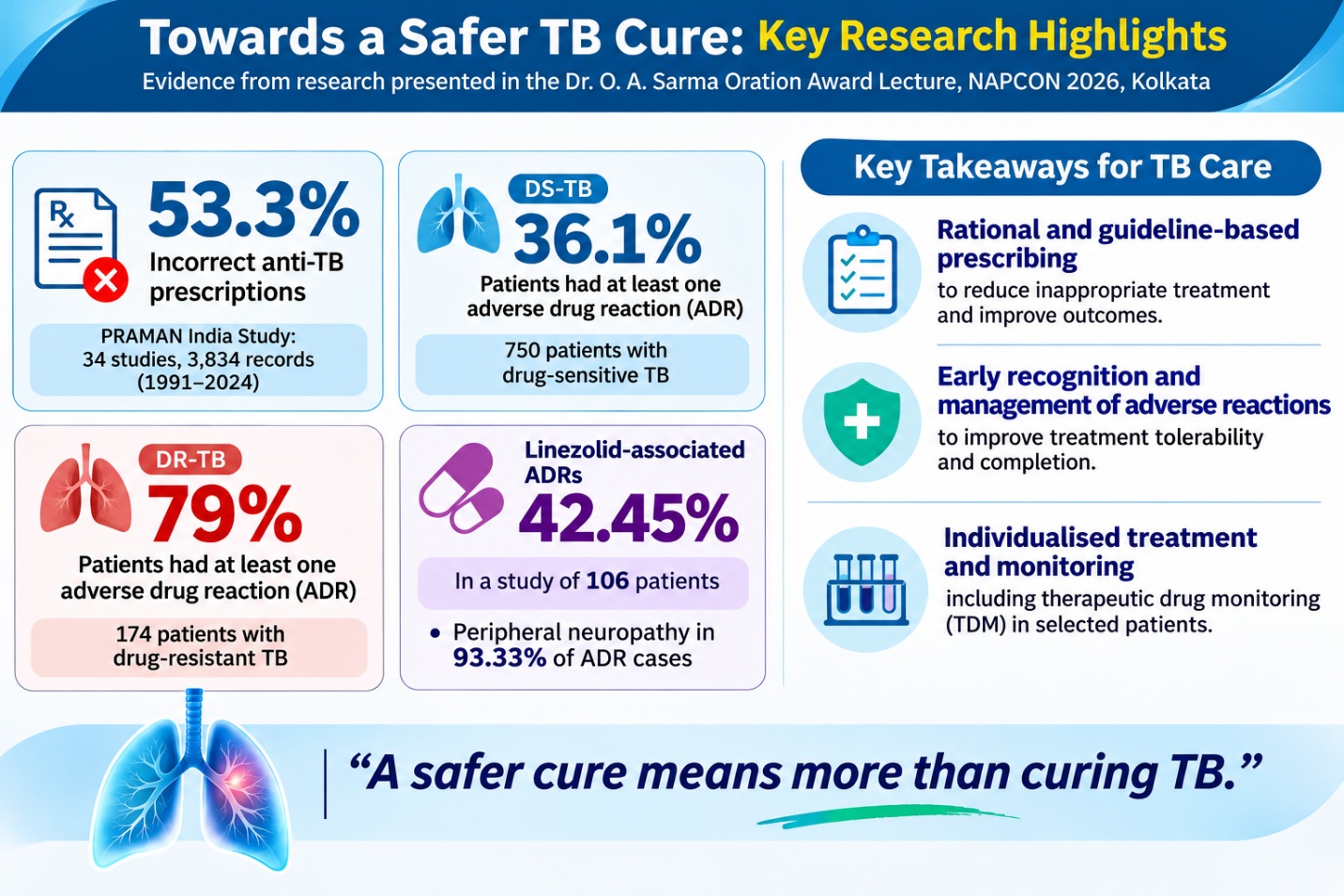
PRAMAN India Study highlights gaps in anti-TB prescribing
One of the major research contributions discussed was the PRAMAN India Study, a systematic review and meta-analysis examining anti-tuberculosis prescription practices in non-programmatic healthcare settings in India.
The study included 34 studies involving 3,834 prescriptions or records, covering evidence from 1991 to 2024. Published in the Indian Journal of Tuberculosis in 2026, it reported a pooled prevalence of incorrect anti-TB prescriptions of 53.3%.
Importantly, the study also identified an encouraging improvement over time. The prevalence of incorrect prescriptions declined from 68.6% during 1990–1999 to 32.6% during 2020–2024. However, the continuing burden highlights the need to strengthen adherence to standardised treatment guidelines, continuing medical education, public-private collaboration and prescription-quality audits.
The study also estimated that approximately 2.6 million potentially inappropriate anti-TB prescriptions could occur annually in India’s non-programmatic healthcare sector.
The findings are detailed in the PRAMAN India Study on anti-tuberculosis prescription practices in India, published in the Indian Journal of Tuberculosis.
Adverse drug reactions: An important challenge in completing TB treatment
The oration highlighted the importance of recognising and managing adverse drug reactions (ADRs), which can affect patients’ quality of life, treatment adherence and clinical outcomes.
In a cohort of 750 patients receiving treatment for drug-sensitive TB, 36.1% experienced at least one adverse drug reaction. The commonly reported reactions included gastrointestinal symptoms, joint pain or arthralgia and cutaneous drug reactions.
The burden was higher in a separate cohort of 174 patients receiving treatment for drug-resistant TB, in which 79% experienced at least one ADR. Skin discolouration, peripheral neuropathy and joint pain were among the leading reported reactions.
Dr. Mishra’s research also examined linezolid-associated adverse reactions in drug-resistant TB through a multicentre study involving 106 patients, conducted in collaboration with faculty from the University of Sydney, Australia. The study found that 42.45% of patients experienced linezolid-associated adverse drug reactions, with peripheral neuropathy accounting for 93.33% of these reactions. Other reported concerns included skin discolouration, anaemia and optic neuritis.
These findings reinforce the importance of counselling patients before treatment, actively enquiring about symptoms during follow-up and identifying adverse reactions early. Patients should not stop or modify anti-TB medicines on their own because of side effects. Prompt reporting and medical assessment allow the treating team to institute appropriate supportive measures, monitoring or treatment modification when clinically indicated.
Therapeutic drug monitoring: Towards individualised TB treatment
Another important theme was the potential role of therapeutic drug monitoring (TDM) in selected patients. Drug exposure can vary between individuals because of differences in absorption, metabolism, drug interactions and associated illnesses.
TDM may be considered in patients with an inadequate response despite adherence, suspected malabsorption or drug interactions, renal impairment, critical illness and selected cases involving second-line anti-TB medicines where inadequate drug exposure or toxicity is suspected.
TDM can support clinical assessment and help guide dose individualisation. Its wider implementation requires laboratory infrastructure, trained personnel, quality assurance and appropriate referral pathways.
The oration also discussed the policy recognition of TDM and adenosine deaminase (ADA) estimation in India’s National Essential Diagnostics List and the need to translate policy inclusion into accessible diagnostic services.
Towards a safer cure for tuberculosis
The research and clinical evidence presented during the oration emphasised that improving TB outcomes requires a comprehensive approach involving rational prescribing, appropriate treatment selection, patient counselling, early recognition of adverse reactions and regular monitoring.
The message for patients is equally important: tuberculosis is curable, and fear of side effects should not lead patients to abandon treatment. Symptoms should be reported promptly to healthcare providers so that adverse reactions can be assessed and managed appropriately.
Dr. Mishra’s work spans clinical research, prescription practices, treatment safety and policy-oriented advocacy, with the overarching objective of improving the quality of tuberculosis care in India.
