
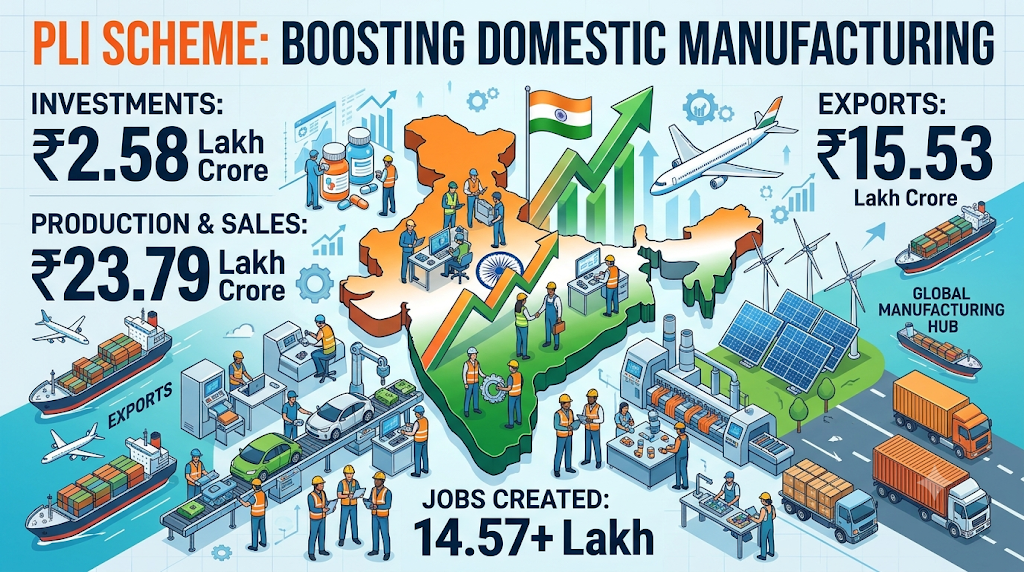
New Delhi, Nov 14: India’s Production Linked Incentive (PLI) scheme is giving a major boost to domestic manufacturing, attracting investments, increasing production and creating employment opportunities across 14 strategic sectors. Introduced in 2020 under the Atmanirbhar Bharat initiative, the scheme is helping strengthen India’s manufacturing capabilities and reduce dependence on imports.
According to the Ministry of Information and Broadcasting’s latest update, the scheme had attracted cumulative investments of ₹2.58 lakh crore as of June 30, 2026. Production and sales crossed ₹23.79 lakh crore, while exports received a boost of ₹15.53 lakh crore. The initiative also generated more than 14.57 lakh direct and indirect jobs across supported industries.
With an approved financial outlay of ₹1.91 lakh crore, the PLI framework covers sectors such as electronics, pharmaceuticals, automobiles, textiles, food processing, specialty steel, solar modules and advanced battery manufacturing. A total of 791 applications had been approved across these sectors.
Electronics manufacturing has emerged as a major beneficiary. Domestic electronics production increased to ₹13.11 lakh crore in 2025-26, while mobile phone manufacturing has expanded significantly. Around 99.2% of mobile phones used in India are now manufactured domestically, reflecting the growth of local production capabilities.
The pharmaceutical sector has also recorded progress, with investments supporting the production of high-value medicines and pharmaceutical ingredients. The scheme has encouraged domestic manufacturing of 191 bulk drugs, helping reduce dependence on imported products.
Food processing is another important area of growth. The sector has attracted investments, created employment and provided opportunities for small and medium enterprises. As of June 2026, the programme had 165 approved applications, including 69 MSMEs, with projects spread across 274 locations.
The automobile, white goods and renewable energy sectors are also benefiting from the initiative. Investments in electric vehicle components, batteries, air-conditioner parts, LED lights and solar modules are helping develop domestic supply chains and create new manufacturing opportunities.
The scheme has also supported India’s export ambitions. Several PLI-supported sectors, including IT hardware, electronics, advanced chemistry cell batteries and solar modules, have recorded strong export growth in recent years.
The government’s focus is now on strengthening domestic supply chains, encouraging innovation and helping Indian manufacturers compete in international markets. With growing investments and production capacity, the PLI scheme is playing an important role in India’s journey towards becoming a stronger global manufacturing hub.
