
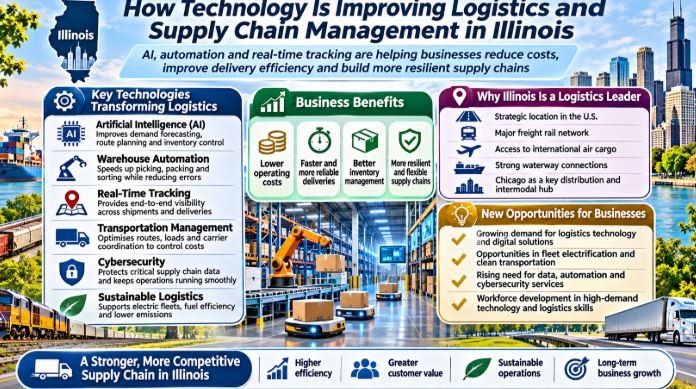
Illinois has long been an important centre for freight transportation and distribution in the United States. Its extensive highway network, major rail connections, international airport access and strategic location make the state an attractive base for manufacturers, retailers, wholesalers and logistics providers. Today, technology is adding a new dimension to this established advantage, helping businesses move goods more efficiently, manage operating costs and respond to increasingly demanding customer expectations.
From artificial intelligence and automated warehouses to real-time shipment tracking and digital transportation platforms, technology is changing how supply chains operate. These developments are not simply about introducing new equipment or software. They are helping companies rethink business processes, make better decisions and build stronger relationships with customers and suppliers.
For Illinois businesses, digital transformation is becoming an important investment in long-term competitiveness.
AI Is Helping Businesses Make Smarter Supply Chain Decisions
Artificial intelligence is creating new opportunities for logistics companies to improve planning and manage the uncertainty that often affects supply chain operations. By analysing information such as customer demand, inventory levels, traffic conditions and delivery schedules, AI-powered systems can help businesses make more informed decisions.
Predictive analytics is particularly valuable for companies that need to anticipate changes in demand. Instead of relying entirely on historical sales figures or manual forecasts, businesses can use data-driven insights to identify emerging patterns, prepare for seasonal demand and manage stock more effectively.
For manufacturers, improved forecasting can support production planning and reduce the risk of costly interruptions. Retailers can use similar tools to maintain product availability while avoiding excessive inventory. Logistics providers, meanwhile, can make better decisions about vehicle allocation, delivery schedules and warehouse capacity.
The commercial benefit is clear. Better information can lead to more efficient operations, fewer avoidable expenses and a stronger ability to respond when market conditions change.
Warehouse Automation Is Creating More Efficient Operations
Warehouses and distribution centres are under increasing pressure to process orders quickly while maintaining accuracy and controlling labour costs. Automation is helping businesses meet these demands.
Robotics, automated storage and retrieval systems, smart sorting equipment and warehouse management software are transforming the way goods are received, stored, picked and dispatched. These solutions can reduce repetitive manual work, improve inventory accuracy and help distribution centres manage larger volumes of orders.
The growth of e-commerce has made these improvements particularly important. Customers increasingly expect reliable delivery times and accurate order fulfilment, putting pressure on businesses to make warehouse operations faster and more responsive.
Automation can also help companies make better use of existing facilities. By improving storage arrangements and streamlining the movement of goods, businesses may be able to increase capacity without immediately expanding their physical footprint.
For small and medium-sized logistics operators, cloud-based warehouse management platforms offer another route into digital transformation. These systems can provide access to modern inventory and order management capabilities without requiring every business to build a complex technology infrastructure from the ground up.
Real-Time Tracking Is Improving Customer Confidence
Visibility has become one of the most valuable elements of modern supply chain management. Businesses need to know where shipments are, whether deliveries are progressing as planned and when potential problems might affect customers.
GPS tracking, Internet of Things sensors and cloud-based transportation platforms are making this information easier to access. Logistics managers can monitor vehicle locations, follow shipment progress and receive updates about changing delivery conditions.
This visibility supports faster decision-making. If a vehicle encounters traffic delays or a shipment is held up, companies can adjust schedules, communicate with customers and consider alternative arrangements.
Connected sensors can also monitor conditions such as temperature and humidity, which is especially useful when transporting food, pharmaceuticals and other sensitive products.
For businesses, the value extends beyond operational control. Reliable shipment information helps strengthen customer relationships by making deliveries more transparent and predictable. In competitive markets, that level of service can become an important differentiator.
Digital Transportation Systems Can Improve Profitability
Transportation is one of the largest operating expenses for many supply chain businesses. Fuel, vehicle maintenance, driver availability, route planning and delivery coordination all influence the cost of moving goods.
Transportation management systems are helping companies manage these pressures through digital tools that support route optimisation, load planning, carrier selection and shipment scheduling.
AI-powered route planning can assess traffic conditions, delivery locations and vehicle capacity to identify more efficient journeys. Better load planning can help businesses make fuller use of available vehicle space, while digital scheduling can reduce unnecessary journeys and improve fleet utilisation.
Illinois has a significant advantage in this area because of its multimodal transportation infrastructure. Businesses can connect road freight with rail, air and water transportation, selecting suitable options according to delivery requirements, cost and distance.
When digital systems improve coordination across these networks, companies can make more effective use of existing infrastructure and strengthen the reliability of their distribution operations.
Digital Transformation Is Opening New Business Opportunities
The growing use of logistics technology is creating opportunities for businesses across a much wider range of industries.
Demand for supply chain software, warehouse automation, data analytics, fleet management, cybersecurity and digital freight coordination is creating space for technology providers and specialist service companies. Businesses that develop practical solutions for inventory forecasting, shipment visibility and automated documentation can find opportunities among manufacturers, retailers and logistics operators.
There is also room for smaller technology companies to compete. Cloud-based platforms and subscription software models are making it easier to offer specialised services without the substantial infrastructure costs traditionally associated with enterprise technology.
For Illinois, this creates an opportunity to build on its established logistics economy by encouraging innovation across transportation, distribution and technology services. The relationship between traditional logistics companies and technology providers can support new products, specialised employment and investment across the wider business ecosystem.
Cybersecurity Is Becoming a Core Business Priority
As logistics companies connect more systems and share more information digitally, cybersecurity has become an essential part of business planning.
Modern supply chains rely on information moving between manufacturers, suppliers, carriers, warehouses and customers. A cyberattack or major system failure can interrupt these connections, delay deliveries and create financial losses.
Businesses therefore need to treat digital security as an operational priority. Secure cloud infrastructure, strong access controls, regular backups, employee training and continuous network monitoring can all help reduce exposure to cyber threats.
Companies should also consider the security of external suppliers and technology partners. A supply chain is only as dependable as the systems and relationships that support it, making cybersecurity an important part of wider risk management.
For business leaders, investment in security is not simply a technical expense. It helps protect customer confidence, commercial information and the continuity of day-to-day operations.
Sustainable Logistics Is Becoming a Competitive Advantage
Technology is also helping Illinois businesses improve the environmental performance of transportation and warehousing.
Electric delivery vehicles, fleet monitoring, intelligent route planning and energy-efficient warehouse systems can help reduce fuel consumption and improve resource management. Digital maintenance tools can also help companies monitor vehicle performance and identify potential problems before they lead to costly repairs.
For logistics operators, these improvements can support both environmental objectives and financial performance. More efficient routes can reduce unnecessary mileage, while better energy management can help control warehouse operating costs.
The development of electric vehicle infrastructure and clean transportation solutions also creates opportunities for businesses involved in charging networks, fleet electrification and associated services.
As customers and commercial partners place greater emphasis on sustainability, companies that combine efficient operations with responsible business practices may be better positioned to compete for contracts and develop long-term relationships.
Investment in Skills Will Support the Next Stage of Growth
Technology adoption also brings changes to the workforce. As logistics operations become more digital, businesses need employees who can work with data platforms, automated equipment, inventory systems and connected transportation technologies.
This is creating demand for skills in data analysis, robotics maintenance, software support, cybersecurity and digital operations management. At the same time, traditional logistics expertise remains valuable. Successful supply chains will depend on combining practical industry experience with the ability to use modern technology effectively.
Businesses that invest in employee training can make better use of their technology investments while helping their workforce adapt to changing operational requirements.
Partnerships between employers, educational institutions and workforce development organisations can also support the development of relevant skills. This is an important part of ensuring that Illinois has the talent needed to sustain growth across its logistics and technology industries.
Illinois Is Well Positioned for a More Connected Supply Chain Economy
Technology is reshaping the commercial landscape of logistics in Illinois. AI-powered forecasting, automated warehouses, real-time tracking and digital transportation management are helping companies improve efficiency while creating new opportunities for investment and innovation.
The state’s established position in freight transportation provides a strong foundation for this transformation. By combining its road, rail, air and water connections with modern digital systems, Illinois can continue to strengthen its role in national and international distribution networks.
For individual businesses, the next stage will involve choosing technology that addresses genuine operational challenges, integrating systems effectively and developing the skills needed to manage increasingly connected operations. Companies that take a strategic approach can improve productivity, strengthen customer service and make their supply chains more adaptable.
The future of logistics in Illinois will not be defined by transportation infrastructure alone. It will increasingly depend on how effectively businesses combine physical networks, digital intelligence and skilled people. This convergence offers significant potential for business growth, innovation and a more resilient supply chain economy.
