
Nov 17: Singapore’s digital payments market is moving beyond the simple replacement of cash. Digital transactions are becoming part of how businesses manage sales, collect payments, serve customers and connect with regional markets. From neighbourhood retailers and hawker stalls to large enterprises and online service providers, businesses are increasingly relying on payment systems that make transactions faster and more convenient.
The scale of this shift is highlighted in the Payments’ State of Play 2026 report, jointly published by PwC Singapore and the Singapore FinTech Association (SFA). According to the report, 92% of Singaporeans used a digital payment method in the year through November 2025. It also projects that Singapore’s digital payments transaction value will increase from US$39.37 billion in 2023 to US$113.65 billion by 2030.
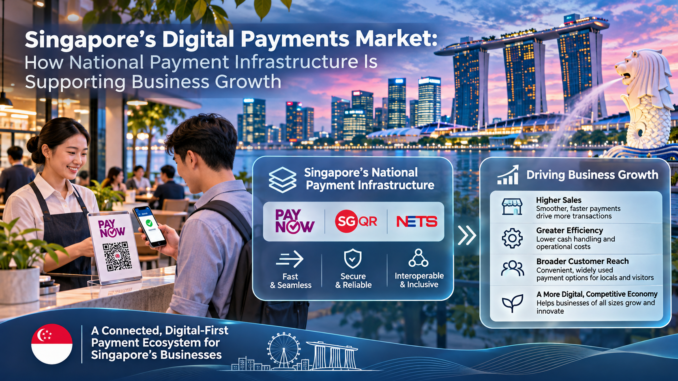
This growth is supported by a national payment infrastructure that connects banks, payment providers, merchants and consumers. Systems such as PayNow, FAST and SGQR are helping businesses accept payments, transfer funds and manage transactions across different channels.
For Singapore, the opportunity is not limited to making payments easier. A well-connected payment ecosystem can support business efficiency, improve customer convenience and create new opportunities for fintech companies, SMEs and organisations operating across Southeast Asia.
How Singapore’s National Payment Infrastructure Works
Singapore’s digital payment ecosystem is built around services that allow different financial institutions and payment providers to work within a connected environment.
Three important components are PayNow, FAST and SGQR.
PayNow: This service allows individuals and businesses to transfer Singapore dollars using identifiers such as mobile numbers, NRIC numbers or a company’s Unique Entity Number (UEN). PayNow Corporate makes it easier for organisations to receive payments without having to share their full bank account details.
FAST (Fast and Secure Transfers): FAST enables customers of participating banks and financial institutions to transfer Singapore dollars between accounts almost instantly. It operates as an important part of the infrastructure supporting PayNow.
SGQR: Singapore Quick Response Code combines multiple participating payment schemes into a single standardised QR code. Merchants can display one SGQR label instead of maintaining several separate QR codes for different payment services.
These systems address different parts of the payment process. PayNow supports account-to-account transfers, FAST enables near-instant fund movement, and SGQR makes it easier for merchants to accept different payment options.
According to the Monetary Authority of Singapore (MAS), the country’s e-payment infrastructure also includes unified point-of-sale terminals and cross-border payment linkages.
PayNow and FAST Are Making Business Transactions More Convenient
For businesses, receiving payments quickly and keeping track of transactions are important parts of financial management.
PayNow Corporate allows companies to receive funds using their UEN, making it useful for collecting customer payments, settling invoices and handling transactions with business partners.
A professional services company, for example, can share its PayNow Corporate details with a client to collect a service fee. A retailer can use supported digital payment options to receive customer payments, while a supplier can use electronic transfers to simplify collections from business customers.
The advantages go beyond convenience.
- Faster payment confirmation: Businesses can receive transaction notifications and monitor incoming payments more easily.
- Simpler reconciliation: Electronic records can help finance teams match payments with invoices and customer accounts.
- Improved cash-flow visibility: More timely payment information can help business owners plan expenses and monitor outstanding collections.
- Reduced manual work: Digital transfers can reduce the need to handle cash and manually verify certain transactions.
However, the actual impact on working capital depends on the payment method, settlement arrangements and the company’s internal processes. Faster payment confirmation does not necessarily mean every payment channel settles funds at the same speed.
How Digital Payments Are Supporting Singapore’s SMEs
Small and medium-sized enterprises (SMEs) often have limited resources for managing financial administration. For a small retailer or restaurant, handling cash, checking transactions and maintaining payment records can take time away from customer service and business development.
Digital payment infrastructure offers a way to simplify some of these activities.
A neighbourhood shop can use an SGQR label to accept supported QR payments. A food outlet can provide customers with cashless payment options, while a service provider can collect fees through electronic transfers.
The benefits can extend across several areas.
Better payment management: Digital transaction records make it easier to monitor sales and check whether payments have been received.
Convenient customer experience: Customers can choose from supported payment methods, reducing the need to carry cash or rely on a single payment option.
Improved sales administration: Electronic records can support accounting and reconciliation when integrated with suitable business software.
Access to digital commerce: SMEs can offer payment experiences that are familiar to customers shopping online or in physical stores.
There is also a customer-retention angle. A convenient checkout experience can reduce friction and make it easier for customers to complete purchases. However, payment convenience is only one part of customer loyalty; product quality, pricing and service continue to matter.
SGQR Is Making Cashless Payments More Accessible to Merchants
For small businesses, accepting digital payments should not involve unnecessary complexity.
SGQR addresses this challenge by combining multiple participating payment schemes into one standardised QR code. Customers can scan the code and select a supported payment option through their preferred application.
This is particularly useful for hawker stalls, neighbourhood retailers, independent shops and service providers. Instead of displaying several QR codes, merchants can use one label to offer access to multiple participating payment options.
The Hawkers Go Digital programme provides a practical example of how this infrastructure has supported smaller merchants. In August 2024, more than 11,500 stallholders were offering electronic payments through the programme. Monthly transaction value reached S$60 million, with approximately 7.6 million transactions recorded that month.
The programme also illustrates why transaction costs matter to small businesses. The government previously subsidised a 0.5% merchant discount rate for eligible stallholders, but the subsidy ended on 30 June 2026. New stallholders joining from January 2026 were subject to prevailing merchant discount rates without that subsidy.
This makes payment pricing an important consideration for merchants adopting cashless services.
Payment Costs, Customer Experience and Working Capital
Digital payments can make business operations more convenient, but their financial benefits depend on how companies manage the costs involved.
Merchants may face merchant discount rates, payment gateway charges, terminal rental fees, settlement costs or other provider-specific charges. These expenses can affect businesses differently depending on transaction volumes, average order values and the payment methods customers prefer.
For smaller merchants, even a modest transaction fee can influence profit margins when sales volumes are high and margins are tight.
Businesses therefore need to compare payment providers based on the overall cost of acceptance rather than choosing a service only because it offers a familiar payment option.
There are also opportunities to improve working capital management. Faster transfers and clearer transaction records can help businesses understand when money is coming in, follow up on unpaid invoices and plan supplier payments.
When digital payments are connected to accounting and inventory systems, companies can also reduce the time spent entering transaction information manually.
The wider opportunity lies in treating payments as part of business operations rather than as a standalone checkout function.
Cross-Border Payment Connectivity Is Strengthening Singapore’s Regional Role
Singapore’s position as an international business and financial centre makes cross-border payment infrastructure particularly important.
Businesses operating across Asia often need to collect payments from international customers, pay suppliers and manage transactions involving different currencies. Traditional international transfers can involve several intermediaries, additional charges and longer processing times.
Singapore has been developing regional payment connections to make certain cross-border transactions more convenient.
One important example is the PayNow-UPI linkage between Singapore and India, launched in February 2023 by MAS and the Reserve Bank of India. It allows customers of participating financial institutions to transfer funds between the two countries using identifiers such as mobile numbers and UPI IDs.
Singapore also has payment connections with Thailand’s PromptPay and Malaysia’s DuitNow. These linkages help participating users make cross-border transfers through connected payment systems.
The next step is to make these connections more scalable. Singapore and India are among the founding members of Project Nexus, a multilateral initiative designed to connect domestic instant payment systems through a common framework.
In September 2026, MAS highlighted the potential of Nexus to expand payment connectivity by allowing participating countries to connect to a shared network rather than building separate bilateral links with every market.
For businesses, stronger regional connectivity could support tourism, retail, professional services, remittances and cross-border digital commerce. It may also create opportunities for payment providers developing foreign exchange, international collections and transaction-management solutions.
Singapore’s Next Payment Infrastructure Phase: SPaN and BLOOM
Singapore’s payment infrastructure is also evolving beyond existing bank transfers and QR-based payments.
In November 2026, MAS announced that the Singapore Payments Network (SPaN) had appointed its key leadership team. SPaN is expected to begin operations in early 2027, with an initial focus on ensuring a smooth transition of national payment schemes from their existing administrators.
The organisation is intended to strengthen the governance, operational resilience and modernisation of Singapore’s core payment infrastructure while supporting deeper regional connectivity.
Another development is BLOOM, announced by MAS on 23 October 2026. The initiative brings together policymakers and industry participants to explore how different forms of digital money, including tokenised deposits and regulated stablecoins, can be used for cross-border financial transactions.
Bank Negara Malaysia and the Bank of Thailand have joined MAS in the initiative as policymaker members. Its objective includes developing common approaches to the acceptance, exchange and settlement of digital money across institutions and jurisdictions.
These developments indicate that Singapore’s payment strategy is expanding from domestic cashless transactions towards more connected financial infrastructure for regional and international business.
Opportunities for Fintech and Technology Companies
The expansion of digital payments is creating opportunities for companies beyond traditional banks and financial institutions.
As businesses look for more efficient ways to process transactions, fintech firms and technology providers can develop services that connect payments with wider business operations.
Some important areas include:
Payment gateway development: Online retailers and service providers need systems that can support different payment methods across websites, mobile applications and physical stores.
Financial software integration: Connecting payment services with accounting, invoicing and enterprise resource planning platforms can reduce manual processes and improve financial visibility.
Cybersecurity and fraud prevention: Payment providers and merchants need tools to identify suspicious transactions, protect customer information and prevent unauthorised access.
Cross-border payment technology: Regional payment connectivity creates opportunities for companies offering international collections, currency conversion and transaction monitoring.
AI-powered financial services: Artificial intelligence can support fraud detection, customer support and transaction analysis, provided businesses maintain suitable data protection and security controls.
The wider fintech ecosystem also provides a supportive environment for these developments. The 2026 PwC-SFA report identifies real-time payments, digital wallets, cross-border connectivity, artificial intelligence and embedded finance among the trends shaping Singapore’s payments landscape.
Security and Trust Will Shape the Next Stage of Growth
As digital payment volumes increase, businesses must also pay attention to fraud and cybersecurity risks.
Phishing, impersonation scams, fraudulent payment requests and unauthorised account access can affect both consumers and merchants. A fraudulent transaction can result in financial losses, customer disputes and reputational damage.
Singapore’s Payment Services Act provides a regulatory framework for payment services, with requirements based on the nature and risks of the activities being conducted.
For businesses, adopting digital payments should go hand in hand with appropriate security measures. These include using trusted payment providers, verifying payment requests, protecting account credentials and training employees to recognise suspicious activity.
The challenge is to make payments both convenient and secure. As transactions become faster and more connected, fraud prevention and real-time monitoring will become increasingly important.
What Singapore’s Digital Payments Growth Means for Businesses
Singapore’s digital payments market demonstrates how national financial infrastructure can support business development. PayNow and FAST are making money transfers more convenient, while SGQR is helping merchants accept multiple payment options through a simpler system. Cross-border connections are also creating opportunities for businesses operating across Asia.
For SMEs, the benefits can include easier payment collection, better transaction visibility and more convenient customer experiences. For fintech companies, the expanding ecosystem creates opportunities in payment gateways, cybersecurity, financial software and cross-border services.
The next phase will depend on how effectively Singapore strengthens interoperability, connects payment systems with business applications and develops secure cross-border financial infrastructure.
With SPaN preparing to begin operations in 2027 and initiatives such as BLOOM exploring new forms of digital settlement, Singapore is positioning its payment ecosystem for a more connected regional economy.
Digital payments are therefore becoming more than a convenient alternative to cash. They are an increasingly important part of the infrastructure supporting business efficiency, financial innovation and regional trade.
