
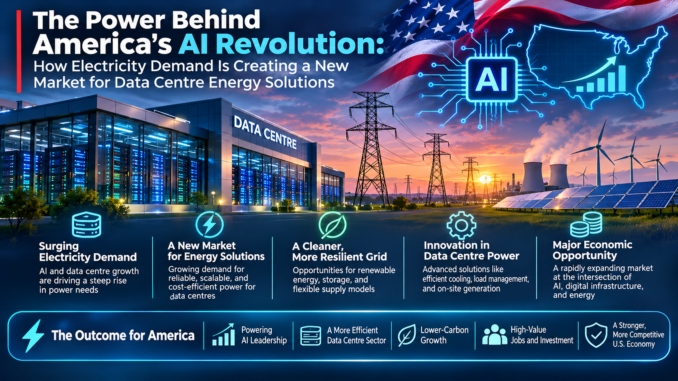
Nov 18: Artificial intelligence is transforming the American economy, but the next phase of this technological revolution will depend on something less visible than algorithms and advanced processors: electricity.
As businesses expand their use of generative AI, cloud computing and high-performance applications, data centres are becoming increasingly power-intensive. The facilities supporting these technologies need a continuous supply of electricity to operate servers, manage data and maintain the cooling systems required for high-density computing.
This is creating a new infrastructure challenge for the United States. Electricity generation, grid capacity and data centre construction must increasingly develop together. For energy companies, equipment manufacturers, engineering firms and technology startups, this shift is opening opportunities in grid modernisation, battery storage, advanced cooling, power distribution and renewable energy integration.
The opportunity extends beyond supplying electricity. Businesses that can help data centres access, distribute, store and use power more efficiently could become important participants in America’s expanding AI economy.
AI data centres are reshaping America’s electricity demand
The scale of the challenge is reflected in research from Lawrence Berkeley National Laboratory. Its June 2026 United States Data Center Energy Usage Report estimates that data centres could consume approximately 649 terawatt-hours (TWh) of electricity annually by 2030, equivalent to around 11.8% of total US electricity consumption. The report gives a wider range of 9.5% to 15.3%, depending on how quickly computing infrastructure expands and how efficiently it operates. These are projections, not guaranteed outcomes.
The US Energy Information Administration also expects electricity demand to reach record levels in 2026 and 2027. Its November 10 outlook projected consumption of approximately 4,306 billion kilowatt-hours in 2026 and 4,370 billion kilowatt-hours in 2027.
AI computing is an important part of the change. Training and operating advanced models requires powerful processors, while the wider adoption of AI applications is increasing demand for computing capacity. As financial institutions, manufacturers, healthcare providers and retailers introduce AI into their operations, the infrastructure supporting these services must expand.
For data centre developers, access to reliable electricity is therefore becoming a major consideration when selecting locations and planning new facilities. For utilities and energy technology companies, it creates demand for additional capacity, smarter power management and more flexible electricity systems.
Grid modernisation becomes a critical investment opportunity
One of the biggest obstacles to data centre expansion is the time required to secure grid connections and upgrade electricity infrastructure.
A new data centre may be planned and constructed relatively quickly, but the transmission lines, substations and generation capacity needed to support it can take considerably longer. This gap is creating challenges in regions attracting large technology investments.
Developments around PJM Interconnection, which operates the largest regional electricity grid in the eastern United States, illustrate the pressure. Approximately 20 gigawatts of data centre projects entered active development within PJM’s territory during the first half of 2026. The rapid growth in proposed demand has intensified concerns about grid capacity, electricity supply and the rules governing large new connections.
These developments create opportunities for companies involved in:
-
High-capacity transmission lines and electrical substations.
-
Advanced transformers and high-voltage equipment.
-
Smart grid monitoring and automation.
-
Grid planning, engineering and interconnection services.
-
Predictive maintenance and digital infrastructure management.
For smaller businesses, specialist services such as power forecasting, equipment monitoring and grid analytics may offer opportunities to participate in a market traditionally dominated by large utilities and engineering contractors.
Battery storage is becoming essential to AI power reliability
Data centres require dependable electricity because interruptions can affect computing operations and the services that businesses rely on. Battery energy storage systems are becoming an important part of the solution.
These systems store electricity and release it when needed. They can support backup arrangements, manage peak demand and help facilities coordinate electricity from different sources. When combined with suitable energy management software, battery storage can also help operators respond to changing grid conditions.
The International Energy Agency’s 2026 analysis highlights the growing importance of storage as data centre operators seek more flexible power arrangements. AI facilities can experience rapid changes in electricity demand, making battery systems particularly relevant to managing power requirements.
The commercial opportunity extends across battery manufacturing, power conversion, battery management software, safety monitoring and system integration.
Startups developing intelligent energy storage platforms could also find opportunities in helping data centre operators decide when to store electricity, when to draw from the grid and how to manage backup capacity.
However, batteries are not a replacement for dependable generation and grid infrastructure. Their value lies in improving flexibility and resilience as part of a wider electricity strategy.
Advanced cooling is creating a new market for data centre technology
Running high-performance AI processors generates substantial heat. Managing that heat is essential for maintaining equipment reliability and preventing disruptions.
Conventional air-cooling systems remain widely used, but the increasing density of AI computing is encouraging operators to consider more advanced approaches. Liquid cooling, direct-to-chip cooling and immersion cooling are attracting interest because they can manage heat in demanding computing environments.
This is creating opportunities for manufacturers of cooling equipment, pumps, heat exchangers, specialised fluids and thermal monitoring systems.
There is also growing scope for engineering companies that can design cooling infrastructure around the specific requirements of AI data centres. Efficient cooling can help operators manage electricity consumption while supporting more powerful computing equipment.
For technology startups, the opportunity may lie in combining cooling hardware with intelligent software. Systems that monitor temperatures, identify inefficiencies and automatically adjust cooling requirements could help facilities improve performance and control operating costs.
Water use must also be considered. Cooling technologies have different water and electricity requirements, so operators need to evaluate local conditions when selecting systems.
Renewable energy is becoming part of the AI infrastructure strategy
The growing electricity requirements of data centres are also creating opportunities for renewable energy developers.
Large technology companies are increasingly using long-term power purchase agreements (PPAs) to secure electricity from solar, wind and other energy projects. These agreements can provide greater visibility over future electricity costs while supporting corporate sustainability targets.
The International Energy Agency’s 2026 report, Powering Artificial Intelligence, highlighted that data centre operators signed renewable electricity purchase agreements covering approximately 45 TWh during the first half of 2026, nearly 20% more than in the same period of 2025. Almost 70% of this contracted volume was in the United States.
This is significant for solar and wind developers, energy suppliers and businesses involved in renewable power procurement. Data centre demand could provide an additional source of long-term customers for clean electricity projects.
However, renewable energy generation does not always match the continuous electricity requirements of a data centre. Solar output changes throughout the day, while wind generation depends on weather conditions. Operators therefore need to combine renewable power with grid electricity, storage and other sources of dependable generation.
The IEA has also identified growing interest in nuclear power, advanced geothermal energy and other emerging technologies as part of the longer-term electricity supply strategy for data centres. Some of these projects remain at an early stage, so their commercial contribution will depend on development timelines, regulatory approvals and financing.
For businesses, the opportunity is not limited to producing renewable electricity. It also includes battery integration, energy forecasting, power procurement platforms and technologies that help large electricity users manage their energy mix.
Microgrids and on-site generation offer greater power flexibility
Grid connection delays are encouraging some data centre developers to consider on-site power generation and microgrids.
A microgrid is a local electricity network that can combine generation, battery storage, power controls and connected facilities. Depending on its design, it can operate alongside the main electricity grid and may be capable of operating independently during certain disruptions.
For data centre operators, microgrids can provide greater control over how electricity is generated, stored and distributed within a campus. They can also bring together renewable energy, battery storage and other generation sources.
On-site generation is attracting particular attention in the United States, where grid constraints are affecting the development of some large facilities. The IEA’s 2026 analysis notes that many developers are exploring on-site natural gas generation, although technical, financial and environmental challenges remain.
This creates opportunities for companies specialising in distributed energy systems, microgrid engineering, control software, storage integration and power management.
However, on-site generation is not a simple substitute for grid investment. It requires appropriate permits, fuel or energy supply arrangements, emissions considerations and technical planning. The commercial case will vary according to location and electricity requirements.
Power distribution technology must evolve with AI computing
Another important area of investment is the equipment that delivers electricity within data centres.
As computing facilities accommodate more powerful processors, their internal power requirements become increasingly demanding. Transformers, switchgear, uninterruptible power supplies, power conversion equipment and monitoring systems must be capable of supporting high-density computing environments.
New power distribution approaches, including higher-voltage direct-current systems, are attracting interest as operators look for ways to improve efficiency and reduce unnecessary conversion losses.
This creates opportunities for electrical equipment manufacturers, engineering companies and technology providers developing integrated power systems.
The commercial potential also extends to intelligent monitoring. Software that tracks electricity consumption, identifies equipment inefficiencies and predicts potential power failures could help operators improve reliability and manage operating expenses.
For suppliers, the market is shifting from individual equipment sales towards integrated solutions that connect power distribution, energy storage, cooling and monitoring.
What the latest research says about data centre energy use
The growing energy requirements of AI infrastructure are also raising questions about emissions and the long-term sustainability of data centre expansion.
A study published in Nature Sustainability in November 2026 examined 403 US hyperscale data centres operating between May 2024 and April 2025. It estimated their electricity consumption at approximately 68–99 TWh, depending on the modelling scenario. Under the central scenario, consumption was around 82 TWh, with associated emissions estimated at approximately 25.7 million metric tonnes of carbon dioxide. The study also found that fossil-fuel sources accounted for roughly 54% of attributed electricity generation in its central analysis.
The findings underline why energy efficiency and electricity sourcing are becoming important considerations for data centre developers.
Improving server utilisation, adopting efficient cooling systems, reducing power conversion losses and using cleaner electricity can all influence the environmental footprint of computing infrastructure.
For technology companies, these considerations may increasingly affect operating costs, sustainability commitments and relationships with customers and local communities.
Where the business opportunities are emerging
America’s AI electricity demand is creating a market that extends across several industries. The strongest opportunities are likely to emerge where companies can solve practical infrastructure problems, improve efficiency or make electricity supply more reliable.
| Industry | Emerging business opportunities |
|---|---|
| Grid infrastructure | Transformers, substations, transmission upgrades and smart grid systems |
| Battery storage | Grid-scale batteries, backup systems and battery management software |
| Cooling technology | Liquid cooling, thermal management and heat exchangers |
| Power distribution | Switchgear, UPS systems, transformers and power conversion |
| Renewable energy | Solar, wind, PPAs and energy procurement services |
| Microgrids | Distributed generation, storage integration and control platforms |
| Energy software | Demand forecasting, energy optimisation and predictive maintenance |
For startups, specialised software, cooling technologies and energy analytics could offer entry points into the market. Established manufacturers may benefit from demand for electrical components, storage systems and integrated power infrastructure.
Engineering and consulting companies could also find opportunities in feasibility studies, grid connections, energy procurement and infrastructure planning.
Investors, meanwhile, may increasingly examine companies that support the physical infrastructure behind AI rather than focusing only on software developers and chip manufacturers.
Challenges that could influence market growth
Despite the opportunities, America’s data centre energy market faces several challenges that could influence the pace of investment.
Grid connection delays: Transmission upgrades and new substations require planning, financing and regulatory approvals. Delays can affect data centre construction schedules and increase project costs.
Infrastructure expenses: New electricity infrastructure requires substantial capital. There are also questions about whether data centre operators should bear a greater share of the cost of upgrades needed to serve their facilities.
Equipment availability: Transformers, batteries, switchgear and specialist electrical components are essential to new projects. Supply constraints can delay construction and increase procurement costs.
Environmental considerations: Data centre expansion raises concerns about electricity emissions, water consumption and the impact on local communities. Operators will need to consider these factors when selecting sites and designing facilities.
Uncertain demand forecasts: Not every proposed data centre will be completed. Overestimating future electricity requirements could result in expensive infrastructure that is underused, while underestimating demand could create capacity shortages.
These challenges make efficient planning, transparent cost allocation and coordination between technology companies, utilities and regulators essential to the industry’s long-term development.
The future of America’s AI revolution will depend on energy innovation
The expansion of artificial intelligence is creating a new relationship between the American technology and energy industries. As data centres become more powerful, access to reliable electricity is emerging as a central factor in determining where and how quickly new computing infrastructure can be developed.
Grid modernisation, battery storage, advanced cooling, renewable energy integration and intelligent power distribution are no longer secondary considerations. They are becoming essential parts of the AI infrastructure ecosystem.
For energy companies, equipment manufacturers, engineering businesses and technology startups, this creates opportunities beyond the conventional AI software market. Businesses that can improve power reliability, reduce energy consumption and make data centre operations more efficient could become important suppliers in the years ahead.
America’s ability to maintain its position in the global AI industry will depend not only on developing advanced chips and algorithms but also on building the electricity infrastructure needed to support them. The next major opportunity in AI may therefore come from the companies powering the technology behind the scenes.
