
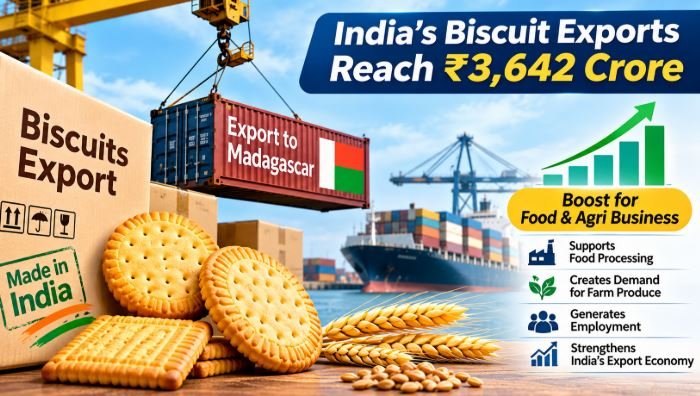
India’s food processing and agricultural export sectors are gaining fresh momentum, with biscuit exports reaching approximately Rs 3,642 crore during the financial year 2025–26, according to government data. The growing demand for Indian food products in international markets is creating new opportunities for manufacturers, exporters and businesses across the agricultural value chain.
A significant development in this direction is the first-ever export consignment of biscuits from Varanasi, Uttar Pradesh, to Madagascar, facilitated by the Agricultural and Processed Food Products Export Development Authority (APEDA).
The shipment was made by Varanasi-based Shree Tirupati Balaji Industries Private Limited. The consignment was transported by road to Jawaharlal Nehru Port in Maharashtra before being shipped to Tamatave Port in Madagascar.
India exported biscuits worth around Rs 7.60 crore to Madagascar during FY 2025–26, highlighting the potential for expanding trade with emerging international markets.
Boost for food processing and agricultural businesses
The development reflects the growing importance of India’s food processing industry in strengthening the country’s export economy. Biscuit manufacturing connects several business sectors, including agriculture, food processing, packaging, transportation, warehousing and international trade.
The industry also creates demand for agricultural commodities such as wheat, sugar and edible oils, along with packaging materials and other manufacturing inputs. As exports expand, opportunities may increase for farmers, food processors, small manufacturers and logistics companies.
New opportunities for regional manufacturers
The Varanasi export initiative highlights how businesses located beyond major industrial centres can access international markets. Support from APEDA through trade exhibitions, exporter outreach and international marketing can help regional manufacturers connect with overseas buyers and build new business partnerships.
The initiative may encourage more food-processing enterprises in Uttar Pradesh and other states to explore export opportunities, strengthen production capacity and improve product quality to meet international requirements.
Positive impact on India’s economy
Rising processed food exports can contribute to foreign exchange earnings, employment generation and industrial growth. Greater export activity also encourages investment in manufacturing facilities, modern processing technology, packaging and supply-chain infrastructure.
For the agricultural sector, stronger demand from food manufacturers can create additional market opportunities for farmers and agricultural suppliers. This can help improve linkages between farm production and value-added industries.
According to the report, trade in APEDA-scheduled products between India and Madagascar currently stands at around Rs 990 crore, indicating scope for further expansion of bilateral agricultural and processed food trade.
Growing global market for Indian food products
With APEDA continuing to support exporters through market access and promotional initiatives, India’s processed food industry has an opportunity to reach more international destinations.
The Varanasi-to-Madagascar biscuit shipment is more than a single export milestone. It demonstrates how regional manufacturing businesses can become part of global supply chains, while creating opportunities for agriculture, industry and trade.
The continued growth of food exports could strengthen India’s position as a global supplier of processed food products and support the wider development of the country’s agricultural and business economy.
