
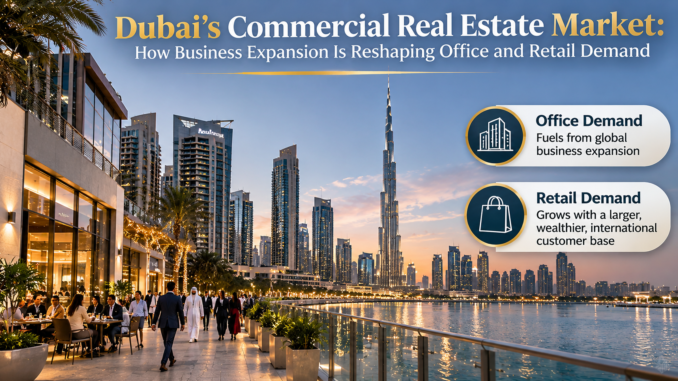
Nov 20: Dubai’s commercial real estate market is undergoing a significant transformation as international businesses expand their presence, new companies enter the emirate and established organisations reconsider their workspace requirements. The city’s position as a global business hub, supported by its connectivity, investment environment and expanding service economy, continues to influence demand for office buildings, retail spaces and mixed-use developments.
The changing requirements of businesses are also reshaping the type of commercial properties attracting interest. Companies are looking beyond conventional office space, placing greater emphasis on location, workplace experience, technology infrastructure and flexibility. Retailers, meanwhile, are adapting their physical stores to changing consumer expectations, with greater attention to experiential shopping, dining and entertainment.
These developments are creating opportunities for property owners, investors, developers and businesses seeking to establish or expand operations in Dubai.
Business Expansion Is Supporting Commercial Property Demand
Dubai’s appeal to international businesses extends across financial services, technology, consulting, logistics, professional services and entrepreneurship. Companies looking to serve regional markets increasingly consider the emirate as a base for operations, regional headquarters and client-facing activities.
Business districts such as DIFC, Business Bay and Dubai Internet City continue to attract organisations because of their commercial infrastructure, connectivity and proximity to other businesses. Their appeal is also supported by access to skilled professionals, transport links and business services.
The expansion of companies creates demand for more than additional floor space. Organisations increasingly assess whether a property can support recruitment, collaboration, customer engagement and long-term operational requirements. This is encouraging demand for well-connected buildings with modern facilities and adaptable layouts.
For developers and property owners, the opportunity lies in providing commercial spaces that reflect how businesses operate today rather than relying exclusively on traditional office formats.
Dubai’s Office Market: Rising Demand for Quality Workspaces
The office segment remains one of the important drivers of Dubai’s commercial property market. Businesses are increasingly prioritising Grade A office buildings, particularly in established business districts where infrastructure, accessibility and professional networks are already developed.
According to CBRE’s UAE Q3 2026 Real Estate Market Review, average office rents in Dubai increased by 12% year-on-year during the third quarter of 2026, while office occupancy stood at approximately 95%. DIFC, Business Bay and Dubai Internet City recorded strong leasing activity, reflecting continued interest from financial services, professional services and technology companies.
These figures indicate that demand is not simply about companies securing more space. Businesses are also competing for suitable locations and higher-quality buildings that can support their operations and workplace expectations.
Why Grade A Offices Are Attracting Businesses
Modern office buildings offer features that have become increasingly important to corporate occupiers. These include efficient building management, reliable connectivity, energy performance, security systems, shared facilities and convenient access to public transport.
For international companies, the office environment can also influence recruitment and employee retention. A well-located workplace with collaborative areas and modern amenities can strengthen the organisation’s appeal to employees and clients.
However, strong demand for premium office space can create challenges for companies with limited budgets. Rising rents and restricted availability in established business districts may encourage smaller businesses and expanding firms to consider emerging commercial locations.
Flexible Offices and Co-Working Spaces Are Expanding the Market
Not every business requires a long-term lease or a large corporate office. Startups, consultants, remote-first companies and smaller regional teams often need professional workspaces that can be adjusted as their operations grow.
This is supporting demand for serviced offices, co-working facilities and flexible leasing arrangements across Dubai. These spaces allow businesses to access meeting rooms, reception services and shared facilities without committing to the cost of managing an entire office.
Flexible workspaces are also becoming relevant to larger organisations that need temporary project offices, satellite locations or additional capacity during expansion.
For commercial property investors, this creates another opportunity. Buildings that can accommodate different workspace formats may appeal to a wider range of occupiers, although their success depends on location, management quality and the ability to maintain consistent occupancy.
Dubai’s Retail Real Estate Market Is Shifting Towards Experiences
The retail property market is evolving alongside changes in consumer behaviour, tourism and population growth. Physical stores continue to play an important role, but retailers are increasingly expected to offer more than product displays and conventional shopping experiences.
Shopping centres, high-street retail locations and mixed-use developments are incorporating restaurants, entertainment, leisure facilities and community-oriented services to encourage longer visits and repeat customers.
CBRE’s Q3 2026 review reported retail occupancy of approximately 97% in Dubai, while average retail rents increased by 5% year-on-year. The figures point to continued demand for retail locations, particularly where strong footfall, established customer catchments and destination appeal support tenant performance.
Experiential Retail Is Changing Tenant Requirements
Retailers are increasingly using physical stores to build stronger relationships with customers. Product demonstrations, interactive displays, personalised services, food and beverage offerings and entertainment-led activities are becoming part of the broader retail experience.
This is changing the requirements of commercial tenants. Businesses may seek larger or more adaptable layouts, prominent storefronts, convenient access and locations that attract both residents and visitors.
For property owners, attracting retailers that contribute to a broader customer experience can help strengthen the appeal of a shopping destination. The focus is gradually moving beyond the number of stores towards the quality and variety of the overall retail offering.
Community Retail and Everyday Services
Neighbourhood retail is another important part of the market. As residential communities expand, demand grows for supermarkets, pharmacies, fitness centres, cafes, clinics and other everyday services.
These businesses often depend on local residents rather than occasional visitors, making accessibility and the surrounding population important factors in location decisions.
For investors, neighbourhood retail can offer a different demand profile from major destination malls. Its performance, however, depends on the strength of the local catchment, competition and the spending capacity of nearby households.
Mixed-Use Developments Are Connecting Offices, Retail and Residential Spaces
Mixed-use developments are becoming increasingly relevant to Dubai’s urban and commercial property landscape. By bringing offices, retail outlets, residential buildings, hospitality and leisure facilities together, these projects can create active destinations throughout the day.
For businesses, such locations can offer access to customers, employees and services within a connected environment. Retailers may benefit from office workers and residents, while commercial tenants gain proximity to dining, transport and other amenities.
The model also offers developers an opportunity to diversify the uses within a project rather than relying on a single property category.
However, successful mixed-use developments require careful planning. Transport access, pedestrian movement, parking, tenant mix and the balance between residential and commercial activity all influence their long-term performance.
Technology and Sustainability Are Influencing Commercial Property Decisions
Technology is becoming a more important consideration in commercial real estate. Businesses increasingly expect buildings to support reliable digital infrastructure, access controls, energy management and efficient facility operations.
Smart building systems can help property managers monitor energy consumption, manage maintenance and improve the experience of tenants. For larger corporate occupiers, these features can also support operational efficiency and internal sustainability objectives.
Environmental performance is another consideration. Energy-efficient lighting, water management, improved cooling systems and sustainable building materials can influence the attractiveness of commercial properties.
As businesses place greater emphasis on operating costs and environmental commitments, developers may find that buildings with stronger sustainability features have an advantage when competing for tenants.
Commercial Property Investment: Opportunities and Risks
Dubai’s commercial property market offers opportunities across office buildings, retail units, flexible workspaces and mixed-use developments. Continued business expansion, population growth and international investment can support demand for well-positioned commercial assets.
However, investors need to assess each property according to its location, tenant profile, rental potential, building quality and future supply in the surrounding area.
Location and Tenant Demand
Established districts may offer access to strong business networks and recognised commercial addresses, but they can also involve higher acquisition costs and rental expectations. Emerging business locations may offer different entry points, although investors need to evaluate infrastructure development, connectivity and the depth of tenant demand.
Rental Growth and Operating Costs
Rising rents can improve income potential for property owners, but they may also affect tenant affordability. Investors should consider maintenance costs, service charges, vacancy periods and the financial strength of prospective tenants rather than relying only on headline rental growth.
New Supply and Competition
Future office and retail developments could increase competition in particular locations. If new supply enters the market faster than occupier demand grows, landlords may face pressure to offer more competitive rents, incentives or upgraded facilities.
The availability of quality space is therefore as important as overall market demand. Investors need to understand which property categories and locations have the strongest long-term fundamentals.
Challenges That Could Influence Market Growth
Despite positive demand indicators, Dubai’s commercial real estate sector is not without risks. Higher property costs can make it difficult for smaller companies to secure space in established districts. Businesses may respond by choosing flexible offices, relocating to emerging areas or adopting smaller workplace formats.
The retail sector also faces changing consumer habits, competition from online shopping and differences in spending patterns among residents and visitors. Retail destinations need to continue investing in customer experience and tenant variety to maintain their appeal.
Market conditions can also vary significantly between property categories. CBRE’s Q3 2026 review highlighted pressure in parts of the wider UAE hospitality sector, illustrating that strong office and retail performance does not automatically translate into similar conditions across every real estate segment.
For investors and developers, this makes careful market research and sector-specific planning essential.
What the Future Holds for Dubai’s Commercial Real Estate Market
Dubai’s commercial real estate market is likely to remain closely connected to the emirate’s wider business and economic development. Continued interest from international companies, demand for modern workplaces and changing retail expectations are expected to influence future development and leasing activity.
The office market may increasingly reward buildings that combine prime locations with flexible layouts, digital infrastructure and efficient operations. Retail developments may focus more heavily on experiences, dining, entertainment and neighbourhood services.
At the same time, the arrival of new commercial supply will make location and asset quality increasingly important. Developers will need to understand tenant requirements before committing to new projects, while investors will need to evaluate rental sustainability rather than relying only on recent growth.
The strongest opportunities are likely to emerge in properties that respond to practical business needs, offer a compelling customer experience and remain adaptable as market conditions change.
Conclusion
Dubai’s commercial real estate market is being reshaped by business expansion, evolving workplace expectations and changing consumer behaviour. Strong office occupancy and rising rents reflect the continued importance of established business districts, while high retail occupancy highlights the resilience of well-positioned shopping destinations.
However, future growth will depend on more than demand alone. The availability of quality space, rental affordability, new supply, technology and sustainability will influence which properties attract businesses and customers.
For developers, landlords and investors, understanding these changes will be essential to identifying opportunities in Dubai’s evolving commercial property landscape.
