
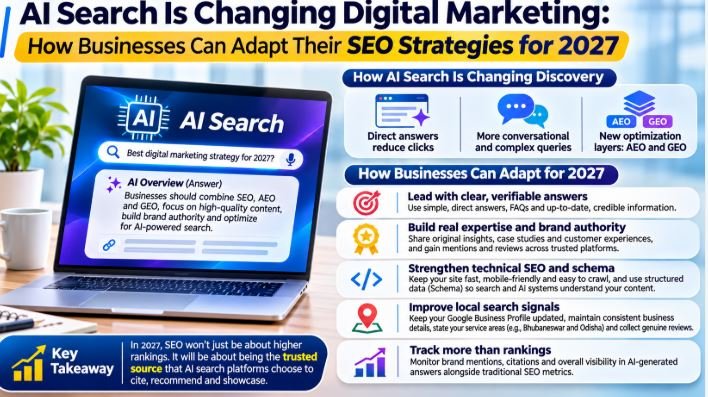
The way people search for information online is changing rapidly. Instead of typing a few keywords into a search engine and opening several websites, users are increasingly asking detailed questions and looking for direct, easy-to-understand answers.
Artificial intelligence is driving this change. Search engines and conversational AI platforms are making it easier for people to discover products, compare services, research companies and find solutions without necessarily visiting multiple websites.
For businesses, this means digital marketing is entering a new phase. Traditional search engine optimisation (SEO) remains important, but companies must also understand how their content appears in AI-generated answers and recommendations.
As 2027 approaches, businesses that combine strong SEO fundamentals with useful content, brand authority and AI search visibility could gain an advantage in an increasingly competitive digital market.
Search Behaviour Is Changing
Online users are becoming more comfortable asking complete questions rather than searching with short phrases.
For example, instead of typing “best accounting software”, a business owner may ask an AI platform to compare affordable accounting tools for a small company, explain their features and recommend the most suitable option.
This change is encouraging businesses to create content that answers real customer questions.
Google’s AI Overviews and conversational AI search experiences are also changing how information is presented. Users may receive a summary with links to supporting websites, making visibility within these answers an additional consideration for marketers.
The challenge for businesses is no longer limited to appearing on the first page of search results. They also need to provide information that search systems can understand, trust and use.
SEO, AEO and GEO Matter
Businesses preparing for 2027 should understand three closely connected approaches.
Search Engine Optimisation (SEO) focuses on improving website visibility in traditional search results through relevant content, technical performance, keywords and website authority.
Answer Engine Optimisation (AEO) focuses on presenting information in a clear format that helps answer specific user questions.
Generative Engine Optimisation (GEO) focuses on making brand information and original content easier for generative AI systems to discover, understand and reference.
These approaches should not be treated as separate marketing activities. A well-structured website with useful information, credible sources and a strong technical foundation can support all three.
Publish Useful, Original Content
Content quality will remain one of the most important factors in digital marketing.
Businesses should move away from publishing large volumes of generic articles simply to target keywords. Instead, they should focus on information that helps customers make decisions.
For example, a technology company can publish practical product comparisons, implementation guides and customer case studies. A financial services business can explain common financial processes in simple language, while a manufacturer can provide technical specifications and industry insights.
Content should answer the main question early, use clear headings and include relevant examples, data and expert explanations.
AI tools can help with research, planning and editing, but businesses should add their own knowledge and experience. Publishing large amounts of repetitive or unoriginal AI-generated material is unlikely to create lasting search visibility.
Build Brand Trust and Authority
Trust is becoming an important part of digital discovery.
When customers research a company, they may look beyond its website and consider reviews, professional discussions, media coverage and customer experiences.
Businesses should therefore build a consistent digital presence across relevant platforms.
Practical steps include:
- Publishing original research and industry insights.
- Sharing genuine customer experiences and case studies.
- Maintaining accurate company information online.
- Earning relevant media coverage and industry mentions.
- Encouraging honest customer reviews.
- Keeping product and service information up to date.
A company that consistently demonstrates expertise and delivers reliable services has a stronger foundation for long-term digital visibility.
Strengthen Technical SEO
Even excellent content may struggle to perform if a website is difficult to access or understand.
Technical SEO should remain a priority in 2027. Businesses need websites that load efficiently, work well on mobile devices and allow search engines to discover important pages.
Important areas include:
Website speed: Improve loading performance and reduce unnecessary scripts and large media files.
Mobile experience: Ensure that pages, menus and forms work smoothly on smartphones.
Site structure: Organise information through logical categories, internal links and descriptive URLs.
Structured data: Use relevant schema markup to help search engines interpret information about products, services, organisations and other content.
Indexing and crawling: Check that important pages can be accessed and indexed correctly.
Structured data can improve how search engines understand a page, but it does not guarantee rankings or special search appearances.
Local SEO Creates Business Opportunities
For businesses serving specific cities or regions, local search visibility will continue to matter.
A customer searching for a restaurant, consultant, furniture store or technology service often wants reliable information about nearby providers.
Companies should maintain accurate Google Business Profile information, including their address, contact details, operating hours, services and photographs.
They should also keep business information consistent across directories and encourage genuine customer feedback.
For businesses operating in cities such as Kolkata, Bhubaneswar, Pune and Bengaluru, locally relevant website content can help connect digital visibility with actual customer demand.
Explaining service areas, local projects and customer experiences can make a business more relevant to people searching in those locations.
Use AI as a Marketing Tool
AI is not only changing search platforms; it is also changing how marketing teams work.
Businesses can use AI tools to analyse customer questions, identify content gaps, organise keyword research, prepare campaign drafts and study website performance.
AI-powered analytics can also help marketing teams identify patterns in customer behaviour and understand which topics generate meaningful engagement.
However, automation should support human decision-making rather than replace it.
Marketing professionals still need to check facts, understand customer needs, maintain brand voice and ensure that published information is accurate.
The strongest results are likely to come from combining technology with practical business knowledge and creative thinking.
Measure More Than Rankings
Traditional SEO reports often focus on keyword positions, website traffic and click-through rates. These measures remain useful, but businesses should also examine how AI search is influencing customer discovery.
A broader measurement strategy can include:
- Organic website traffic and qualified leads.
- Conversions from search visitors.
- Brand mentions across relevant websites.
- Referral traffic from AI platforms, where measurable.
- Citations and appearances in AI-generated answers.
- Customer enquiries linked to local and branded searches.
Businesses should also monitor whether their content attracts the right audience rather than focusing only on higher visitor numbers.
The commercial value of digital marketing ultimately depends on whether it helps generate enquiries, build customer relationships and support revenue.
A Practical SEO Roadmap for 2027
Businesses do not need to replace their entire digital marketing strategy to prepare for AI search. A planned approach can help them adapt without wasting resources.
First, review existing content. Identify outdated pages, weak articles and information that no longer reflects customer needs.
Second, improve important website pages. Make product descriptions, service information and business details clear, accurate and easy to understand.
Third, publish original material. Add expert opinions, case studies, useful data and practical examples that distinguish the business from competitors.
Fourth, improve technical performance. Review mobile usability, loading speed, indexing, internal links and relevant structured data.
Fifth, strengthen brand visibility. Build genuine customer reviews, professional partnerships and relevant industry recognition.
Finally, measure business results. Track leads, enquiries, conversions and search visibility across traditional and AI-driven discovery channels.
This approach allows companies to build on their existing SEO investments while preparing for changing search behaviour.
The Business Outlook for 2027
AI-powered search is creating both opportunities and challenges for digital marketing businesses.
Some users may find the information they need directly within AI-generated summaries, reducing the number of visits to individual websites. This makes it important for businesses to build visibility and credibility beyond traditional website traffic.
At the same time, companies that provide reliable information, specialised expertise and useful customer experiences can strengthen their position in an increasingly competitive digital environment.
For startups and small businesses, this change also creates opportunities to compete through focused expertise rather than large advertising budgets.
The future of SEO will not be about chasing every new AI feature or publishing content simply to satisfy an algorithm. It will be about understanding customers, answering their questions and building a digital presence that people and search systems can trust.
In 2027, businesses that combine strong SEO foundations with original content, technical quality and genuine brand authority will be better prepared for the next phase of digital marketing.
