
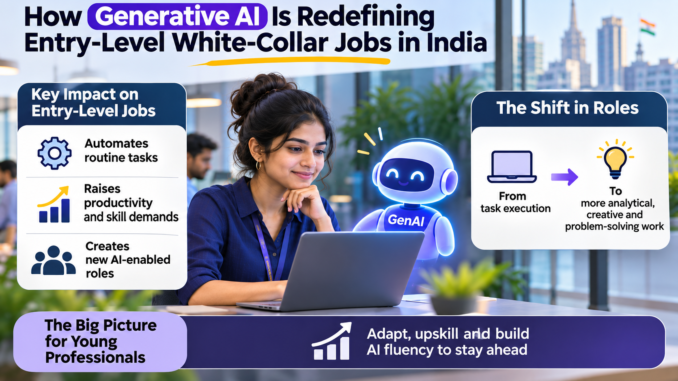
Nov 24: Generative AI is changing how businesses operate, and its impact is becoming increasingly visible in India’s employment landscape. Tasks that once required hours of manual effort, such as preparing reports, conducting research, analysing data and writing routine content, can now be completed faster with AI-powered tools.
For fresh graduates entering the workforce, this shift is changing what employers expect from entry-level candidates. Companies increasingly value professionals who can use AI tools effectively, verify the information they generate and apply their knowledge to real business situations.
This does not mean that entry-level jobs are disappearing altogether. Instead, many roles are being redesigned. As AI takes over selected repetitive activities, skills such as critical thinking, communication, problem-solving and industry knowledge are becoming more important.
For India’s large graduate workforce, understanding this transition could make a significant difference when preparing for a first professional opportunity.
How Generative AI Is Changing Entry-Level Jobs
Traditionally, entry-level positions allowed fresh graduates to learn through everyday assignments. Junior employees often started by preparing documents, updating databases, conducting research, writing content and assisting senior team members.
Generative AI is changing how some of these tasks are performed. Businesses can use AI tools to prepare initial drafts, summarise lengthy documents, analyse information, generate code and respond to routine customer queries.
This can help companies improve productivity and turnaround times. However, AI-generated work still requires human review, particularly when accuracy, business context and customer requirements are involved.
For new employees, the expectation is gradually shifting from simply completing assigned tasks to understanding how those tasks contribute to wider business objectives.
Which Entry-Level White-Collar Jobs Are Being Affected?
The impact of generative AI varies across industries and job functions. It is particularly visible in activities involving repetitive work, structured information and routine communication.
Content Writing and Digital Marketing
AI tools can help prepare content drafts, product descriptions, social media captions, email campaigns and keyword ideas. However, businesses still need professionals who understand their audiences, develop creative ideas, maintain brand consistency and ensure that content is accurate.
For junior content writers and marketing professionals, the ability to edit AI-generated material and add original thinking is becoming increasingly valuable.
Data Entry and Business Operations
Routine activities such as entering information, organising documents, extracting data and preparing basic reports can increasingly be supported by automation.
Employees are therefore expected to check information, resolve errors and handle tasks that require human judgement.
Customer Support and BPO Services
AI-powered chatbots and virtual assistants can respond to common customer questions and handle basic service requests. This can reduce the workload associated with repetitive enquiries.
However, human employees remain important when customers have complex complaints, require personalised assistance or need solutions involving judgement and empathy. BPO companies may increasingly focus on exception handling, customer experience and more specialised support services.
Software Testing and Junior Development
Generative AI can assist with writing code, generating test cases, identifying errors and preparing technical documentation.
This does not remove the need for developers and software testers. Instead, junior professionals may need stronger programming fundamentals, problem-solving abilities and an understanding of complete software development processes.
Research and Administrative Support
AI can summarise documents, organise information, prepare meeting notes and support preliminary research.
However, checking facts, interpreting findings and understanding the business context remain important responsibilities.
The extent of change will vary across companies. In many cases, AI is changing individual tasks rather than eliminating entire job roles.
What an ICRIER Report Reveals About Entry-Level Hiring in India
One of the most relevant studies on this subject is the February 2026 report titled AI and Jobs: This Time Is No Different – A Case Study of India’s IT Sector, published by the Indian Council for Research on International Economic Relations (ICRIER).
The study draws on a survey of 651 IT firms across 10 Indian cities, conducted between November 2025 and January 2026. It examines how generative AI is influencing employment, hiring priorities, productivity and workforce training.
Its findings highlight a shift in entry-level employment. Among the surveyed firms, 55% reported a decline in entry-level employment over the preceding 24 months, while 35% reported an increase. These figures represent the proportion of firms reporting a change, not the percentage of entry-level jobs lost or created.
The report also identifies a growing preference for candidates with a combination of industry knowledge and technology skills. Around 63% of surveyed firms reported increased demand for candidates who combine domain expertise with AI or data-related skills.
Demand for prompt engineering and generative AI capabilities was also reported by 68% of firms, followed by data analytics at 36% and data science and machine learning at 35%.
Importantly, the researchers do not attribute the entire moderation in hiring to AI. Broader changes in the IT industry’s hiring environment also play a role. The study finds no evidence of large-scale job losses across the sector following AI adoption, while overall employment has continued to grow.
The findings suggest that the employment challenge is not simply about fewer jobs. It is also about changing recruitment priorities, the skills expected from new employees and the ability of businesses to prepare their workforce for AI-assisted operations.
How AI’s Impact Differs Across IT, BPO and Other Industries
Although generative AI is influencing several white-collar professions, its impact is not uniform.
In the IT services industry, AI-assisted coding, software testing, documentation and data analysis are changing how development teams work. Companies may need fewer people for certain routine assignments while placing greater emphasis on professionals who can manage complex technical work and integrate AI into software development.
In the BPO and customer service sector, automation is particularly relevant to repetitive customer enquiries, basic data processing and standardised back-office activities. This could change the composition of entry-level work, with greater emphasis on complex customer interactions, quality assurance and process management.
In banking, finance, marketing and consulting, AI is increasingly being used to support research, document analysis, reporting and customer communication. However, employees are still needed to interpret results, manage relationships, assess risks and make decisions.
This distinction is important. AI adoption does not affect every industry or occupation at the same speed. The outcome depends on the nature of the work, the quality of available technology, regulatory requirements and the level of human judgement involved.
Why Employers Are Looking Beyond Traditional Graduate Skills
A degree remains an important foundation for a professional career. However, employers are increasingly interested in how candidates apply their knowledge to practical situations.
When AI can handle selected routine assignments, companies need employees who can understand problems, use technology effectively and evaluate the results.
For example, a junior marketing professional may use AI to research audiences and prepare campaign drafts. However, understanding customer behaviour, brand positioning and communication strategy still requires human input.
Similarly, a junior financial analyst may use AI to organise data and prepare summaries but must be able to interpret figures and identify inconsistencies.
This is making a combination of technical and professional skills increasingly important.
Some of the skills gaining relevance include:
- AI literacy: Understanding how generative AI tools work and how they can support everyday business activities.
- Prompt writing: Giving AI systems clear instructions to produce relevant and useful results.
- Data analysis: Understanding information, identifying patterns and drawing meaningful conclusions.
- Critical thinking: Checking AI-generated answers and identifying errors or missing information.
- Communication: Explaining ideas clearly and working effectively with colleagues and clients.
- Industry knowledge: Understanding the business function in which AI tools are being used.
- Problem-solving: Using technology to address practical challenges rather than relying entirely on automated answers.
For fresh graduates, combining academic knowledge with these abilities can help create a stronger professional profile.
New Career Opportunities Are Emerging Alongside Automation
Although generative AI is changing some traditional entry-level responsibilities, it is also creating demand for new skills and specialised capabilities.
Businesses adopting AI need professionals who can help implement these systems, manage workflows, evaluate outputs and support day-to-day operations.
Emerging areas of opportunity include:
- AI operations and workflow support
- Data management and analysis
- AI quality evaluation and testing
- Junior automation analysis
- Business intelligence
- AI-assisted software development
- Responsible AI and compliance support
Not every opportunity requires an advanced degree in computer science. Graduates from commerce, management, finance, marketing and other disciplines can also explore AI-related roles by developing relevant digital and analytical skills.
For instance, a commerce graduate who understands financial reporting and AI-assisted data analysis may be better prepared for changing finance roles. Similarly, a marketing graduate who understands customer behaviour and AI-powered campaign tools can bring additional value to a business.
The opportunity lies in understanding how AI can be applied within a chosen profession.
How Fresh Graduates Can Prepare for an AI-Driven Job Market
For students and recent graduates, adapting to generative AI does not necessarily mean changing their career plans. It means understanding how technology is transforming the work they want to pursue.
A good starting point is to become familiar with AI tools used in a chosen industry. Marketing students can explore AI-assisted research and campaign planning, while finance graduates can learn how automation supports reporting and data analysis. Engineering students can develop skills in AI-assisted coding, software testing and technical problem-solving.
Practical experience also matters. Instead of simply mentioning AI tools on a résumé, candidates should demonstrate how they have used them to complete a project or solve a problem.
Internships, industry projects and independent assignments can help graduates understand how AI is used in real workplace situations.
Most importantly, they should learn to check AI-generated information rather than accepting every output at face value. Accuracy, judgement and accountability remain essential in professional work.
What Businesses and Educational Institutions Need to Do
Preparing graduates for an AI-driven job market should not be left entirely to individuals. Businesses and educational institutions also have an important role to play.
Companies need to identify which activities can be automated and which require human judgement. They should invest in employee training, rethink entry-level responsibilities and provide opportunities for new recruits to develop practical skills.
Educational institutions, meanwhile, need to bring classroom learning closer to workplace requirements. AI literacy, data interpretation, digital communication and problem-solving should become part of professional education across different disciplines.
Industry partnerships, internships and practical projects can also help students understand how businesses are adopting AI.
The objective should not simply be to teach students how to use AI tools. It should be to prepare them to question, evaluate and apply these technologies responsibly.
The Future of Entry-Level Jobs in India: Adaptability Will Matter Most
Generative AI is changing how young professionals begin their careers in India. Routine assignments that once helped fresh graduates enter the workforce are increasingly being automated or redesigned. At the same time, businesses are looking for people who can combine industry knowledge, technology skills and independent thinking.
For employers, this transition offers an opportunity to improve productivity and build more capable teams. For graduates, it makes continuous learning, practical experience and adaptability increasingly important.
India’s large young workforce gives the country significant potential to participate in the growing AI economy. Turning that potential into sustainable employment, however, will require collaboration between businesses, educational institutions and policymakers.
The future of entry-level employment will not simply depend on how many tasks AI can perform. It will depend on how effectively people learn to work alongside the technology, bring human judgement to automated processes and create value beyond routine execution.
